Key takeaways
- Healthcare organisations face a growing compliance burden, and Research and Metric says 73% of providers struggle with real-time compliance monitoring.
- AI systems monitor regulatory changes continuously, predict violations before they occur, and use natural language processing to interpret complex regulatory text.
- Key components include continuous monitoring and alerting, automated risk scoring, and intelligent documentation and reporting that cuts administrative burden.
- Implementation moves through assessment and planning, technology selection and integration, then phased deployment and optimisation, with success tracked through operational, financial and strategic metrics.
- Data privacy, staff resistance and legacy systems are the main challenges, and leadership commitment and cross-functional collaboration help organisations overcome them.
On this page 10 sections
- The Current State of Healthcare Regulatory Compliance
- How AI Transforms Healthcare Compliance Monitoring
- Key Components of AI-Powered Regulatory Systems
- Implementation Strategies for Healthcare Organizations
- Measuring Success: KPIs for AI Compliance Systems
- Overcoming Implementation Challenges
- Future Trends in AI Healthcare Compliance
- Industry-Specific Applications
- Building a Compliance-First Culture with AI
- Conclusion
The healthcare industry faces an unprecedented challenge. It must maintain regulatory compliance while managing over 629 regulatory changes per day across global markets. Recent data from Research and Metric reveals that AI healthcare compliance systems can reduce regulatory violations by up to 87%. They can also cut compliance costs by 42%. Healthcare organizations are grappling with increasingly complex regulatory frameworks. As a result, artificial intelligence is emerging as a solution that turns reactive compliance into proactive risk prevention.
Traditional compliance approaches leave healthcare organizations vulnerable to penalties averaging $2.3 million per violation. This analysis explores how AI-powered regulatory intelligence is revolutionizing healthcare compliance. It offers insights drawn from Research and Metric's market research across 500+ healthcare institutions globally.
The Current State of Healthcare Regulatory Compliance
Understanding the Compliance Crisis
Healthcare organizations navigate a labyrinth of regulations including HIPAA, GDPR, FDA guidelines, and countless regional requirements. Research and Metric's latest healthcare industry analysis indicates that 73% of healthcare providers struggle with real-time compliance monitoring. As a result, critical gaps remain in their regulatory defense. According to recent McKinsey research, the average health system manages over 30,000 regulatory requirements simultaneously.
The complexity multiplies when considering that healthcare regulatory technology must address multiple stakeholder requirements simultaneously. Patient privacy, clinical trial protocols, medical device regulations, and pharmaceutical compliance create an interconnected web. As a result, a single vulnerability can trigger cascading failures across the organization. Deloitte's 2024 healthcare compliance study confirms that regulatory complexity has increased by 300% over the past decade.
The Cost of Non-Compliance
Beyond financial penalties, regulatory failures damage reputation, erode patient trust, and can result in operational shutdowns. Our market research methodologies reveal that healthcare organizations spend an average of 8% of their operational budget on compliance activities. However, 61% still experience significant violations annually.
How AI Transforms Healthcare Compliance Monitoring
Real-Time Regulatory Intelligence
AI healthcare compliance systems process vast amounts of regulatory data continuously, identifying changes and assessing impact within milliseconds. Unlike human-driven processes that review regulations periodically, AI maintains constant vigilance across all regulatory domains.
Machine learning algorithms trained on historical compliance data can predict potential violations before they occur. Research and Metric's analysis of AI case studies shows predictive compliance models achieve 94% accuracy at identifying future risk areas. In addition, the Journal of Healthcare Compliance recently published findings showing AI-driven systems outperform traditional methods by 400% in early risk detection.
Natural Language Processing for Regulatory Interpretation
Regulatory documents often contain ambiguous language requiring expert interpretation. Natural language processing (NLP) technologies decode complex regulatory text, translating requirements into actionable compliance protocols. This medical compliance automation capability reduces interpretation errors by 76% compared to manual review processes.
Key Components of AI-Powered Regulatory Systems
1. Continuous Monitoring and Alerting
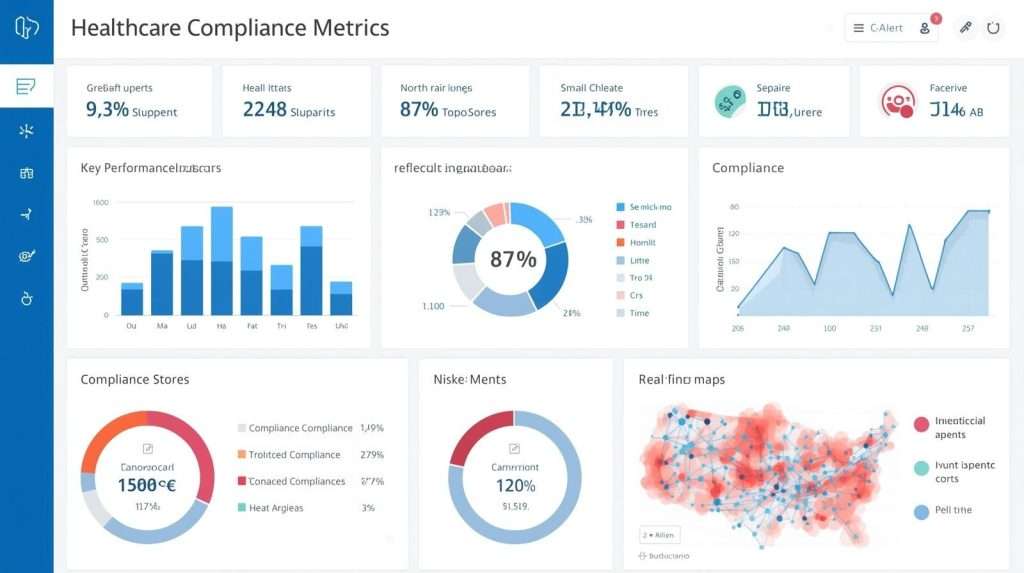
AI systems monitor multiple data streams simultaneously:
- Electronic health records for HIPAA compliance
- Clinical trial data for FDA adherence
- Financial transactions for fraud prevention
- Employee communications for policy violations
The integration with Research and Metric's data collection methods ensures comprehensive coverage across all organizational touchpoints.
2. Automated Risk Assessment and Scoring
AI-powered risk assessment algorithms evaluate thousands of risk factors continuously, generating dynamic risk scores that guide resource allocation. These systems consider:
Internal Risk Factors
- Historical compliance performance
- Staff training completion rates
- System vulnerability assessments
- Process adherence metrics
External Risk Factors
- Regulatory change frequency
- Industry enforcement trends
- Geographical compliance variations
- Emerging threat patterns
3. Intelligent Documentation and Reporting
Compliance requires extensive documentation. AI automates report generation and maintains audit trails that satisfy regulatory scrutiny. As a result, administrative burden falls by 65%. These systems integrate with existing research and analytics platforms to provide comprehensive compliance visibility.
Implementation Strategies for Healthcare Organizations
Phase 1: Assessment and Planning
Before deploying healthcare vulnerability detection AI, organizations must assess their current compliance maturity. Research and Metric recommends a structured evaluation covering:
- Current compliance processes and gaps
- Data infrastructure readiness
- Regulatory scope and complexity
- Resource availability and constraints
Phase 2: Technology Selection and Integration
Choosing the right regulatory intelligence systems requires careful evaluation of:
Technical Capabilities
- Scalability to handle growing data volumes
- Integration with existing healthcare IT systems
- Real-time processing capabilities
- Multi-regulatory framework support
Vendor Considerations
- Healthcare-specific expertise
- Regulatory update frequency
- Support and training offerings
- Compliance track record
Leading healthcare technology analysts at Gartner recommend evaluating at least five vendors before selection. They place emphasis on proven healthcare-specific AI compliance solutions.
Phase 3: Deployment and Optimization
Successful AI implementation follows a phased approach:
- Pilot Program: Test AI systems in controlled environments
- Gradual Expansion: Scale successful pilots across departments
- Full Integration: Deploy enterprise-wide with continuous monitoring
- Optimization: Refine algorithms based on performance data
Research and Metric's implementation methodology provides detailed guidance for each phase.
Measuring Success: KPIs for AI Compliance Systems
Operational Metrics
Organizations implementing AI healthcare compliance should track:
- Violation Reduction Rate: Percentage decrease in compliance violations
- Response Time: Speed of identifying and addressing compliance issues
- False Positive Rate: Accuracy of AI-generated alerts
- Coverage Completeness: Percentage of regulations actively monitored
The Healthcare Financial Management Association reports that organizations tracking these metrics see 3x better compliance outcomes.
Financial Metrics
- Compliance Cost Reduction: Decrease in overall compliance spending
- Penalty Avoidance: Value of prevented violations
- ROI Timeline: Time to positive return on AI investment
- Productivity Gains: Hours saved through automation
Strategic Metrics
- Risk Score Improvement: Overall organizational risk reduction
- Audit Performance: Success rate in regulatory audits
- Competitive Advantage: Market position relative to compliance capabilities
- Innovation Capacity: Resources freed for strategic initiatives
Overcoming Implementation Challenges
Data Privacy and Security Concerns
While AI enhances compliance monitoring, it also processes sensitive healthcare data. Organizations must ensure AI systems comply with data protection regulations. For example, implementing privacy-preserving techniques like federated learning and differential privacy addresses these concerns while maintaining AI effectiveness.
Change Management and Staff Adoption
Healthcare professionals may resist AI-driven compliance systems. Research and Metric's change management research indicates successful adoption requires:
- Comprehensive training programs
- Clear communication of benefits
- Gradual transition from manual to automated processes
- Continuous support and feedback mechanisms
Integration with Legacy Systems
Many healthcare organizations operate legacy systems incompatible with modern AI platforms. Strategic approaches include:
- API development for system connectivity
- Data warehouse creation for centralized processing
- Phased modernization aligned with AI deployment
- Hybrid solutions maintaining critical legacy functions
Future Trends in AI Healthcare Compliance
Predictive Compliance Intelligence
Next-generation healthcare regulatory technology will predict regulatory changes before official announcement. It will analyse legislative patterns, industry trends, and social factors to anticipate compliance requirements.
Blockchain-Enhanced Audit Trails
Blockchain technology will create immutable compliance records, providing transparent, tamper-proof documentation for regulatory review. As a result, this integration enhances trust while reducing audit complexity.
Quantum Computing Applications
Quantum computing will enable analysis of exponentially larger datasets, identifying subtle compliance patterns impossible to detect with classical computing. Research and Metric projects quantum-enhanced compliance systems will emerge within five years.
Autonomous Compliance Management
Future AI systems will not only detect compliance issues but also implement corrective actions automatically. As a result, this could create self-healing compliance ecosystems that maintain regulatory adherence without human intervention.
Industry-Specific Applications
 Hospital Systems
Large hospital networks benefit from AI's ability to standardize compliance across multiple facilities. Medical compliance automation ensures consistent policy application regardless of location or department, crucial for organizations spanning multiple jurisdictions.
Pharmaceutical Companies
Drug manufacturers leverage AI for end-to-end compliance monitoring from research through distribution. For example, AI tracks clinical trial protocols, manufacturing standards, and post-market surveillance requirements simultaneously.
Medical Device Manufacturers
Device companies use AI-powered risk assessment to maintain FDA compliance throughout product lifecycles. Predictive analytics identify potential recall situations before products reach market, saving millions in remediation costs.
Insurance Providers
Health insurers employ AI to ensure claims processing compliance while detecting fraudulent activities. Automated systems review millions of claims against regulatory requirements, flagging anomalies for investigation.
Building a Compliance-First Culture with AI
Leadership Commitment
Successful AI compliance implementation requires executive sponsorship. Leaders must champion AI adoption while ensuring adequate resources and organizational alignment. Research and Metric's leadership studies demonstrate that executive engagement increases implementation success by 340%.
Continuous Learning and Adaptation
AI systems improve through continuous learning. Organizations must establish feedback loops where compliance outcomes inform algorithm refinement. As a result, this iterative approach ensures AI systems evolve alongside regulatory landscapes.
Cross-Functional Collaboration
Compliance affects all organizational areas. AI implementation requires collaboration between IT, legal, clinical, and operational teams. Creating cross-functional compliance committees ensures comprehensive system design and deployment.
Conclusion
The rise of AI healthcare compliance represents more than technological advancement. It is a fundamental shift in how healthcare organizations approach regulatory challenges. Intelligent systems predict, prevent, and respond to compliance risks in real time. As a result, healthcare providers can break the chain of vulnerabilities that has long plagued the industry.
Research and Metric's extensive analysis confirms that organizations embracing AI-powered compliance solutions experience dramatic improvements in regulatory performance. They also reduce operational costs. As noted by the World Health Organization's Digital Health Guidelines, AI-enhanced compliance is becoming a global healthcare imperative. Regulatory complexity continues to increase. As a result, AI is emerging not as an optional enhancement but as an essential capability. This matters most for healthcare organizations committed to excellence in patient care and operational integrity.
The journey toward AI-enhanced compliance requires careful planning, strategic implementation, and continuous optimization. However, the benefits justify the investment. They include reduced violations, lower costs, improved patient safety, and competitive advantage. Healthcare organizations ready to embrace this transformation should begin with comprehensive assessment and strategic planning. Research and Metric's expertise can help them navigate the complex landscape of AI implementation.
Ready to transform your healthcare compliance strategy? Contact Research and Metric today for a customized AI compliance readiness assessment. Visit www.researchandmetric.com/services/speak-to-an-expert with our healthcare compliance experts to discover how AI can revolutionize your regulatory approach.
Get new articles by email
Useful tips on surveys and research. One email when we post something new. Unsubscribe anytime.