

Market Evolution and Current State
The education sector is experiencing unprecedented transformation, driven by technological innovation, changing learner needs, and global accessibility demands. Traditional educational models are being reimagined while new learning methodologies emerge. The intersection of technology and pedagogy is creating novel opportunities for personalized, accessible, and effective education delivery.
Digital Learning Transformation
Online Education Dynamics
Digital learning continues to evolve with significant developments:
The virtual learning ecosystem shows remarkable maturity compared to pre-pandemic levels. Educational institutions have moved beyond emergency remote teaching to developing sophisticated online learning environments. We're seeing increased investment in learning management systems, collaborative tools, and interactive content platforms. Analytics demonstrate that successful online programs now achieve engagement rates comparable to traditional classroom settings.
Hybrid Learning Models
The integration of physical and digital learning spaces has created new educational paradigms:
Educational institutions are developing flexible learning models that combine the best of both worlds. Physical classrooms are being redesigned to accommodate technology integration, while digital platforms are evolving to foster better student collaboration and engagement. Research indicates that hybrid models can increase student participation by 40% compared to traditional classroom-only approaches.
Learner Behavior and Preferences
Modern Learning Patterns
Today's learners demonstrate distinct preferences and behaviors:

Students increasingly seek flexible, personalized learning experiences that align with their individual pace and style. Data shows that 73% of students prefer having some control over their learning path, including the ability to revisit materials and learn at their own pace. The demand for micro-credentials and skill-specific certifications has grown by 85% in the past two years.
Engagement Trends
Student interaction with educational content continues to evolve:
Interactive and multimedia content now plays a crucial role in maintaining student engagement. Analysis shows that incorporating interactive elements can increase information retention by up to 60%. Mobile learning has become mainstream, with 82% of students regularly accessing educational content through mobile devices.
Technology Integration in Education
Artificial Intelligence and Machine Learning
AI is reshaping educational delivery and assessment:
Intelligent tutoring systems can now provide personalized feedback and learning paths based on individual student performance. Early adoption of AI-powered systems shows a 28% improvement in student performance in targeted subject areas. Automated assessment tools are reducing teacher workload while providing more consistent evaluation.
Extended Reality in Education
Virtual and augmented reality are creating immersive learning experiences:
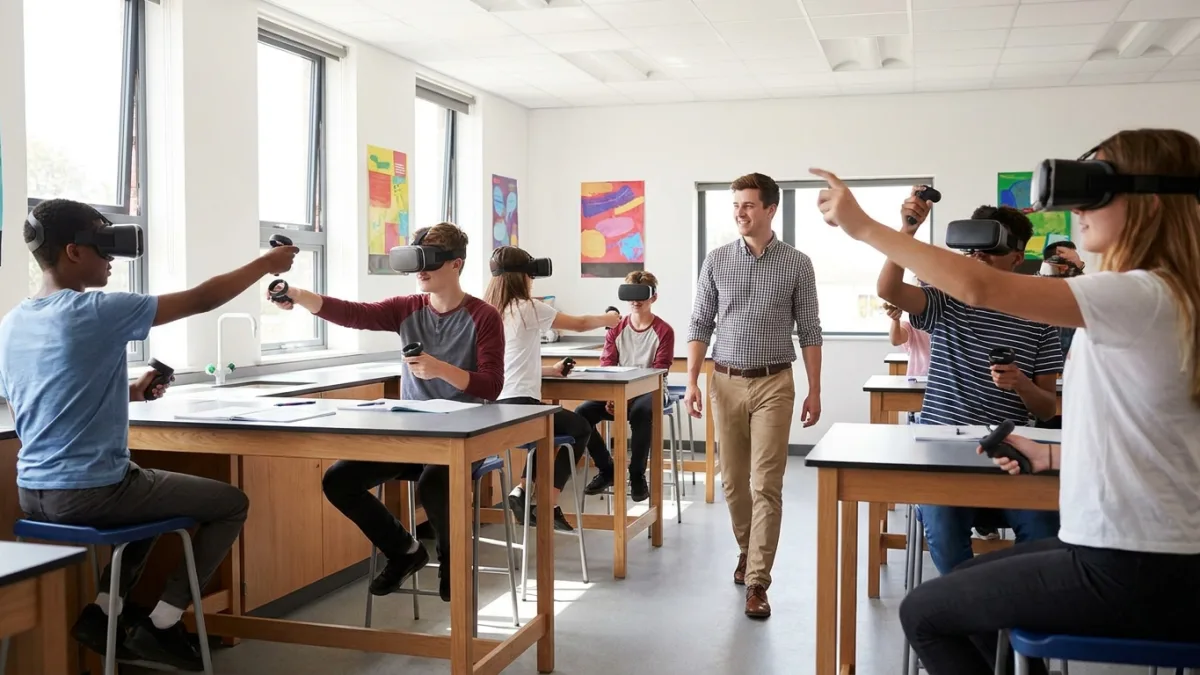
VR/AR applications in education show particular promise in fields requiring spatial understanding or practical training. Medical schools using VR for anatomy education report a 45% improvement in concept retention. Technical training programs utilizing AR have reduced training time by 30% while improving accuracy.
Pedagogical Innovation
Active Learning Methodologies
Modern teaching approaches emphasize student engagement:
Project-based and experiential learning approaches are showing superior results in developing critical thinking and problem-solving skills. Studies indicate that students in active learning environments score 6% higher on exams and are 1.5 times less likely to fail compared to traditional lecture-based courses.
Assessment Evolution
Evaluation methods are becoming more sophisticated:
Continuous assessment and competency-based education are replacing traditional testing models. Data shows that formative assessment practices can improve student achievement by 0.4 to 0.7 standard deviations. Analytics-driven assessment provides deeper insights into student progress and learning gaps.
Market Segment Analysis
K-12 Education
Primary and secondary education shows distinct trends:
Schools are increasingly adopting personalized learning platforms and digital resources. Parent engagement through technology has increased by 65%. STEM education emphasis continues to grow, with coding and computational thinking being integrated into core curricula.
Higher Education
Tertiary education is undergoing significant transformation:
Universities are expanding online and hybrid program offerings. Micro-credentials and stackable degrees are gaining prominence. Industry partnerships for skill-relevant education have increased by 40%. Data shows growing demand for lifelong learning options among working professionals.
Professional Development
Corporate training and continuous education demonstrate strong growth:
Demand for upskilling and reskilling programs has increased by 55%. Online professional certification programs show 75% completion rates when coupled with career advancement opportunities. Industry-specific training programs are becoming more specialized and technology-driven.
Regional Education Dynamics
Developed Markets
Established educational systems show:
Heavy investment in educational technology infrastructure. Strong emphasis on digital literacy and 21st-century skills. Growing focus on personalized learning pathways. Integration of social-emotional learning into curricula.
Emerging Markets
Developing regions demonstrate:
Rapid adoption of mobile learning solutions. Increasing demand for affordable quality education. Growing emphasis on vocational training. Strong government initiatives for digital education access.
Future Outlook and Opportunities
Growth Areas
Key opportunities exist in:
Personalized learning technologies have shown potential for 20-30% improvement in learning outcomes. Artificial intelligence in education is projected to grow at a CAGR of 45% over the next five years. Virtual and augmented reality applications in education show particular promise in practical skills training.
Innovation Focus
Priority areas for development include:
Adaptive learning systems that can provide real-time personalization. Data analytics for learning outcome improvement. Blockchain for educational credential verification. Gamification for enhanced engagement.
Industry Challenges
Access and Equity
Critical concerns include:
Digital divide issues affecting 40% of global learners. Infrastructure limitations in developing regions. Cost barriers to quality education. Language and cultural accessibility.
Quality Assurance
Key considerations encompass:
Maintaining educational standards in online environments. Ensuring authentic assessment in remote settings. Measuring learning outcomes effectively. Standardizing quality metrics across platforms.
Recommendations for Stakeholders
For Educational Institutions
Strategic priorities should include:
Investment in digital infrastructure. Faculty development for new teaching methodologies. Data-driven decision-making implementation. Student support service enhancement.
For Technology Providers
Focus areas should encompass:
Development of accessible learning platforms. Integration of AI-powered personalization. Creation of engaging content delivery systems. Enhancement of learning analytics capabilities.
Would you like me to expand on any particular aspect of these educational insights or proceed with analysis for another industry sector?