On 1 September 2026, ISO withdrew the 2019 edition of the research industry's quality standard and published a fourth edition in its place. The ISO 20252 revision is the first full rewrite in seven years, and most of what it changes sits where respondents are sourced, contacted and interviewed. That is why it matters most for fieldwork.
What changed in the new edition of ISO 20252? ISO 20252:2026 separates sampling from panel management through a new Annex G, adds a clause on the development and use of AI, introduces transparency tables for sample and panel providers, brings information security closer to ISO 27001 with incident reporting, and moves legal requirements to the front of the framework.
The standard is maintained by ISO/TC 225 and sets the vocabulary and service requirements for anyone conducting market, opinion and social research, including insights and data analytics. The official ISO 20252:2026 listing on iso.org confirms the fourth edition as published and the 2019 text as withdrawn.
Below, we explain the five changes that carry the most operational weight and how to prepare. Research and Metric works as a specialist fieldwork partner worldwide, so we read the rewrite through the lens of online data collection, phone and face-to-face work. One caveat: certification bodies are still digesting the text, so treat early interpretations, including ours, as a starting point.
[caption id="attachment_13764" align="alignleft" width="800"]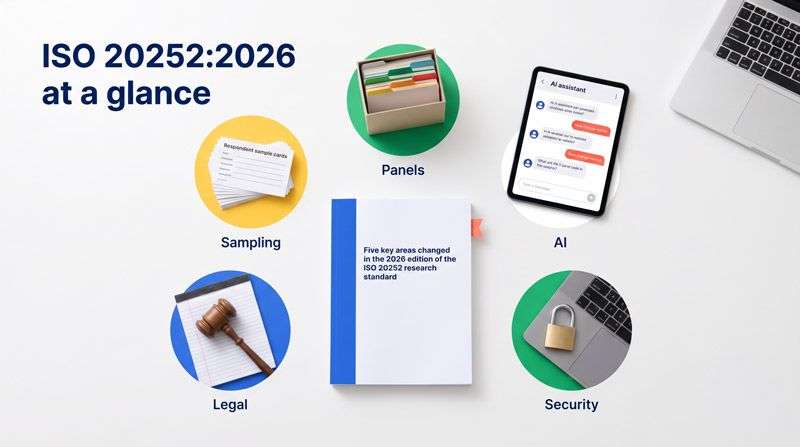 Five areas of the standard changed in the 2026 edition: sampling, panels, AI, security and legal requirements.[/caption]
What the ISO 20252 Revision Actually Changed
The ISO 20252 revision keeps the architecture introduced in 2019: a core framework in clause 4 that applies to every service provider, supported by annexes for specific activities such as sampling, fieldwork, observation, self-completion and data processing. What has changed is the content inside that frame, including a vocabulary section that early analysis says has grown by 31 terms.
The draft was opened to the global research community for comment in mid-2025, as Research Live reported on the ISO 20252 draft consultation, and the final text followed in September 2026. It replaces a version written before generative AI and before the current wave of survey fraud.
Five Changes in the 2026 Edition
According to a first clause-by-clause reading by ISO consultancy Assent Risk Management, the key changes in ISO 20252:2026 fall into five groups. First, Annex A now covers sampling only, and a new Annex G covers panel development and lifecycle management. Second, new tables set out what sample providers and panel providers must be transparent about.
Third, clause 4.1.5 introduces requirements for the development and use of AI and related technologies. Fourth, information security in clause 4.3 sits closer to ISO 27001 and gains an incident reporting subclause. Fifth, legal requirements move forward from 4.8 to 4.1.2, and management review becomes senior management review, signalling that accountability belongs at the top.
The document is still not structured like ISO 9001, and it remains a sector-specific quality management system built around how research projects are delivered. For us, that is the point: a standard written around project delivery is a standard written around global fieldwork.
Key Takeaway: The fourth edition keeps the 2019 structure but rewrites the rules on sampling, panels, AI, security and accountability.
Why Fieldwork Quality Carries the Heaviest Load
A full-service agency touches every clause, but it rarely performs every activity itself. Sampling, recruitment, interviewing and data capture are routinely outsourced, often through two or three layers of suppliers. The standard has always held the certified provider responsible for outsourced work, so every new requirement flows downstream to whoever actually reaches the respondent.
Look at where the new text concentrates. Sampling and panels are data collection activities, AI disclosure to participants happens during an interview, and security incidents are most likely where personal data is collected. Fieldwork quality is therefore the place where compliance with the ISO 20252 revision will be won or lost.
Where the Requirements Land in the Supply Chain
Consider a healthcare study that needs 300 physicians across six markets. The agency designs the questionnaire, but a fieldwork partner sources respondents from panels, databases and referrals, verifies them, and runs the interviews. Under the ISO 20252 revision, which source each complete came from, how it was validated, and whether any AI tool touched the process all need documented answers.
The same logic applies in finance, retail and technology research. A CATI research project, a CAPI study in tier-two cities and a product placement test all generate records that a certified client will now want to see. In our experience, the suppliers who struggle are rarely the ones with poor processes. They are the ones whose good processes were never written down.
A 2019 certificate is expected to stay valid during transition, but it says nothing about Annex G or AI. Our guide to ISO 20252 vs ESOMAR explains how certification and the ICC/ESOMAR Code fit together.
[caption id="attachment_13766" align="alignleft" width="800"]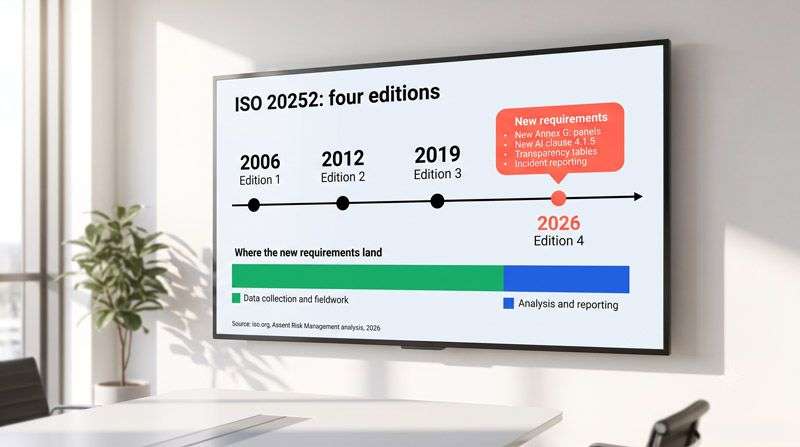 Four editions in twenty years, with the 2026 text concentrating its new requirements on fieldwork quality.[/caption]
Key Takeaway: Because agencies outsource data collection, most of the new obligations end up on the desks of fieldwork suppliers.
Sample Provider Transparency and the New Annex G
In the 2019 edition, Annex A tried to cover two different things at once: how a sample is drawn, and how an access panel is built and maintained. That worked for large online panel companies. It worked less well for qualitative recruiters and B2B specialists who hold a contact list of experts and re-engage them study by study.
The ISO 20252 revision resolves this by splitting the two. Annex A now addresses sampling alone, while the new Annex G addresses panel development and lifecycle management. A provider can reportedly attest to Annex A, Annex G, or both, depending on what it actually does.
Panel Lifecycle Management Becomes Its Own Discipline
A panel is not a static asset: members are recruited, profiled, validated, invited, rewarded and eventually retired. Each stage is a point where fraud, fatigue or stale profiling data can enter. Giving panel lifecycle management its own annex tells buyers that these controls deserve separate scrutiny from the sampling plan.
The new transparency tables matter just as much. Requirements in A.2.4.1 for sample providers and G.3.1.1 for panel providers set out what a supplier should disclose about its sources and methods. It turns sample provider transparency from a courtesy into a checklist.
Our specialty panel audiences work, from physicians to IT decision makers, blends proprietary databases with verified partners, and each source needs its own validation trail. Our piece on layered quality control at recruitment covers the verification side.
[caption id="attachment_13768" align="alignleft" width="800"]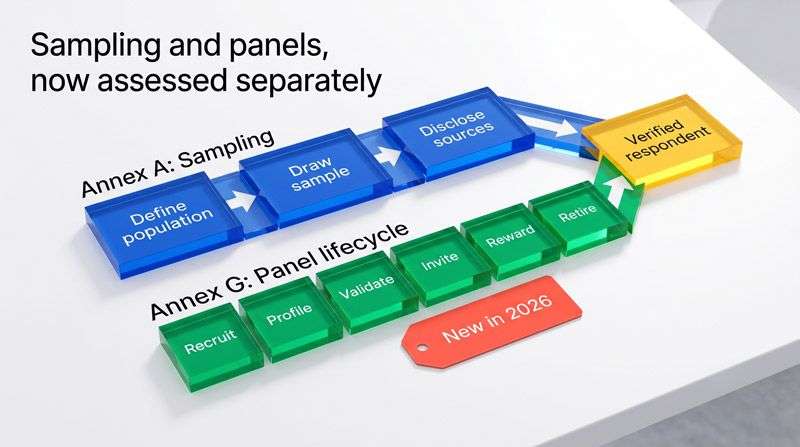 Panel lifecycle management now has its own annex, separate from sampling.[/caption]
Key Takeaway: Under the ISO 20252 revision, sampling and panels are assessed separately, and providers are expected to show their sources, not just describe them.
How the ISO 20252 Revision Treats AI in Data Collection
The ISO 20252 revision gives AI its own clause for the first time. Clause 4.1.5 covers the development and use of AI and related technologies, and it sensibly separates the two. Most suppliers do not build models, but almost all now use AI embedded in survey platforms, transcription tools and fraud detection systems.
Consent, Versions and Participant Disclosure
Based on the published summaries, the requirements are practical. Proposals should describe the type of AI used and the research stage where it is applied. Providers should record and tell the client when AI was used to generate insight, and should document the version of each tool.
Two requirements will be felt most in the field. Project or client-owned data should not be passed through AI without the client's explicit consent, and participants who interact with AI should be told that they are doing so. An AI-moderated interview or a chatbot probe in an online survey falls into that second category. Monitoring procedures for security, privacy and quality are also expected.
This lands in a crowded space. The EU AI Act, GDPR and UK data protection law already push toward disclosure, and the ICC/ESOMAR Code was updated in 2025 with AI in mind. Across APAC, rules differ by market, which is why one documented AI register per project is easier to defend than country-by-country improvisation.
Our technology-first approach means AI sits inside several of our own workflows. The discipline the new clause demands is the one we set out in our guide to AI governance in fieldwork: know which tool, which version, which data and whose consent.
Key Takeaway: AI use is now an auditable part of a research project, and the disclosure duty reaches all the way to the respondent.
Information Security and Incident Reporting Across Borders
Research suppliers hold names, phone numbers and health details for thousands of people at a time. That is why so many firms pair this market research quality standard with ISO 27001. The ISO 20252 revision narrows the gap a little: clause 4.3 is now somewhat better aligned with ISO 27001, and a new subclause covers incident reporting.
Subcontractor Oversight in Multi-Country Projects
Incident reporting is simple to write and hard to operate. In a multi-country project, a lost tablet or a misdirected respondent file has to reach the lead agency in time for it to meet its own legal deadlines. Under GDPR, that window can be as short as 72 hours. A chain of three suppliers, each taking a day to escalate, uses the whole allowance.
Subcontractor oversight therefore becomes a design question, not a contract clause. Who is the named security contact at each local partner, and do CAPI interviewers know that a stolen device is a reportable event?
Moving legal requirements to the front of the framework reinforces the point. Knowing which laws apply in each market is now one of the first things asked of a provider. For qualitative research recruitment, where recordings and identifiable transcripts are routine, that ordering feels right.
Key Takeaway: Security expectations now include a working incident route that spans every supplier and every market in the chain.
Best Practices for Meeting the New Data Collection Standards
You do not need to wait for certification schemes to catch up. Most of the work is documentation and supplier conversation, and both can start now.
5 Strategies for a Smooth Transition
First, run a gap analysis against the ISO 20252 revision rather than against your old manual. Map each new or moved clause to an existing procedure and mark where nothing exists. The AI clause and Annex G are the usual blanks.
Second, decide which annexes you attest to. If you maintain a panel or a re-contactable database, Annex G probably applies. If you only draw samples from third parties, Annex A may be enough.
Third, build an AI register. List every tool that touches project data, its version, its purpose and which clients have consented. Then update proposal templates so AI use is described by research stage.
Fourth, rewrite supplier questionnaires around the transparency tables. Ask sample and panel partners for source breakdowns, validation methods and lifecycle controls in one consistent format.
Fifth, test your incident route. Run a tabletop exercise with at least one overseas partner and time how long a simulated breach takes to reach your quality manager.
At Research and Metric, our Extended Team Services model places our project managers inside client workflows, so these records are shared as the project runs rather than requested after the fact. Good data collection standards produce exactly what the ISO 20252 revision asks for: evidence that already exists when someone asks for it.
[caption id="attachment_13769" align="alignleft" width="800"]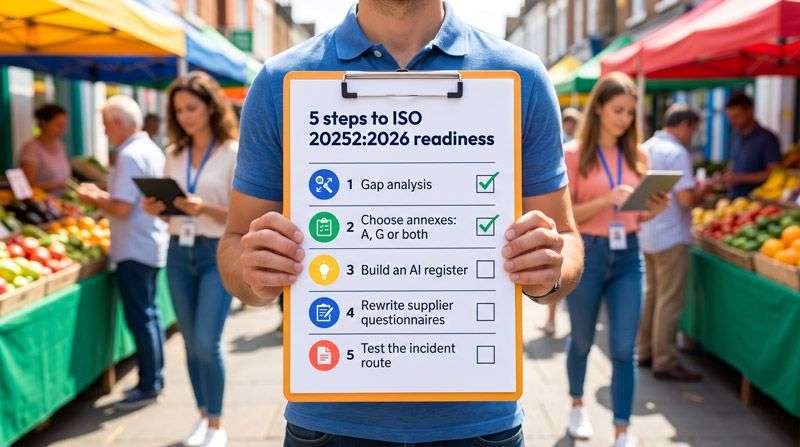 Five practical steps to bring data collection standards in line with the 2026 edition.[/caption]
The Future of ISO 20252 Certification
Certification to the new edition will not be available on day one. Accreditation bodies must update their schemes and train auditors, so the first 2026 certificates are likely some months away. A transition period of around three years is typical, although the exact window had not been confirmed at the time of writing.
Emerging Trends in Research Quality Assurance
Three trends are worth watching. Buyers, particularly in pharma and financial services, are likely to add the new edition to RFP questionnaires before transition ends. Bodies such as the MRS in the UK and the Insights Association's CIRQ in the US will shape how auditors read the AI clause. And the transparency tables may become a de facto template for sample disclosure, even among suppliers that never seek ISO 20252 certification.
For agencies, the ISO 20252 revision is an opportunity to reset supplier expectations while everyone is rereading the rules. For related analysis on fraud, pricing and compliance, visit the Research and Metric blog.
[caption id="attachment_13771" align="alignleft" width="800"]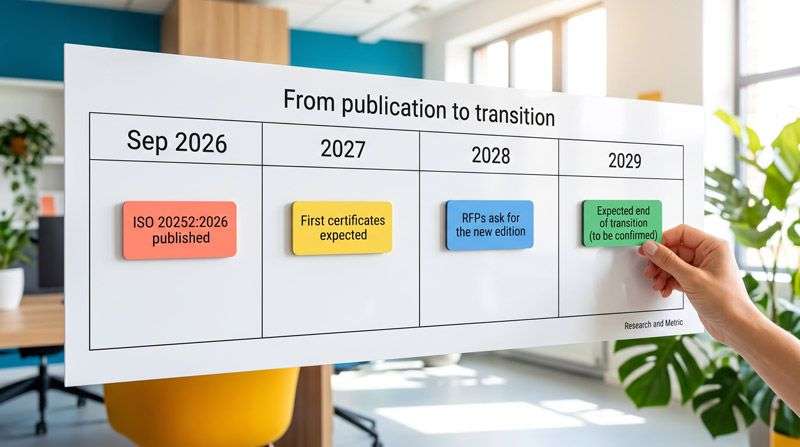 ISO 20252 certification to the new edition will follow once accreditation schemes are updated.[/caption]
Key Takeaway: Certification will follow slowly, but buyer expectations will move quickly.
Conclusion: A Standard Rewritten Around Fieldwork
The ISO 20252 revision matters because it moves the standard closer to where research quality is actually decided. Sampling and panels are separated, sources must be shown, AI must be declared, incidents must be reported, and senior management must own the result. Every one of those duties is discharged during data collection.
At Research and Metric, our teams worldwide work as an extension of agency project teams, with ESOMAR-aligned methodologies and documentation designed to be shared. We are happy to walk clients through what the fourth edition means for live and upcoming projects.
If your next multi-country study depends on suppliers you have not questioned since 2019, start with sources, AI and incident routes, and ask for evidence rather than assurances.
Ready to make your fieldwork chain audit-ready? Contact Research and Metric today to discover how our AI-powered fieldwork solutions transform your data into actionable intelligence.
FAQ: The 2026 Edition of ISO 20252
FAQ: The 2026 Edition of ISO 20252
The ISO 20252 revision is the fourth edition of the international quality standard for market, opinion and social research, published by ISO in September 2026 to replace the 2019 text. It matters because it updates the rules on sampling, panels, AI, information security and accountability, where research quality is most exposed today.
How does the ISO 20252 revision impact fieldwork providers?
The impact of the new edition falls mainly on data collection. Fieldwork providers must show where sample comes from, manage panels through a documented lifecycle, tell participants when they interact with AI, and report security incidents through a tested route. Because agencies remain responsible for outsourced work, certified clients will pass these duties down the chain.
What are the key trends in the ISO 20252 revision for 2026?
Key trends include the separation of sampling from panel management through a new Annex G, table-based transparency requirements for sample and panel providers, a dedicated clause on developing and using AI, closer alignment with ISO 27001 plus incident reporting, and legal requirements placed at the front of the framework. The common thread is evidence.
What ROI can businesses expect from understanding the ISO 20252 revision?
Businesses that leverage the updated standard early gain fewer supplier surprises, faster vendor due diligence and stronger answers in client RFPs. Documented sources and AI registers reduce rework when data is challenged, and a tested incident route limits legal exposure. The return is a lower risk of losing a project, or a client, to a quality failure.
How can Research and Metric help with the ISO 20252 revision?
Research and Metric supports clients as a specialist fieldwork partner worldwide, providing sample source documentation, respondent validation records, AI usage disclosure and clear incident contacts on every project. Our teams work as an extension of yours, so the evidence a certified client needs is available throughout fieldwork. Learn more about our services.