Almost every fieldwork proposal that crosses a research buyer's desk in 2026 mentions automation somewhere. Faster screening. Smarter fraud detection. Instant coding of open ends. Very few of those proposals explain who is accountable when the machine gets something wrong.
AI governance in fieldwork is the documented set of controls that decides where automated tools may be used in data collection, who reviews their output, and how those decisions are recorded. It covers disclosure, human oversight, bias testing, data protection and audit evidence in every market a study touches.
That gap matters more than it did two years ago. ESOMAR published its 20 Questions to Help Buyers of AI-Based Services precisely because buyers were commissioning work they could not interrogate, and the updated ICC/ESOMAR International Code now puts human oversight, transparency and synthetic data disclosure at the centre of professional practice rather than the margins.
This article sets out the nine questions worth putting to any data collection supplier, the answers that signal real control, and the replies that should give a procurement team pause. At Research and Metric we run global fieldwork programmes worldwide, and these are the questions our own clients ask us.
[caption id="attachment_13713" align="alignleft" width="800"]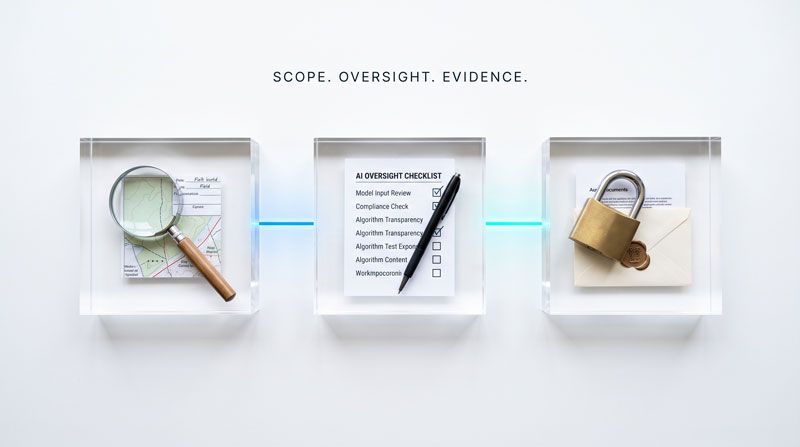 The three areas any vendor question set needs to cover.[/caption]
Why AI governance in fieldwork became a procurement question
For most of the last decade, automation in data collection was an internal efficiency story. A supplier used it, the client benefited from a faster turnaround, and nobody asked to see the machinery. That arrangement has quietly collapsed. Nobody talked about AI governance in fieldwork because nobody needed to.
Three things changed at once. Regulation arrived with specific obligations around automated processing and disclosure. Client-side legal teams started attaching AI clauses to master service agreements. And end clients, particularly in healthcare and financial services, began asking their agencies to evidence how insights were produced, not just what the insights said.
From efficiency story to audit trail
The practical consequence is that supplier AI controls are now a contract term. A research buyer who cannot describe how automation touched a dataset is exposed twice over, once to their own client and once to whichever regulator has jurisdiction over the markets in the sample.
This is not an argument against using automation. Machine assistance genuinely improves data collection quality control, particularly in fraud detection where pattern recognition outperforms manual review at scale. Our own work on layered quality control relies on it. The argument is that AI governance in fieldwork has to be demonstrable, and demonstrable means documented.
Key Takeaway: Supplier AI controls stopped being a technical detail the moment buyers became accountable for how findings were produced.
Where machine assistance already sits in your data collection pipeline
Before asking a vendor anything, it helps to know where the answer should apply, because AI governance in fieldwork only works when it is mapped to the actual workflow. Buyers often picture automation as a single tool bolted on at analysis. In practice it is distributed across the whole project, and much of it operates before a researcher sees a single response.
Screening, translation, coding and fraud detection
Participant sourcing frequently uses model-driven profiling to identify likely qualifiers. Screening layers apply automated checks for duplication, bot traffic and inattentive responding. Multi-country studies lean on machine translation for questionnaire localisation and for back-translating verbatims. Open-end coding is increasingly handled by large language models. Quality scoring at delivery may combine a dozen automated signals into a single keep or drop decision.
Each of those steps changes the dataset. A translation error narrows a concept. An over-tuned fraud filter removes a legitimate respondent segment, which is a particular risk in specialty audience sampling where the population is small and unusual behaviour looks like fraud. An under-tuned one lets survey farms through. None of this is visible in a topline.
[caption id="attachment_13729" align="alignleft" width="800"]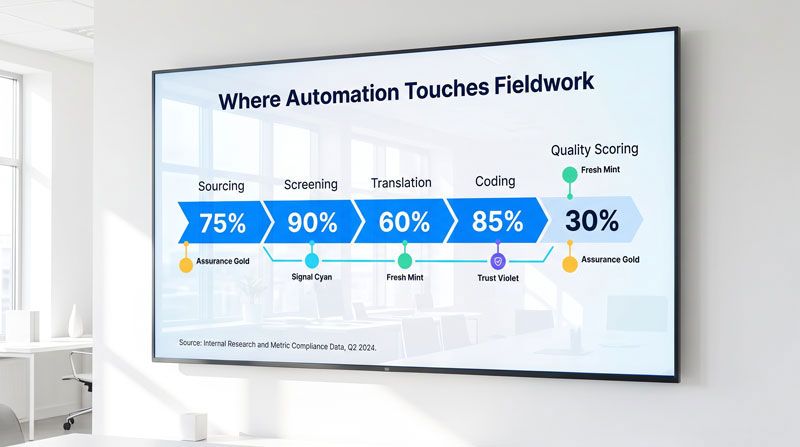 Automated steps across a typical data collection pipeline, with human review points marked.[/caption]
Key Takeaway: Machine assistance shapes the dataset long before analysis, which is exactly why AI governance in fieldwork belongs in the brief rather than the debrief.
The 9 questions that separate AI governance in fieldwork from AI marketing
These questions map closely to the structure ESOMAR uses for buyers of AI-based services: company capability, fitness for purpose, trust and transparency, human supervision, and data governance. Each one tests AI governance in fieldwork rather than technical capability. Ask them at RFQ stage, in writing, and keep the answers.
Questions 1 to 3: disclosure and scope
First, where exactly does automation touch this project, and at which steps? A good supplier answers with a list tied to your workflow, not a capability statement. Second, which tools or models are involved, and are they proprietary or third party? If a general purpose model sits in the chain, you need to know whose it is and under what terms. Third, what are participants told about automated processing? Consent language that predates the tooling is a live compliance problem, and it is the kind of detail that surfaces during multi-country fieldwork compliance reviews rather than during the pitch.
Questions 4 to 6: human oversight and error handling
Fourth, who reviews machine output before it reaches the deliverable, and what qualifies them to do it? Human in the loop review is meaningless as a phrase and valuable as a named role with a defined checkpoint. Fifth, how is the tool tested for bias and drift across your markets and languages? A model validated on English-language data will behave differently in Bahasa Indonesia or Brazilian Portuguese, and a supplier who has never measured that has not looked. Sixth, what happens when it gets something wrong, and how quickly do you find out? Ask for the last real example. Suppliers with mature controls have one ready.
Questions 7 to 9: data protection, ownership and audit evidence
Seventh, does our data train your models or anyone else's? The answer should be unambiguous and contractual. Eighth, who owns the inputs and outputs, and where does processing physically happen? Cross-border processing turns this into a jurisdictional question under GDPR and equivalent regimes. Ninth, what evidence can you hand us if our client, a regulator or an ethics board asks? This is the question that separates a supplier who governs automation from one who merely uses it.
[caption id="attachment_13716" align="alignleft" width="800"]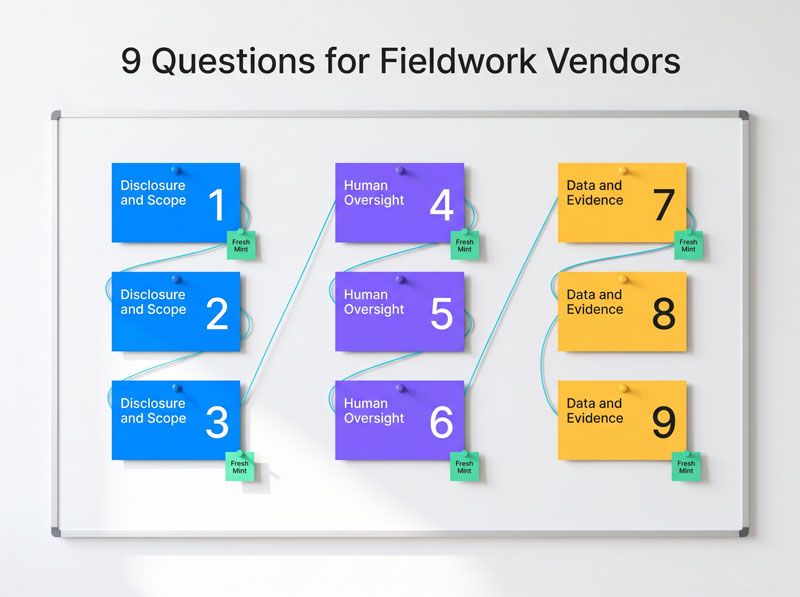 The nine questions grouped into disclosure, oversight and evidence.The nine questions grouped into disclosure, oversight and evidence.[/caption]
Key Takeaway: Nine questions, asked in writing at RFQ stage, reveal more about supplier AI controls than any capability deck.
What a strong vendor answer actually looks like
Answers on AI governance in fieldwork tend to fall into one of two camps. There is a recognisable difference between a supplier describing a system and a supplier describing a brochure. Strong answers are specific, bounded and occasionally unflattering.
A vendor with real controls will tell you which steps are automated and which are deliberately not. They will name the review points and the roles that own them. They will describe a failure, what it cost, and what changed afterwards. They will decline to claim accuracy figures they cannot evidence. Much of this mirrors the structure of the NIST AI Risk Management Framework, which organises responsible AI practice around governing, mapping, measuring and managing risk rather than around tooling.
Warning signs in supplier responses
Watch for four patterns. Answers that describe the technology instead of the process. Assurances of accuracy with no measurement method attached. A human in the loop claim with no named role or checkpoint. And silence on training data, which is rarely an oversight.
The same logic applies in qualitative recruitment, where automated screening decisions determine who reaches a discussion guide at all. If a supplier cannot explain a rejection, the sample cannot be defended.
Key Takeaway: Specificity is the signal. Vague fluency about capability is the warning.
Five ways to build an AI vendor assessment into your RFQ process
Making AI governance in fieldwork routine matters more than making it thorough once. Five practices turn AI vendor assessment from an ad hoc conversation into a repeatable part of procurement.
Five practices for embedding oversight in procurement
First, put the nine questions directly into the RFQ template so every supplier answers the same set and responses become comparable rather than anecdotal.
Second, ask for written answers before the pitch call. Prepared prose exposes gaps that a confident presenter can talk past in a meeting.
Third, require a named human review point for every automated step that alters the dataset, and write it into the statement of work rather than leaving it as an understanding.
Fourth, treat audit evidence as a deliverable. If a supplier cannot hand over documentation alongside the data file, you are carrying their risk without their records.
Fifth, align your own checklist to an external structure so it survives staff turnover. ISO/IEC 42001, the first certifiable AI management system standard, gives procurement teams a vocabulary that legal and IT already recognise, which shortens internal approval considerably.
Applying this consistently across modes matters too, since automated quality scoring behaves differently in CATI research than it does online.
[caption id="attachment_13717" align="alignleft" width="800"]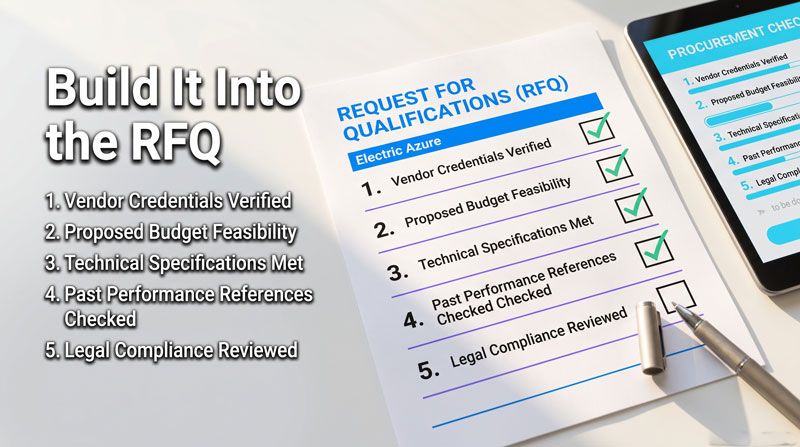 How buyer expectations on supplier AI controls are expected to develop.[/caption]
The future of AI oversight in global fieldwork
The direction of travel is towards evidence rather than assurance. AI governance in fieldwork is following the path data privacy took a decade ago, from differentiator to baseline. Global fieldwork compliance is converging on a model where suppliers ship documentation with data as a matter of course, in the same way that panel providers now ship source and quality metrics without being asked.
Emerging trends in research procurement
Expect three developments through 2027. Certification will become a shortlisting filter rather than a differentiator. Synthetic data disclosure will move from voluntary to expected, with buyers requiring an explicit statement of whether any respondent record was model generated. And audit evidence will be standardised, because agencies cannot review a different format from every supplier.
Buyers who build these habits now will find the transition administrative rather than disruptive. Those who wait will be retrofitting governance onto live studies, which is expensive and rarely convincing.
[caption id="attachment_13720" align="alignleft" width="800"]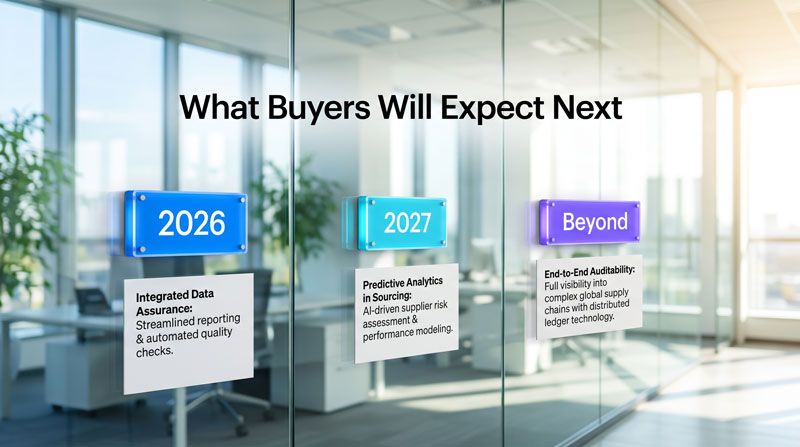 How buyer expectations on supplier AI controls are expected to develop.[/caption]
Key Takeaway: Documentation shipped with the dataset is becoming the norm, and retrofitting AI governance in fieldwork later costs considerably more.
Conclusion: what buyers should do next
AI governance in fieldwork is no longer a technical topic owned by a supplier's engineering team. It is a procurement discipline, and the buyer who asks nine specific questions at RFQ stage learns more in an afternoon than a year of capability decks would tell them.
The nine questions cover scope and disclosure, human oversight and error handling, and data protection with audit evidence. The pattern to look for is specificity. The pattern to worry about is fluency without detail.
At Research and Metric, our teams worldwide run ESOMAR-aligned data collection with documented review points, bias testing by market and language, and an audit trail supplied with every dataset. We answer these nine questions for our own clients because we expect to be asked.
Ready to put your fieldwork partner to the test? Talk to the Research and Metric team and see what documented AI oversight looks like in practice.
FAQ: vendor AI oversight in data collection
What is AI governance in fieldwork and why does it matter?
It is the documented set of controls that decides where automated tools may be used in data collection, who checks their output, and how those decisions are recorded. It matters because the buyer remains accountable to their own client and regulator for findings produced with machine assistance, whoever ran the study.
How does AI governance in fieldwork affect data quality?
The effect is direct. Automated screening, translation and open-end coding all shape the dataset before a researcher sees it. Without defined review points, an error in a model is silently converted into a finding. Documented oversight catches drift, mistranslation and false fraud flags while a study is still in field.
What questions should buyers ask about AI governance in fieldwork?
Ask where automation touches the project, which tools are used, what participants are told, who reviews output, how bias and drift are tested, what happens when the system errs, whether your data trains any model, who owns inputs and outputs, and what audit evidence the supplier can produce on request.
Which standards apply to AI governance in fieldwork in 2026?
Several frameworks now overlap. The ICC/ESOMAR International Code sets the sector expectation on transparency and human oversight, the NIST AI Risk Management Framework offers a voluntary structure for identifying and managing risk, and ISO/IEC 42001 defines a certifiable management system. Regional law, including the EU AI Act, sits on top of all three.
How can Research and Metric help with AI governance in fieldwork?
Research and Metric supports clients with documented controls across every study we run, covering disclosure, named human review points, bias testing by market and language, and an audit trail supplied with the dataset. Our teams operate ESOMAR-aligned methods worldwide. Learn more about our services.