
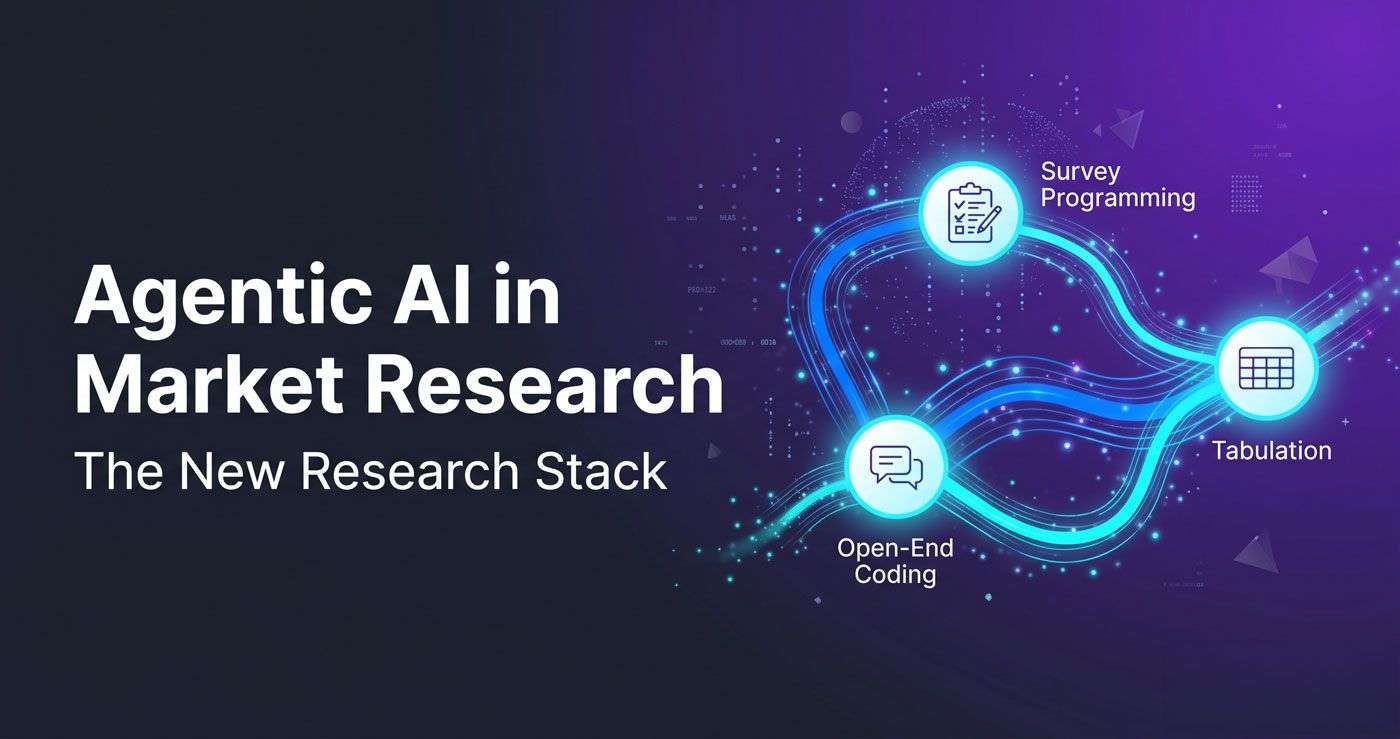
Agentic AI market research is no longer a 2027 prediction it is running in production at agencies you have already heard of.
Agentic AI market research refers to autonomous AI systems that plan, execute, and self-correct multi-step research tasks without continuous human prompting. Unlike single-turn AI tools, agentic systems automate full workflows from survey programming and open-end coding to tabulation by chaining language models with research-specific tools and quality checks.
According to McKinsey's State of AI report, more than 70% of organizations now report regular use of generative AI in at least one business function, and market research operations are among the fastest-moving adopters. The shift is happening because the work that consumes most research hours scripting, coding, tabbing is exactly the work agentic systems do well.
This article unpacks where agentic AI market research is delivering value today, how it is being deployed inside production research stacks, and what the extended team services at Research and Metric look like in an agentic era. Across our operations worldwide, we have spent the last 18 months integrating agentic workflows into client research pipelines and the patterns that work are now clear.
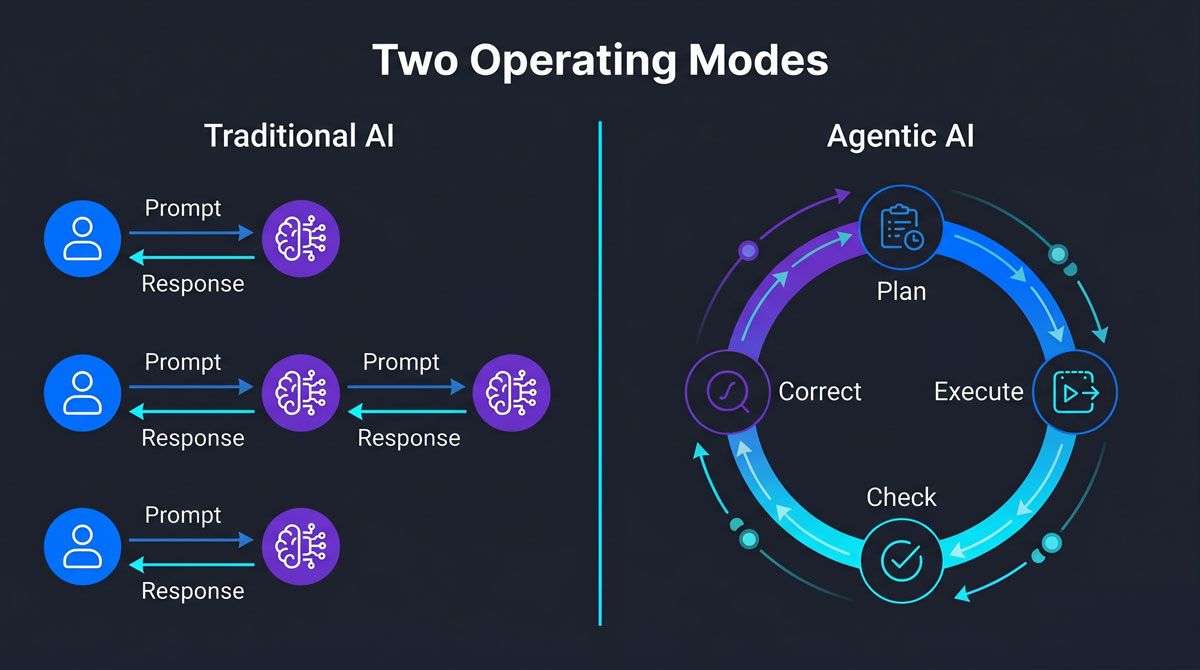
Table of Contents (Auto-generated by RankMath TOC block from H2 headings)
Why Agentic AI Market Research Is Different From Other AI Tools
Agentic AI market research is a different category of tool from the chatbots and writing assistants most teams have already adopted. Where a chatbot waits for the next prompt, an agentic system pursues a goal write the questionnaire, code the open-ends, build the tab plan and breaks the goal down into steps it can execute on its own.
The Three Capabilities That Make an AI System "Agentic"
A system qualifies as agentic when it combines three properties. First, planning: it can decompose a research objective into ordered sub-tasks. Second, tool use: it can call external software survey platforms, statistical tools, file systems through APIs or function calls. Third, self-correction: it can read the output of its own actions, detect errors, and retry.
This is why Large Language Models (LLMs) alone are not agentic. An LLM that writes a Decipher script is helpful. An LLM that writes the script, uploads it to Decipher, runs the test, reads the test report, fixes the routing bug, and re-tests until it passes is agentic. The difference is whether the system can close the loop.
According to Gartner research on AI agents, more than a third of enterprise software applications will include autonomous agent capabilities by the end of 2026 up from less than 1% in 2024. Market research tooling is moving with this curve, not behind it.
Key Takeaway: Agentic AI market research replaces single-shot AI prompts with goal-driven workflows that plan, execute, and verify their own work.
Agentic AI Market Research in Survey Programming
Agentic AI market research has its most mature use case in survey programming, because the work has structure that agents can reason about: question types, routing logic, quota cells, language versions, and platform-specific syntax.
From Questionnaire Document to Live Survey in Hours
A modern agentic programming workflow takes a Word or PDF questionnaire as input. The agent extracts question structure, identifies routing logic, builds the appropriate syntax for the target platform (Decipher, Forsta, Qualtrics, or a proprietary system), and generates the script. It then runs the script in a test environment, reads back any platform errors, and iterates until the survey passes basic validation.
What this changes operationally: a 60-question study that took a senior scripter two days now reaches first-test-ready state in a few hours. Translation versions, which historically multiplied scripting time linearly, are handled in parallel because the agent writes the multilingual variants in the same pass pulling translated text from approved glossaries.
This is where our online data collection team has seen the largest productivity gains. Senior scripters now spend their time on the 20% of logic that is genuinely complex interlocking quotas, conjoint setups, hidden variables tied to sample frame data while the agent handles the 80% that is routine.
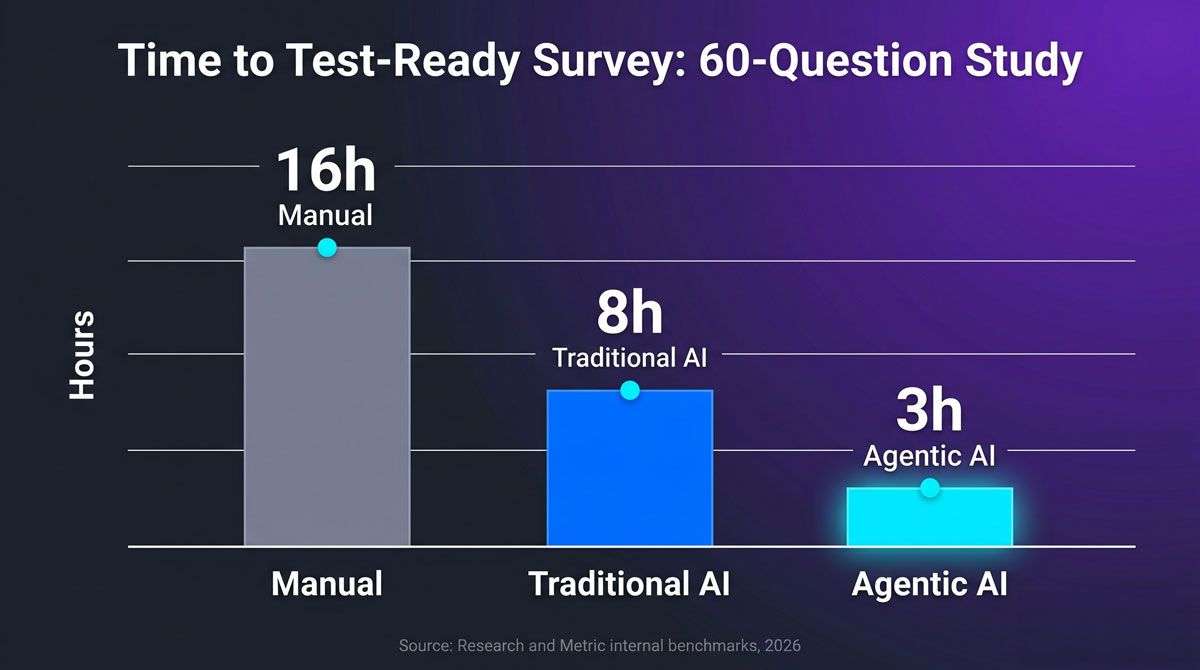
Key Takeaway: AI survey programming compresses the script-to-test cycle from days to hours and shifts senior scripter time toward genuinely complex logic.
Agentic AI Market Research for Open-End Coding
Agentic AI market research has transformed open-end coding more than any other research phase, because verbatim coding is a Natural Language Processing (NLP) problem that LLMs solve natively.
From Verbatim Responses to Themed Codeframes Without Manual Work
Traditional open-end coding required a team of coders to read every response, identify themes, build a codeframe, then code each verbatim against it. For a study with 1,500 respondents and three open-ends, that meant 4,500 manual code decisions per study slow, expensive, and inconsistent across coders.
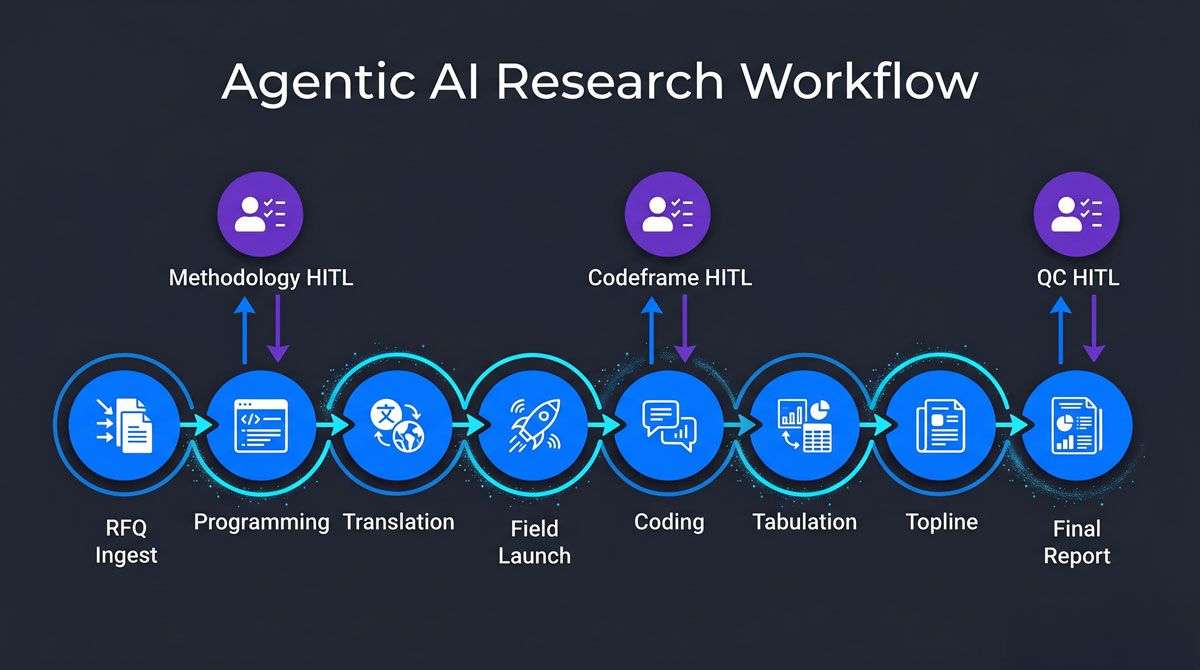
An agentic open-end coding workflow now does this in three passes. First, it reads a sample of verbatims and proposes a codeframe with theme hierarchy and definitions. A senior coder reviews and edits the codeframe this is the Human-in-the-Loop (HITL) checkpoint that should never be skipped. Second, the agent codes all verbatims against the approved frame, attaching confidence scores. Third, it flags low-confidence responses for human review, so coder attention focuses on the genuinely ambiguous 5–10%.
Multi-language coding is where the productivity gain is largest. A study running across English, Japanese, Bahasa Indonesia, and Malay traditionally required four coding teams. The same study with an agentic workflow runs in one pass through a single multilingual model a capability we have integrated into our global fieldwork operations.
Key Takeaway: Automated open-end coding has shifted coder roles from manual coding to codeframe design, quality oversight, and edge-case adjudication.
Agentic AI Market Research in Tabulation and Reporting
Agentic AI market research is now closing the final mile tabulation and reporting where AI was slowest to arrive because the work requires both technical execution and judgment.
From Tab Plan to Dashboard Without a Manual Build
An agentic tabulation workflow starts with the project brief or RFQ. The agent extracts the analysis requirements, generates a tab plan with banner points, weighting variables, and significance testing setup, then writes the actual tabulation specification in the target system SPSS, Q Research Software, Wincross, or a custom pipeline. It runs the tabs, scans the output for anomalies (small base sizes, suspicious nets, missing splits), and generates an executive summary that flags significant differences.
In APAC and EU markets which together represent over half of Research and Metric's specialty audiences project volume clients increasingly expect tabulated output and a topline summary within 48 hours of fieldwork close. That timeline is only feasible because agentic tabulation runs alongside fieldwork, not after it.
Retrieval-Augmented Generation (RAG) plays a quiet but important role here. The agent pulls from the client's own past tab specifications and reporting templates, so the output matches their house style rather than generic AI defaults. This is what separates a usable agentic tabulation system from a demo: it is grounded in the client's actual patterns.
Key Takeaway: AI tabulation extends agentic workflows into the final mile of research delivery, where ESOMAR-aligned quality standards still depend on human oversight of the methodology.
Best Practices for Deploying Agentic AI Market Research
Agentic AI market research delivers its full ROI only when the deployment is designed properly. Pilots that skip the design work tend to fail noisily, then set the program back by quarters.
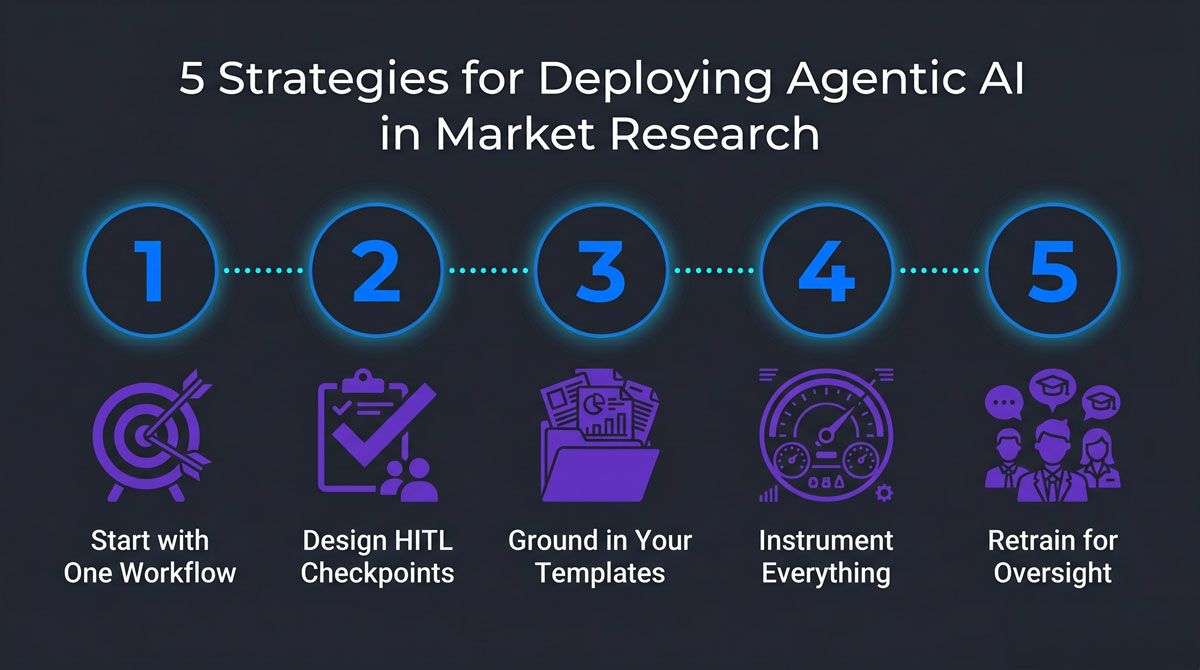
Five Strategies for Successful Agentic AI Deployment
First, start with one workflow, not the whole pipeline. The agencies seeing the largest gains have picked open-end coding or routine survey programming as the first agentic deployment, run it for six to twelve weeks alongside the manual process, and measured the gap before scaling. Trying to launch agentic systems across scripting, coding, and tabulation simultaneously almost always fails.
Second, design the human-in-the-loop checkpoints before launch. Agentic systems should propose, not decide, at every step that affects research validity codeframe approval, quota interlock logic, significance test methodology. The HITL checkpoints are where senior researcher expertise lives.
Third, ground the agent in your own templates and past work. A vanilla LLM produces generic output. An LLM connected to your codeframes, tab specs, and reporting templates produces output that matches your house style. This is the difference between a demo and a deployment.
Fourth, instrument everything. Log every decision the agent makes, every retry, every escalation to a human. Without this telemetry, you cannot tell whether the system is improving or quietly degrading on edge cases.
Fifth, retrain your team for oversight, not extinction. The roles that disappear are the routine ones; the roles that grow are codeframe designers, agent supervisors, methodology validators. Our extended team services model has reorganized around this: senior staff supervise multiple agentic workflows in parallel, rather than executing one workflow themselves.
The Future of Agentic AI Market Research
Agentic AI market research in 2026 looks operational but bounded. The next 18 months will push the boundary in three directions.
Emerging Trends in Agentic AI Market Research
First, end-to-end project agents. Today's agentic systems handle individual phases. The next generation will run a full project from RFQ ingestion to final report, with human checkpoints at sample design, fieldwork launch, and final deliverable. Second, qualitative research agents. Transcription, theme extraction, and synthesis of qualitative interviews is the next frontier, and early systems are already in production trials a development we are tracking closely for our qualitative recruitment work. Third, real-time methodology validation. Agents that flag methodology issues leading questions, insufficient sample, biased framing before fieldwork rather than after.
Key Takeaway: Agentic AI market research is moving from phase-level automation toward end-to-end project agents within the next 18 months.
Conclusion: What Agentic AI Market Research Means for the Industry
Agentic AI market research is not a future technology; it is a present-day operating model that is reshaping how research firms structure work, price projects, and staff teams. The agencies and clients who treat it as a tooling upgrade drop in an agent, expect savings are not seeing the gains. The ones treating it as an operating model redesign are.
At Research and Metric, our teams worldwide have spent the last 18 months integrating agentic workflows into survey programming, open-end coding, and tabulation, while keeping ESOMAR-aligned methodology and human oversight at the center of every project. The lesson from that work is consistent: agentic AI market research expands what a research team can deliver, but only when it is deployed with the same rigor we bring to fieldwork itself.
Ready to bring agentic AI workflows into your research operations? Contact Research and Metric today to discover how our AI-powered fieldwork and extended team services transform your data into actionable intelligence.
FAQ: Agentic AI Market Research
What is agentic AI market research and why does it matter?
Agentic AI market research uses autonomous AI systems that plan, execute, and self-correct multi-step research tasks without continuous human prompting. It matters because agentic AI market research compresses timelines from weeks to days, reduces programming and coding errors, and frees senior researchers to focus on strategy and insight rather than repetitive operational work that historically consumed most project hours.
How does agentic AI market research differ from traditional AI tools?
Agentic AI market research differs from traditional tools because it operates autonomously across full workflows rather than answering one prompt at a time. An agentic AI market research system plans a tabulation, runs the script, checks the output, fixes errors, and produces the final deliverable. Traditional AI tools require a human to chain each step manually, which slows everything down.
Can agentic AI market research replace survey programmers and coders?
Agentic AI market research does not replace programmers and coders today; it changes what they do. The technology handles repetitive scripting, codeframe building, and tabulation, while specialists supervise complex logic, validate AI output, and handle edge cases. Most production deployments of agentic AI market research run as human-in-the-loop systems where senior staff approve every key decision.
What ROI can agencies expect from agentic AI market research?
Agencies deploying agentic AI market research typically report fifty to seventy percent time savings on programming, coding, and tabulation phases. The ROI of agentic AI market research compounds through faster project delivery, lower per-project labor cost, fewer revision cycles, and the ability to take on more concurrent studies without expanding headcount. Quality also improves when AI handles consistent rule-based work.
How can Research and Metric help with agentic AI market research?
Research and Metric supports clients with agentic AI market research through our technology-first fieldwork operations across thirty-five countries. We deploy agentic workflows for survey programming, open-end coding, and tabulation while pairing them with experienced research operations specialists. Learn more about our services and how we integrate agentic AI market research into client research stacks.


