On this page 9 sections
- Introduction
- What Are Synthetic Respondents and How Do They Work?
- The Hype: Why AI-Generated Survey Data Is Everywhere
- The Reality: Where Synthetic Respondents Fall Short
- Where Synthetic Data in Market Research Genuinely Adds Value
- Best Practices for Evaluating Synthetic Respondents
- The Future of Synthetic Respondents and Human Fieldwork
- Conclusion: Synthetic Respondents Deserve Adoption, Not Faith
- FAQ: Synthetic Respondents
Introduction
Imagine fielding a 1,000-person study before lunch no recruitment, no incentives, no waiting. That is the promise currently electrifying our industry, and it deserves an honest examination.
Synthetic respondents have become the most polarizing topic in market research, dividing conferences, LinkedIn feeds, and boardrooms into believers and skeptics.
Synthetic respondents are AI-generated personas, powered by large language models, that answer survey and interview questions as though they were real consumers. Researchers use synthetic respondents to simulate survey results in minutes rather than weeks, at a fraction of traditional fieldwork cost though their accuracy remains heavily debated across the research industry.
The commercial pressure is real. With research budgets tightening and timelines compressing, AI-generated survey data looks irresistible on paper. McKinsey estimates that generative AI could add trillions in annual economic value across business functions, and insights teams are under visible pressure to capture their share. Yet the question that matters is not whether synthetic respondents are impressive it is whether they are true.
In this analysis, we draw on Research and Metric's fieldwork experience worldwide to separate genuine capability from marketing hype. You will learn what synthetic respondents do well, where they fail quietly and dangerously, and a practical framework for deciding when to use them and when only real human data collection will protect your decisions.
[caption id="attachment_13525" align="alignleft" width="800"]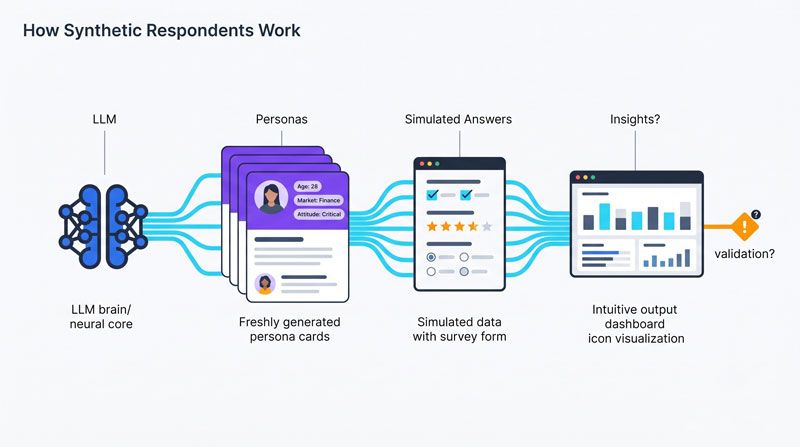 How synthetic respondents turn LLM personas into simulated survey data.[/caption]
What Are Synthetic Respondents and How Do They Work?
Synthetic respondents are built by prompting a large language model such as GPT-4, Claude, or Gemini to adopt a detailed consumer persona and then answer research questions in character. A vendor might generate 500 "urban Indian mothers aged 28–40" or 1,000 "US Gen Z sneaker buyers," each with assigned demographics, attitudes, and purchase histories, then run an entire questionnaire against them.
From Persona Simulation to Digital Twins
The more ambitious version of this idea is the digital twin: a synthetic profile calibrated on a real individual's past survey responses, designed to predict how that specific person would answer new questions. Digital twins sit at the sophisticated end of a spectrum that ranges from simple persona simulation to statistically augmented respondent panels.
The technical foundation matters because it defines the limits. An LLM does not know your target consumer; it predicts plausible text based on patterns in its training data. When those patterns align with real consumer sentiment, synthetic respondents can look startlingly accurate. When they don't for new categories, local markets, or fast-moving cultural trends the model produces confident, fluent, and wrong answers. In machine learning terms, this is hallucination applied to consumer insight.
Key Takeaway: Synthetic respondents are pattern-prediction engines wearing consumer masks powerful where training data mirrors reality, unreliable where it does not.
The Hype: Why AI-Generated Survey Data Is Everywhere
The enthusiasm around AI-generated survey data is not irrational. Three genuine advantages explain why synthetic respondents attract so much investment and attention.
Speed, Cost, and Infinite Sample
First, speed: a synthetic study returns results in minutes, collapsing timelines that traditionally ran three to six weeks. Second, cost: there are no incentives, no panel fees, and no fieldwork management overhead. Third, reach: hard-to-find audiences rare disease patients, C-suite buyers, niche B2B roles can be "sampled" without the recruitment battles that make specialty audiences genuinely difficult to source.
Vendors have amplified these advantages into a replacement narrative: why pay for slow humans when silicon respondents never drop out, never speed through grids, and never fail attention checks? Industry surveys reflect the momentum Gartner has repeatedly projected that a majority of enterprises will use synthetic data in AI and analytics projects within the next few years, and insights teams are experimenting accordingly.
For research buyers, the hype creates a real dilemma. Ignore synthetic respondents entirely and you look behind the curve; adopt them uncritically and you may anchor major decisions to fabricated evidence. The resolution lies in understanding exactly what the evidence says.
[caption id="attachment_13527" align="alignleft" width="800"]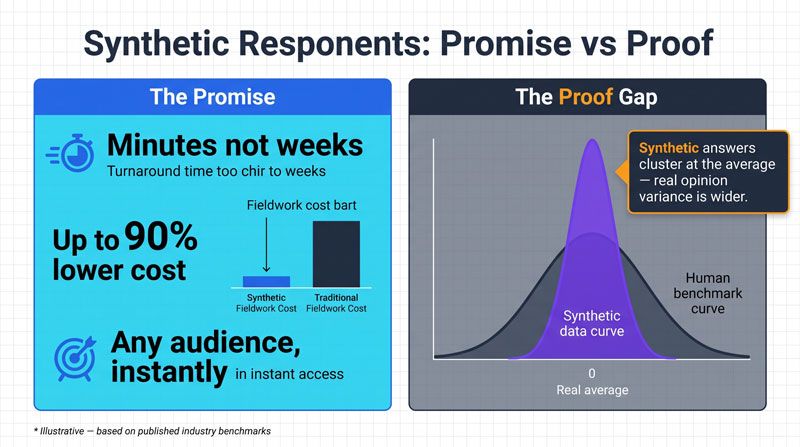 AI-generated survey data delivers speed - but synthetic respondents compress real opinion variance.[/caption]
Key Takeaway: The advantages of AI-generated survey data are real but they are advantages of logistics, not of truth.
The Reality: Where Synthetic Respondents Fall Short
Independent evaluations of synthetic respondents reveal a consistent set of failure modes, and each one is more dangerous because it is invisible in the output.
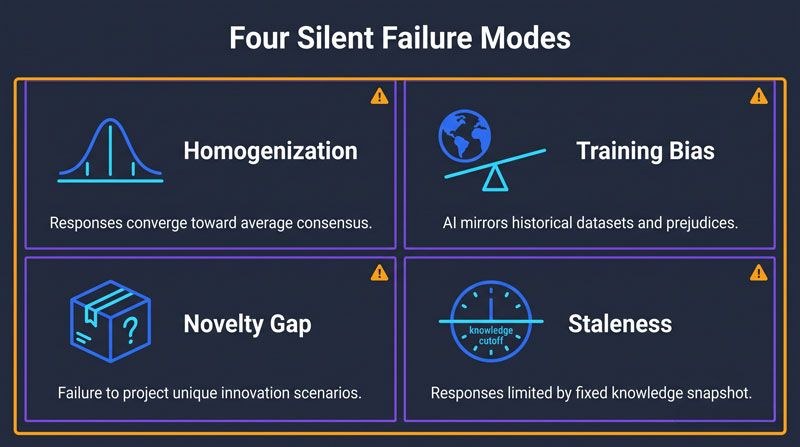
Four Documented Failure Modes
The first is homogenization. LLMs are trained to produce likely answers, so synthetic respondents cluster around the average opinion and understate variance. Real markets are won at the edges among passionate minorities, early adopters, and rejectors precisely the signal synthetic samples flatten. Academic comparisons of LLM responses against human survey benchmarks repeatedly find compressed distributions and inflated consensus.
The second is training data bias. Models learn disproportionately from English-language, Western, online text. Synthetic respondents representing consumers in tier-2 India, francophone Africa, or Southeast Asian rural markets inherit a distorted picture a serious problem for anyone running global fieldwork across genuinely diverse markets, where sample representativeness is the entire point.
The third is the novelty gap. A model cannot report authentic reactions to a product concept, package, or price point that did not exist in its training data. It will still answer fluently which is exactly the problem. For concept testing and innovation work, this is disqualifying as a standalone method.
The fourth is temporal staleness. Every model has a knowledge cutoff. Consumer sentiment shifts weekly; synthetic respondents are frozen at training time, blind to the price shock, viral moment, or competitor launch that changed everything last month.
Key Takeaway: Synthetic respondents fail silently producing fluent, confident data that can be systematically wrong in ways the output never discloses.
Where Synthetic Data in Market Research Genuinely Adds Value
Dismissing synthetic data in market research entirely would be as lazy as embracing it uncritically. Used with discipline, synthetic respondents have legitimate, valuable roles all of them upstream of decisions.
Smart Use Cases for Research Teams
Questionnaire pre-testing is the clearest win. Running a draft survey through synthetic respondents surfaces confusing wording, broken logic, and unbalanced scales before a single human sees it improving data quality in market research rather than threatening it. Hypothesis generation is a second strong case: synthetic personas can rapidly map the plausible opinion space, helping teams design sharper discussion guides for qualitative recruitment and real interviews.
Simulation and boosting form a third category. Teams use synthetic data to stress-test segmentation models, estimate likely base sizes, and rehearse analysis pipelines while fieldwork is still running. Some also explore synthetic augmentation of small human samples defensible only when the synthetic contribution is disclosed, quantified, and validated, in line with the transparency principles ESOMAR has emphasized in its guidance on AI in research.
Notice the pattern across every legitimate use case: synthetic respondents inform how you research; human respondents determine what is true. The tool prepares the study; it does not replace the evidence.
Key Takeaway: Synthetic data in market research earns its keep upstream in design, piloting, and simulation never as the final word.
Best Practices for Evaluating Synthetic Respondents
Adopting synthetic respondents responsibly requires a written evaluation discipline, not vendor faith. These five practices protect your insight quality.
Five Strategies for Responsible Adoption
First, demand parallel validation. Before trusting any synthetic tool, run the same questionnaire against a matched human sample and quantify the divergence overall, and within key subgroups. If a vendor resists benchmarking, that is your answer.
Second, classify decisions by stakes. Write a policy that names where synthetic respondents are permitted (pre-tests, drafts, simulations) and where they are banned (pricing, launch decisions, claims support, regulated categories). Ambiguity is where bad data leaks into big decisions.
Third, interrogate provenance. Ask which base model powers the tool, what its knowledge cutoff is, how personas were calibrated, and which markets and languages were validated. Human respondents come with verified panel quality controls; synthetic ones deserve equivalent scrutiny.
Fourth, label everything. Any deliverable containing AI-generated survey data should say so explicitly, with the synthetic share quantified. Transparency is both an ethical obligation and a legal safeguard as disclosure norms tighten.
Fifth, re-validate on a schedule. Model updates silently change synthetic behavior. Treat every major version change as a new tool requiring fresh benchmarking against human respondents.
[caption id="attachment_13531" align="alignleft" width="800"]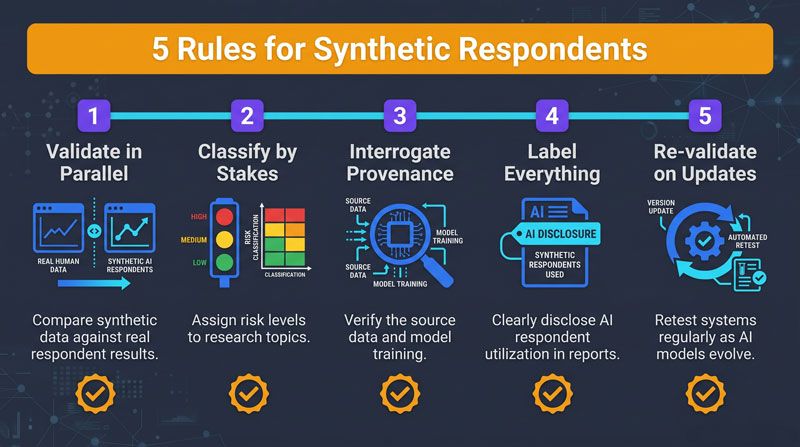 Five rules that let teams adopt synthetic respondents without gambling on data quality.[/caption]
The Future of Synthetic Respondents and Human Fieldwork
The realistic future is neither replacement nor rejection it is stratification. Synthetic respondents will become standard infrastructure for research design: piloting instruments, simulating outcomes, and pressure-testing hypotheses at near-zero cost. Human fieldwork will concentrate where it is irreplaceable: decision-grade measurement, emerging behavior, culturally specific insight, and any finding a stakeholder will bet money on.
Emerging Trends to Watch
Expect three developments. Hybrid designs synthetic pilots feeding validated human studies will become the default workflow for sophisticated buyers. Verification services will emerge as a discipline in their own right, with fieldwork specialists benchmarking synthetic outputs against fresh human data, including CATI research in markets where online panels under-represent the population. And disclosure standards from bodies like ESOMAR will harden from guidance into client-mandated contract terms.
At Research and Metric, we are building for that hybrid future: AI-accelerated design on the front end, rigorously verified human data at the decision point. Research buyers who master this division of labor will move faster and decide better. Follow our blog as this space evolves.
Key Takeaway: The future of synthetic respondents is hybrid AI for speed in design, humans for truth in decisions.
Conclusion: Synthetic Respondents Deserve Adoption, Not Faith
Synthetic respondents are neither the end of market research nor a passing gimmick they are a powerful design tool being oversold as an evidence source. The hype is grounded in real advantages of speed, cost, and reach. The reality is a set of silent failure modes homogenized opinion, training bias, hallucinated reactions to novelty, and stale worldviews that make unvalidated synthetic data a genuine business risk.
The organizations that win with synthetic respondents will be those that deploy them upstream, validate them relentlessly, and anchor every decision-critical finding in verified human evidence. At Research and Metric, our teams worldwide run exactly this hybrid model every day pairing AI-accelerated design with fieldwork built to the highest quality standards.
FAQ: Synthetic Respondents
What are synthetic respondents and why do they matter?
Synthetic respondents are AI-generated personas, built on large language models, that answer survey questions as if they were real consumers. They matter because they promise dramatic reductions in cost and turnaround time, forcing every research buyer to decide where AI-generated survey data is acceptable and where genuine human respondents remain essential.
Can synthetic respondents replace real survey respondents?
No current evidence shows synthetic respondents cannot fully replace real people. Studies find AI personas compress opinion diversity, drift toward average answers, and miss cultural and emerging behaviors absent from training data. Synthetic respondents work best as a complement for pre-testing and simulation, with human fieldwork validating any decision-critical findings.
What are the biggest risks of using synthetic respondents in market research?
The biggest risks of synthetic respondents are homogenized answers that understate real opinion variance, training data bias that misrepresents minority and non-Western consumers, hallucinated preferences for new products the model has never seen, and stale insights frozen at the model's knowledge cutoff. Each risk can silently distort business decisions if outputs are not validated against human data.
When should businesses use synthetic respondents?
Businesses should use synthetic respondents for low-stakes, exploratory work: pre-testing questionnaires, simulating survey logic, drafting discussion guides, generating hypotheses, and stress-testing segmentation before fieldwork. Synthetic respondents are not appropriate for pricing decisions, launch go/no-go calls, claims substantiation, or any study where regulatory, financial, or brand risk depends on accurate human data.
How can Research and Metric help validate synthetic respondents?
Research and Metric supports clients with synthetic respondents through hybrid validation: we run parallel human fieldwork worldwide to benchmark AI-generated survey data against verified respondents, using online panels, CATI, and qualitative recruitment. Learn more about our services — every decision-critical insight stays anchored in real human evidence.
Get new articles by email
Useful tips on surveys and research. One email when we post something new. Unsubscribe anytime.