On this page 7 sections
- What survey incidence rate means and how it is calculated
- Why cost rises steeply once survey incidence rate drops below 20%
- How length of interview and audience specificity interact with IR
- Incidence tests and feasibility checks before you commission
- What happens when real incidence comes in below the estimate
- Information to include in an RFQ for an accurate quote
- Frequently asked questions
When budgets are tight, it is frustrating to receive fieldwork quotes for the same sample size that differ widely. In most cases the biggest single driver is the survey incidence rate: the share of people entering your screener who actually qualify for the study. Combined with length of interview (LOI) and how specific your audience is, incidence determines how much effort, time and sample it takes to deliver each completed interview.
This guide is written for agency project managers and brand buyers who want to read quotes with confidence, spot where assumptions differ, and brief suppliers in a way that produces accurate, comparable prices.
What survey incidence rate means and how it is calculated
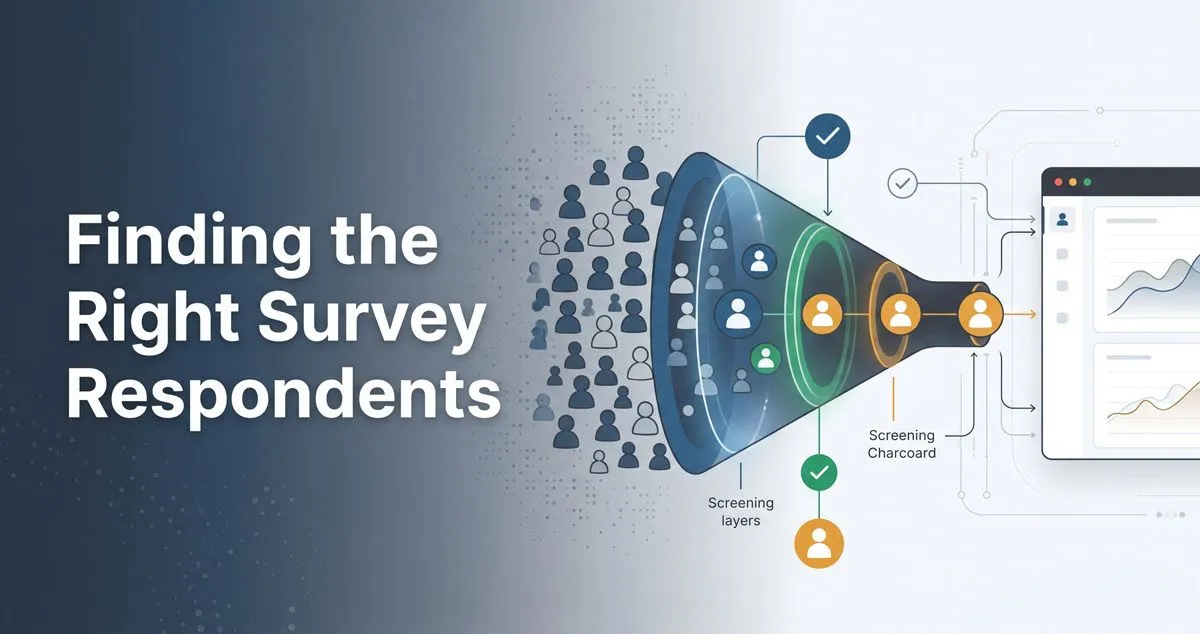
Incidence rate (IR) measures how common your target audience is within the population you are sampling from. It is calculated by dividing the number of respondents who qualify by the total number who complete the screener, which is those who qualify plus those screened out on your criteria.
A few points matter when you compare quotes:
- What counts as screened out. Incidence should reflect respondents who fail your qualifying criteria. People who drop out mid-survey, are removed for quality reasons or arrive after a quota has closed are usually tracked separately.
- The base population. Incidence among general population panellists is very different from incidence within a pre-profiled list of, say, IT decision makers. Always ask which base a supplier has assumed.
- Cumulative criteria. Every screening question narrows the funnel. Category users who are also main grocery shoppers, live in a certain region and have bought a specific brand recently will have a much lower combined incidence than any single criterion suggests.
Incidence is closely linked to feasibility, the question of whether the target number of completes can realistically be achieved in the timeline and markets you need.
Why cost rises steeply once survey incidence rate drops below 20%
The cost per interview (CPI) does not rise in a straight line as incidence falls. It accelerates. Once incidence drops below 20%, the large majority of people who start your screener will not qualify, yet each of them still has to be invited, incentivised for their time in some form, and managed.

Several things happen at the same time when incidence is low:
- More invitations per complete. The supplier has to send far more invitations to reach each qualified respondent, which consumes panel capacity.
- Panel fatigue. Repeatedly screening out the same people reduces their willingness to respond to future invitations, so panel owners price that cost in.
- More sources. Low incidence often means blending multiple panels or adding targeted recruitment, which adds coordination and quality control work.
- Longer field periods. Low incidence studies take longer to fill, which affects project management time and your deadlines.
For broader context on how panel providers think about CPI and incidence, see this overview of survey sample cost, CPI and incidence rate and this guide to market research cost factors.
How length of interview and audience specificity interact with IR
Incidence never acts alone. LOI and audience specificity combine with it to set the final price.
Length of interview
A longer survey requires a higher incentive, increases the chance of mid-survey drop-out and raises the risk of disengaged answering in later sections. On its own, a longer LOI raises CPI moderately. Combined with low incidence, the effect compounds: you are paying for many screen-outs and a more expensive interview for each person who qualifies.
Be realistic about LOI. Time the questionnaire with real people on the devices they will use, not with the team who wrote it. If a supplier quotes on a shorter LOI than the final script delivers, expect a revised price.
Audience specificity
Specialist audiences such as physicians, senior B2B decision makers or affluent consumers have low natural incidence and higher incentive expectations. They also tend to be reached through specialist panels, verified databases or direct recruitment rather than general panels. Our hard-to-reach and specialty audiences work is priced around these realities, including verification of professional credentials where needed.
Mode also matters. An audience that is difficult online may be more feasible through CATI or face-to-face methods, and the reverse can also be true. A good supplier will tell you when a different approach would serve the study better.
Incidence tests and feasibility checks before you commission
If your incidence estimate is a guess, the quote built on it is a guess too. There are practical ways to reduce that uncertainty before you commit budget.
- Use existing data. Previous waves, category penetration data or client sales data can provide a reasonable starting estimate. Share the source with your supplier.
- Request a feasibility check. Ask suppliers to confirm achievable completes by market, quota cell and timeline, and to state the incidence and LOI they have assumed.
- Run a soft launch. Fielding a small portion of the sample first shows the real incidence, drop-out points and median LOI. Adjustments to the screener or quotas can be made before full launch.
- Commission an incidence test. For very niche or new categories, a short standalone screener can establish incidence before the main study is designed and priced.
These steps cost a little time upfront but protect you from mid-field price changes and missed deadlines. For studies running across several markets, incidence can vary widely by country, which is where global fieldwork coordination helps keep assumptions consistent.
What happens when real incidence comes in below the estimate
It is common for live incidence to differ from the estimate. When it comes in lower, the supplier is spending more effort per complete than was priced. Most fieldwork contracts address this, and it is worth understanding the options before fieldwork begins.
- Re-quote. The supplier proposes a revised CPI based on actual incidence. Agree in advance at what point this is triggered.
- Relax criteria. Loosening a screening condition, such as widening a purchase window, can restore feasibility, provided it does not undermine the research objectives.
- Adjust quotas or sample size. Merging cells or reducing the target for the hardest quota can keep the project within budget.
- Extend the timeline. More time lets panels replenish and allows additional sources to be added.
- Change or add modes. Supplementing online sample with phone or targeted recruitment can reach respondents that panels miss.
The key is transparency. Your supplier should report incidence, drop-out and LOI daily during the early stages of field so that decisions are made early, not after the deadline has passed. Pressure to fill hard quotas should never come at the expense of data quality, so quality checks must stay in place whatever the incidence.
Information to include in an RFQ for an accurate quote
Comparable quotes come from complete briefs. When suppliers have to fill gaps with their own assumptions, prices diverge. Include the following in every request for quotation:

| RFQ item | Why it matters |
|---|---|
| Target audience and full screening criteria | Determines combined incidence and which sources are needed |
| Estimated incidence and its source | Lets suppliers check the estimate rather than invent one |
| Length of interview, timed on real respondents | Drives incentive levels and drop-out risk |
| Sample size and quota structure by market | Shows where the hardest cells are |
| Markets, languages and mode | Affects feasibility, translation and cost |
| Field dates and deadlines | Tight timelines can limit feasibility at low incidence |
| Deliverables needed | Programming, hosting, coding, tables and weighting all affect scope |
| Quality requirements | Defines checks, removals and replacement policy |
Ask each supplier to state the incidence and LOI assumptions behind their price, and how they handle incidence variance. That makes quotes directly comparable. This article on market research pricing offers further background.
If you would like a transparent quote or a feasibility check on a current project, speak to an expert on our team. We will review your audience, incidence and LOI, and tell you plainly what is achievable.
Frequently asked questions
Is a low survey incidence rate a sign of a bad study design?
No. Many valuable studies target rare audiences. Low incidence simply needs to be planned for in budget, timeline and sourcing. Problems arise only when the estimate is unrealistic.
Should incidence include respondents removed for quality reasons?
Usually not. Incidence reflects who qualifies on your criteria. Quality removals, drop-outs and over-quota respondents are tracked separately, though all of them affect cost and should be reported.
How can I compare quotes that use different incidence assumptions?
Ask every supplier to price on the same incidence and LOI, then request their view on whether those assumptions are realistic. This separates pricing differences from assumption differences.
Get new articles by email
Useful tips on surveys and research. One email when we post something new. Unsubscribe anytime.