
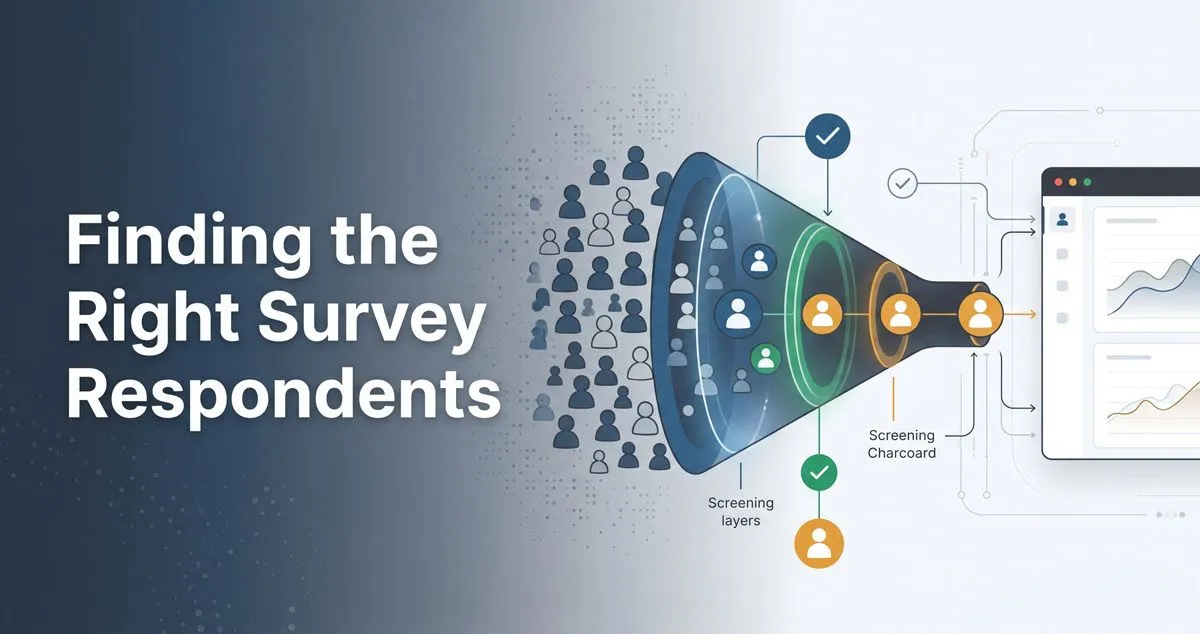
Every expensive research mistake has a quiet beginning: the wrong people answered the questions. Survey respondents are the raw material of every insight your organization acts on, and no amount of sophisticated analysis can repair a sample built on the wrong foundations.
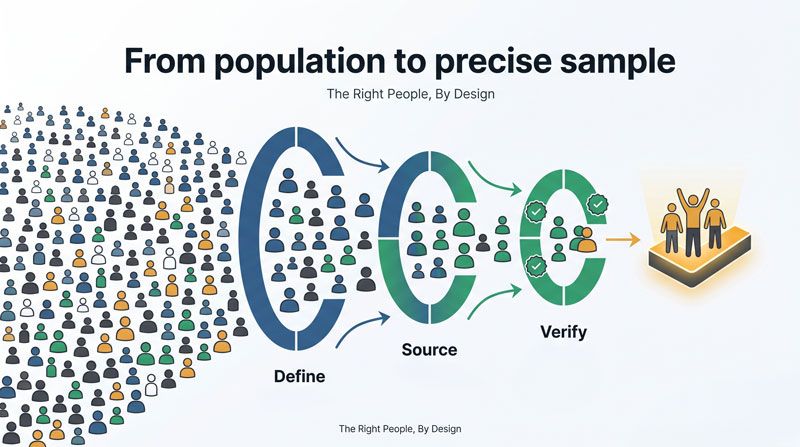
To find the right respondents for a survey, define your target population precisely, choose a sample source that actually contains those people, apply layered screening questions, verify identity and attention during fieldwork, and validate the final sample against known benchmarks before analysis begins.
The stakes keep rising. Statista values the global market research industry at more than 80 billion US dollars in annual revenue, yet a meaningful share of that spend delivers weak returns because the people providing answers were never the people the study needed. Fraudulent completes, professional survey takers, and loosely screened panels quietly distort findings long before a chart reaches a boardroom.
This guide walks through how research teams define who they need, where to find them, how to screen and verify them, and five practical strategies for better recruitment. At Research and Metric, our fieldwork teams apply these methods on online data collection projects worldwide, so the recommendations here come from daily practice rather than theory.
Why Survey Respondents Determine the Accuracy of Your Insights
Research quality follows one simple rule: an insight can never be more accurate than the sample behind it. When survey respondents genuinely match the population you want to understand, every downstream step, from weighting to segmentation to significance testing, works as designed. When they do not, the study produces confident numbers about the wrong people.
The danger is that a flawed sample rarely announces itself. Completion rates look healthy, quotas fill, and dashboards populate on schedule. The distortion only becomes visible later, when a launch underperforms its concept test or a tracker moves in ways the market clearly does not. By then the cost has multiplied: the study budget, the decision built on it, and the correction that follows.
Why a Representative Sample Beats a Bigger One
A representative sample of 800 people that mirrors the structure of the target population will outperform a convenient sample of 8,000 that does not, because a biased sample simply amplifies its own bias with impressive precision. Statisticians describe this through coverage error and selection bias: the people you can reach easily are systematically different from the people you need. Two concepts govern the problem. The sampling frame, meaning the list or source from which participants are drawn, decides who can possibly enter your study. The incidence rate, meaning the share of a population that qualifies, decides how hard the right people are to find.
Low incidence audiences, such as treatment specific patients or senior finance decision makers, are exactly where shortcuts do the most damage, and where the discipline of professional qualitative recruitment pays off even in quantitative work. Finding a hundred genuine survey respondents in a rare audience is a harder and more valuable task than finding ten thousand in a common one.
Key Takeaway: A smaller, well matched sample beats a large, convenient one on every measure of accuracy that matters.
Survey Sampling Starts With a Precise Target Population
Effective survey sampling begins long before an invitation goes out. The first step is defining the target population in operational terms. Not "IT decision makers" but "people who influenced or approved a cybersecurity purchase above a defined budget within the past 12 months." Vague definitions produce vague samples, because every downstream partner interprets them differently.
Once the definition exists, run a feasibility check: what is the expected incidence, which countries and languages are in scope, and does the timeline allow the audience to be reached honestly? Incidence directly drives cost per interview, so a realistic feasibility view protects both budget and quality. Quota sampling then protects structure, setting targets for age, gender, region, or firm size so the achieved sample reflects the population rather than whoever responds fastest.
Matching the Sample Source to Your Target Audience
No single source fits every audience. Online panels work well for general consumers at scale. Senior executives and rare professional roles often require verified business lists, referral chains, or telephone recruitment. Patients may sit in condition specific communities, while customer experience studies draw from client CRM lists. Sophisticated studies blend several sources and deduplicate across them so no participant enters twice.
Multi country projects add another layer, since panel depth, digital access, and response norms vary widely by market. Working with global fieldwork teams that maintain local sourcing relationships keeps a 20 country study consistent instead of 20 separate experiments.
Key Takeaway: Define the audience precisely first, then choose sources that can credibly contain those exact people.
Screening Questions That Reveal Genuine Survey Respondents
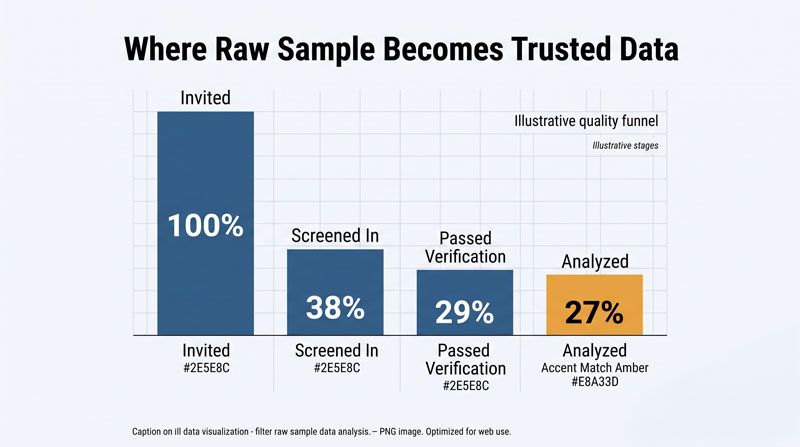
The screener is the gate where the right people are separated from everyone merely willing to click. Well designed screening questions qualify genuine survey respondents without ever revealing what the study wants to hear, and that second half is where most screeners fail.
Strong screeners layer criteria. Demographics alone are weak, because they are easy to guess and easy to fake. Behavioral criteria with recency, such as a purchase, a treatment, or a decision made within a defined window, are far harder to game and far closer to what the research actually needs.
Designing Screeners That Do Not Leak the Answer
Never signal the qualifying answer. If the question asks "Do you own a dog?" everyone who wants the incentive owns a dog. Instead, present the qualifying condition inside a longer list of plausible alternatives, and include red herrings such as fictional brands or non existent products; anyone selecting them exits immediately. Open ended screener questions add another layer, since a genuine category user can describe their last purchase in specific, natural language while a pretender writes something generic. Re asking one qualification later inside the main survey catches people who answered strategically at the gate.
Business audiences need extra care because job titles inflate easily. Screening on actual responsibilities, budget authority, and named tools produces cleaner professional samples than title matching, which is why specialty audience recruitment leans on responsibility based qualification rather than seniority labels.
Key Takeaway: Screen on layered behavior, hide the qualifying answers, and verify claims with open ends.
Protecting Data Quality: How to Detect Survey Fraud
Even a perfect screener faces a hostile environment. Bots, click farms, duplicate accounts, and professional survey takers now pose as legitimate survey respondents at scale, and AI written open ends have made low quality completes harder to spot by eye. Data quality is therefore no longer a cleaning step at the end of fieldwork; it is a defense system that runs throughout it.
Industry bodies have responded in kind. ESOMAR publishes duty of care and buyer guidance that make quality checks an explicit expectation, and research buyers increasingly ask suppliers to document exactly which protections run on every project.
Technology and Human Review Working Together
The technical layer includes digital fingerprinting to catch duplicate devices, geo and IP validation to confirm location claims, speed thresholds benchmarked against median completion time, attention checks embedded in grids, and trap questions with impossible answers. Open ended responses are scored for copied text, gibberish, and the flat, generic patterns typical of AI generated filler.
Technology flags, but people decide. Analysts should review a soft launch batch before full fieldwork, remove weak sources early, and re verify borderline cases. For high stakes B2B and healthcare work, voice verification through CATI research confirms that a claimed cardiologist or CFO is exactly that. We covered how to sequence these defenses in our guide to layered quality control, which pairs naturally with this article.
Key Takeaway: Treat fraud detection as a live system during fieldwork, not a cleanup task after it.
Five Proven Strategies for Better Respondent Recruitment
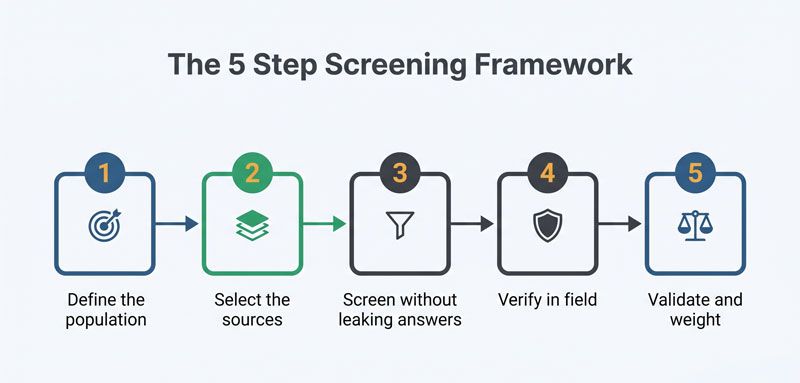
Respondent recruitment improves fastest when teams treat it as a designed process instead of a procurement task. Five habits consistently separate accurate studies from noisy ones.
First, write the screener and qualification criteria before selecting any sample source. Teams that choose the source first unconsciously bend the definition of the audience to fit whatever that source can deliver.
Second, blend sources and deduplicate across them. Two or three complementary sources with fingerprint level deduplication produce a healthier respondent pool than one large source stretched past its natural depth.
Third, soft launch about 10 percent of the sample and inspect it fully, including open ends, speed distribution, and quota balance, before releasing the rest. Every serious problem is cheaper to fix at 10 percent than at 100.
Fourth, respect the participant experience. Shorter, mobile friendly questionnaires with fair incentives keep engaged survey respondents reading carefully to the final page. Pew Research Center's methods work has long shown that questionnaire design and respondent burden directly shape answer quality, so the survey itself is part of recruitment.
Fifth, close the loop. Track quality removal rates by source across projects, build a preferred supplier view from that history, and feed the results into the next feasibility decision. At Research and Metric this scorecard review is a standing part of every project debrief.
[caption id="attachment_13600" align="alignnone" width="800"]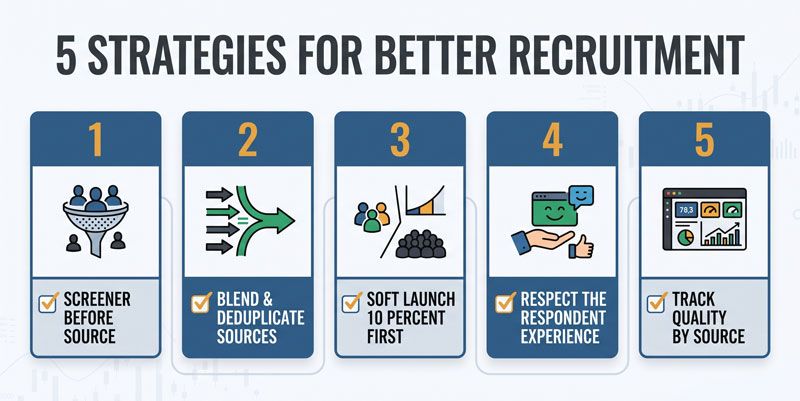 Five habits that separate accurate studies from noisy ones.[/caption]
The Future of Panel Quality and Respondent Engagement
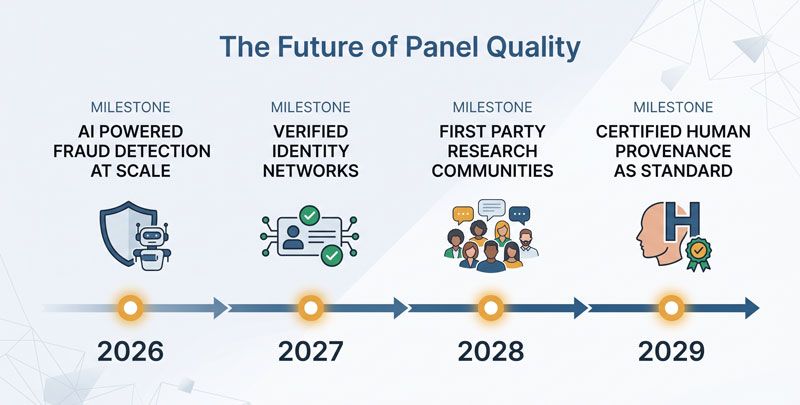
Panel quality is entering an arms race. The same AI that generates fraudulent open ends is being turned around to detect them, scoring text authenticity, click patterns, and device signals in real time. Verified identity networks are emerging so that one confirmed human can be recognized across suppliers without exposing personal data.
Emerging Trends in Respondent Engagement
Expect three shifts. Brands will build more first party research communities where profiled, consented members replace anonymous one time completes. Respondent engagement will become a tracked quality metric in its own right, since a respected, fairly rewarded participant is the cheapest fraud control that exists. And the debate around synthetic data will push the industry to certify what is verifiably human, making provenance a selling point rather than a footnote. Teams that invest in these foundations now will spend the next decade analyzing instead of apologizing. Our latest research insights track these developments as they mature.
Key Takeaway: Verified humans, engaged participants, and transparent provenance are the next competitive edge in sampling.
Conclusion: Accurate Insights Start With the Right People
Survey respondents decide the ceiling of your research quality before a single question is analyzed. Define the target population operationally, select sources that genuinely contain it, screen without leaking the answers, verify identity and attention while fieldwork runs, and keep score by source over time. None of these steps is glamorous, and together they are the difference between insight and expensive noise.
At Research and Metric, our fieldwork teams worldwide apply ESOMAR aligned, technology supported quality systems to every consumer, healthcare, and B2B study we run, so our clients present findings with confidence in exactly who stands behind them.
Ready to build your next study on a sample you can trust? Contact Research and Metric today to discover how our AI powered fieldwork solutions transform your data into actionable intelligence.
FAQ: Finding the Right People for Your Research
What makes survey respondents the right fit for a research project?
The right fit means a participant genuinely belongs to the population the study is designed to understand. They match the defined behavioral, demographic, or professional criteria, they were reached through a source that can credibly contain them, and they passed screening without being led to the qualifying answer. Fit also includes engagement: survey respondents who read carefully and answer honestly produce data worth analyzing.
How do survey respondents affect the accuracy of insights?
The impact is direct: findings can only be as accurate as the people behind them. If the sample under represents key groups or includes unqualified participants, every metric inherits that distortion, and weighting can only partially repair it. Studies built on well matched, verified samples produce estimates that hold up against real world benchmarks, while noisy samples generate confident numbers that mislead decision makers.
What screening methods identify high quality survey respondents?
Effective screening layers several techniques: precise qualification criteria written before fieldwork begins, screener questions that hide the desired answer among plausible alternatives, red herring options that trap careless clickers, and open ended questions that reveal genuine knowledge. In business studies, role and responsibility checks confirm professional claims. Re asking one qualifying question later in the survey exposes people who answered strategically the first time.
How can you detect fraudulent survey respondents?
Fraud detection combines technology and human review. Digital fingerprinting and IP validation catch duplicates and location mismatches, speed checks flag completes finished implausibly fast, and attention checks expose random clicking. Open ended answers are reviewed for copied, generic, or AI generated text. The strongest programs review a soft launch sample before full fieldwork, so problem sources are removed before they contaminate the dataset.
How can Research and Metric help you find survey respondents?
Research and Metric supports clients with specialist recruitment worldwide, combining vetted panel partnerships, CATI verification, and multi layer quality control. Our teams design screeners, manage feasibility, monitor fraud signals in real time, and deliver verified survey respondents for consumer, healthcare, and B2B studies. Learn more about our services.


