
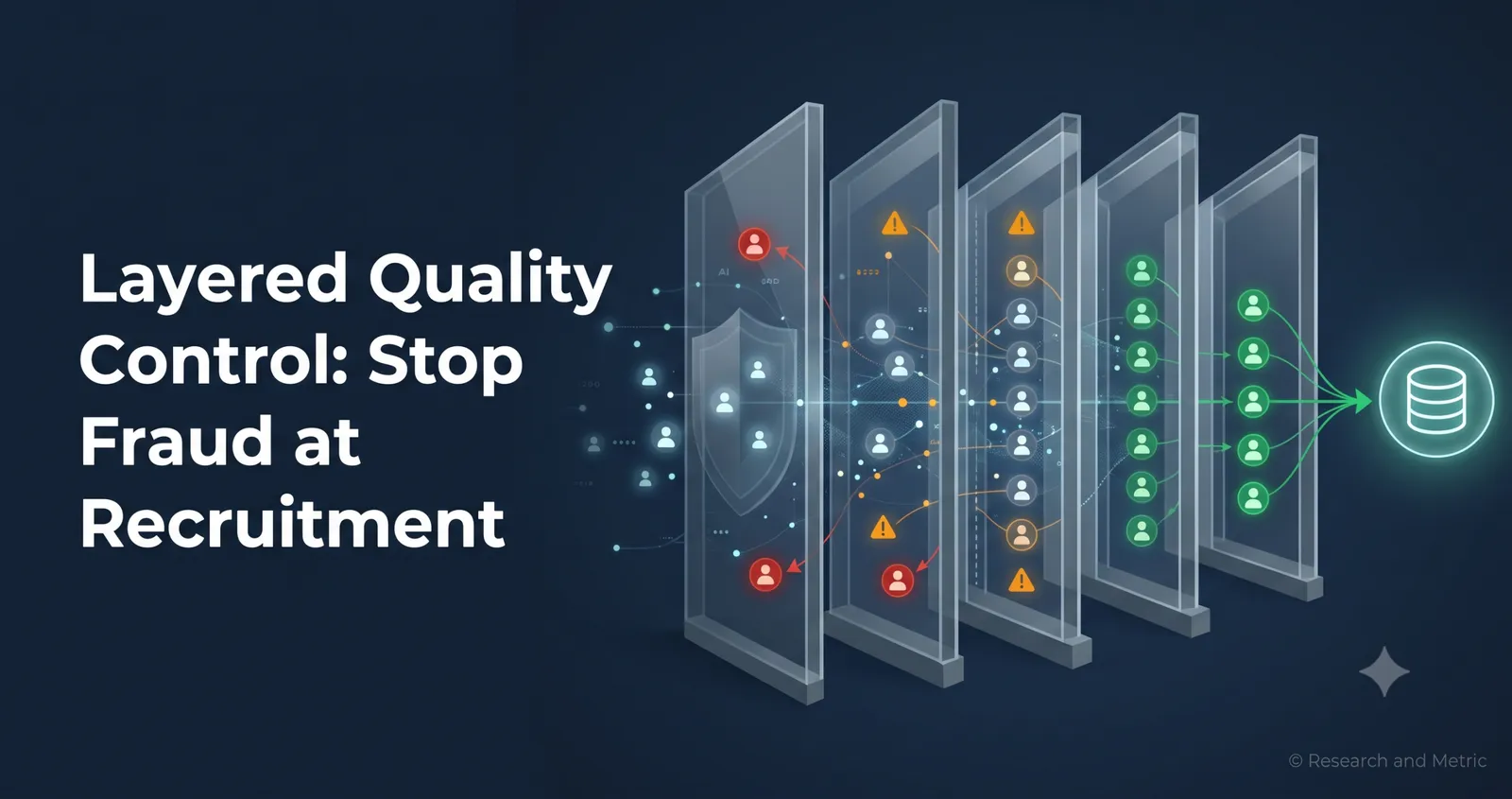
How much of your last dataset did you delete before analysis? For many research teams the honest answer is 15 to 30 percent, and every one of those discarded completes was recruited, incentivized, and reconciled before it was thrown away. Layered quality control takes the opposite position: the cheapest fraudulent respondent is the one who never enters your survey.
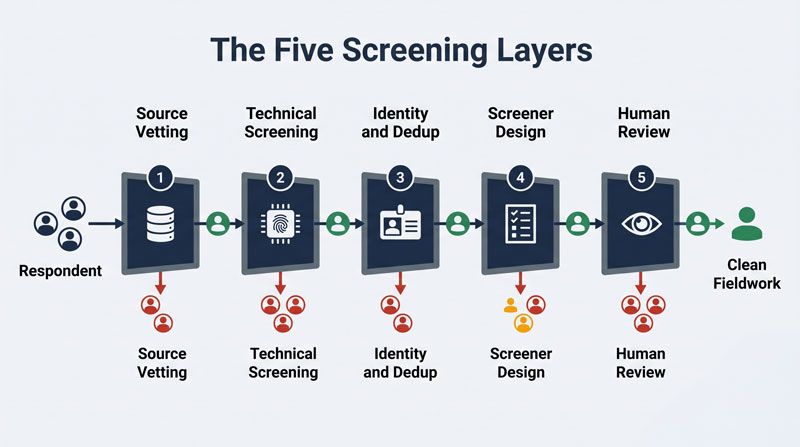
Layered quality control is a fraud prevention approach that stacks multiple independent checks at the recruitment stage of a survey: source vetting, device and location screening, identity verification, screener design traps, and human review. Fraudulent respondents are blocked before they enter fieldwork, instead of being removed later during data cleaning.
The financial case is hard to ignore. Fraud drained an estimated 350 million dollars from research industry incentive budgets in 2024, roughly 10 percent of everything the industry paid out to respondents that year. Meanwhile, generative AI now writes fluent open ends for bots, so the traditional cleaning playbook catches less with every quarter.
This guide breaks down the five screening layers specialist fieldwork teams stack at recruitment, what each layer catches, and how to adapt the stack across markets. At Research and Metric, these checks run as standard within our online data collection operations in the global markets where our teams field studies every week.
[caption id="attachment_13563" align="alignleft" width="800"]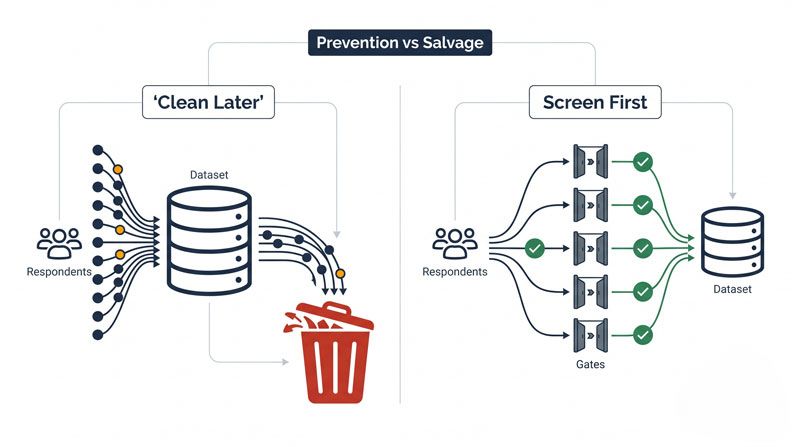 Screening at recruitment protects the sample; cleaning afterward only deletes rows.[/caption]
Why Layered Quality Control Beats Post-Field Data Cleaning
Post-field cleaning is a reactive control. By the time a suspicious complete is flagged, the incentive is paid, the sample is consumed, and project hours have gone into fielding an interview that will be deleted. Layered quality control applies the same scrutiny upstream, where turning away a bad entrant costs a fraction of a cent rather than the full price of a replaced complete.
Deletion also repairs less than it appears to. Removing a quarter of completes shrinks cells below readable sizes, breaks quota balance, and forces re-fielding that stretches timelines. Worse, the interviews that survive cleaning are not guaranteed clean, because sophisticated fraud is engineered to look like a careful respondent.
The Hidden Bias That Data Cleaning Leaves Behind
Modern fraud is built to pass traditional checks. Survey bots paired with language models produce AI-generated open ends that read fluently, answers cluster around plausible midpoints, and well-known attention checks get learned and shared in fraud communities. What slips through skews results toward bland consensus: inflated purchase intent, muted brand differentiation, and softened price sensitivity.
Once those responses are averaged into the data, no cleaning script recovers the truth, because a biased mean carries no error message. The risk is sharpest in qualitative recruitment, where a single fake participant can derail an eight-person group. Verification has to happen before the invitation goes out, not after the discussion guide is written.
The True Cost of Fraudulent Respondents
Every fraudulent complete is paid for three times. The first cost is the incentive that goes to someone who should never have qualified. The second is the replacement interview that must be recruited and fielded. The third is the delay, because removals are usually discovered late, after soft counts looked healthy and stakeholders were promised a delivery date.
The exposure is larger than most budgets assume. Commonly cited industry estimates put suspicious or fraudulent traffic at 15 to 30 percent of online survey entrants, which on a 1,000-complete study means several hundred attempts you do not want anywhere near your data. That is exactly the gap layered quality control is designed to close before fieldwork spend begins.
Where Survey Fraud Comes From in 2026
Today's threat is organized rather than opportunistic. Click farms run racks of physical handsets, bot networks route through residential proxies to look local, and professional respondents attempt dozens of surveys in a single day across panels. On top of that, cheap AI toolkits now answer screeners convincingly and produce plausible open ends on demand.
Incentive economics decide the targets. A fake general consumer earns a small reward, but a fake oncologist, CFO, or IT decision maker earns many times more per complete. That is why low-incidence specialty audiences attract the most determined fraud and justify the heaviest screening of all.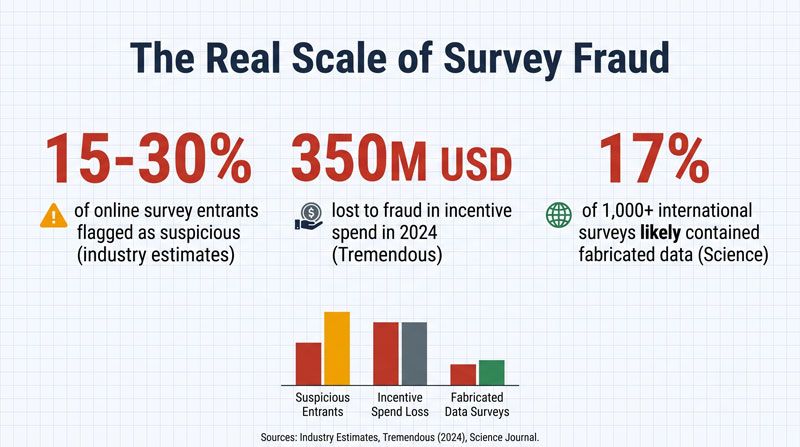
Inside Layered Quality Control: The Five Screening Layers
A layered quality control stack works like airport security. No single checkpoint is expected to catch everything, but very little gets through all five in a row. Each layer targets a different fraud behavior, and together they filter entrants before the first real question is asked.
Layer 1: Source vetting. Quality starts with knowing where sample originates. Supplier scorecards, blend management, and per-source quality histories keep weak or compromised panels out of the mix before invitations are even sent.
Layer 2: Technical screening. Device fingerprinting, IP geolocation, VPN and proxy detection, emulator checks, and bot challenges sit at the survey door. These signals catch machines and location spoofing that a questionnaire alone never would.
Layer 3: Identity and deduplication. Cross-supplier digital fingerprints stop the same person entering twice under different panel identities. Contact validation and credential checks add proof for professional audiences, where a claimed job title carries real analytical weight.
Layer 4: Screener design. Trap questions, internal consistency logic, open-ended qualifier items that bots answer badly, and knowledge-based questions only a genuine specialist passes all make lying expensive. Crucially, screeners should never telegraph the qualifying answer.
Layer 5: Human review. Soft launches with manual inspection of early completes, native-speaker review of open ends, and verification callbacks through CATI teams close what automation misses, especially on high-stakes audiences.
Why the Layers Must Overlap
Each layer has a blind spot. Fingerprinting cannot see a real human answering dishonestly, and screener traps rarely stop a careful professional respondent. Overlap is what closes those gaps, and machine learning fraud scoring increasingly ties the signals together, weighting dozens of inputs into a single admit, flag, or block decision in real time.
Survey Fraud Prevention Across Global Markets
Fraud is not evenly distributed across the world. A screening method published in Science flagged 17 percent of just over 1,000 international surveys as likely to contain significant fabricated data, with rates near 5 percent in wealthy western markets and far higher elsewhere. For multi-market programs, that variation is the whole story.
The patterns differ as well. High incentive values in dollar and euro markets invite geo-spoofing from outside, while other markets see more duplicate identities, incentive farming, or fabrication in offline modes. Open ends need native-language reviewers who can tell a translated bot from a real person writing casually.
Adapting the Screening Stack by Market
This is why layered quality control cannot be copy-pasted across borders. Incentive levels should be calibrated to motivate genuine participation without inviting industrial farming. Deduplication needs market-specific identity signals, and plausibility checks must reflect local reality, because a claimed profession or purchase pattern that is normal in one country is a red flag in another.
Our global fieldwork teams maintain market-level fraud pattern libraries for exactly this reason, pairing central screening technology with in-market QC reviewers across the regions where Research and Metric operates.
Best Practices for Fraud Detection at Recruitment
Principles only pay off when they become operating procedure. The five practices below turn recruitment-stage screening into a repeatable system rather than a heroic one-off effort.
Five Strategies for Stronger Recruitment Screening
First, vet and score every sample source continuously. Maintain quarterly supplier scorecards built on quality history rather than price alone, and retire weak sources before they contaminate a live study instead of after.
Second, stack independent technical checks. Combine device fingerprinting, geolocation, and bot challenges from separate providers where possible, because fraud operations optimize against single tools and rarely beat three unrelated ones at once.
Third, design screeners that are hard to game. Use reversed items, realistic low-incidence dummy options, and short open-ended qualifiers, and keep qualification criteria invisible so respondents cannot reverse-engineer the path in.
Fourth, soft-launch and audit before you scale. Release roughly 10 percent of sample, review those completes by hand, and open full fieldwork only once early data confirms the screening stack is holding.
Fifth, close the loop between cleaning and recruitment. Anything post-field checks still catch should update entry rules within days, so the same fraud pattern never gets in twice.
Together, these habits turn layered quality control from a proposal slide into daily practice. It is the operating model behind Research and Metric's fieldwork QC, where screening outcomes feed a continuous improvement cycle across projects and markets.
[caption id="attachment_13572" align="alignleft" width="800"]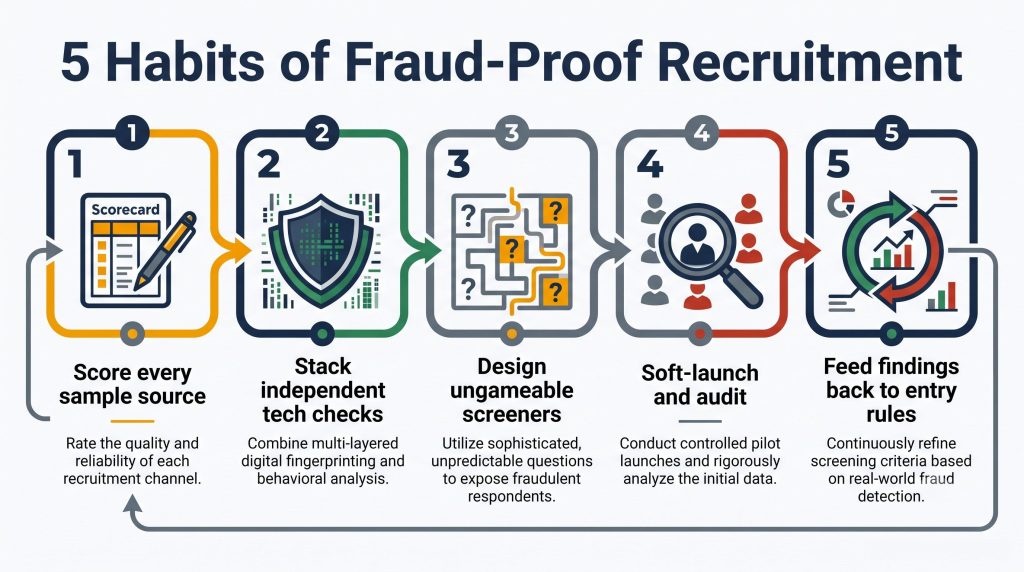 Five operating habits that keep layered quality control working project after project.[/caption]
The Future of Data Quality in Market Research
The next phase of data quality is an arms race between generative AI on both sides. Fraud rings already use language models to draft fluent open ends and coach screener answers, while quality platforms respond with machine learning fraud scoring that evaluates behavior, metadata, and text in real time.
Emerging Trends in Research Data Integrity
Three shifts stand out. Industry collaboration is formalizing, led by the Global Data Quality initiative, a coalition founded in 2023 by ESOMAR, the Insights Association, MRS, and partner bodies to build shared benchmarks, terminology, and multi-market measurement. Persistent verified respondent identity is gaining ground over per-survey anonymity. And research buyers have started auditing the screening stack itself during procurement, treating documented fraud prevention as a selection criterion.
The debate around synthetic respondents raises the stakes further, because provably human data is becoming a product claim in its own right. Fieldwork partners who can evidence their prevention infrastructure will win that conversation. You can explore more of our thinking on research quality on the Research and Metric blog.
Conclusion: Build Quality In, Not Clean It Out
Layered quality control turns data quality from a post-field salvage operation into a recruitment-stage guarantee. Source vetting, technical screening, identity checks, screener design, and human review each catch what the others miss, and together they keep budgets, timelines, and findings intact.
The alternative is familiar and expensive: paying incentives to fraudsters, deleting hard-won completes, and explaining slipped deadlines. Prevention is simply cheaper than salvage, and it is the only approach that protects representativeness rather than just row counts.
At Research and Metric, this screening stack runs as standard across fieldwork worldwide, supported by ESOMAR-aligned methodologies, in-market QC teams, and AI-assisted fraud scoring refined project after project.
Ready to stop paying for fraudulent completes? Contact Research and Metric today to discover how our AI-powered fieldwork solutions transform your data into actionable intelligence.
FAQ: Screening Out Survey Fraud
What is layered quality control and why does it matter?
Layered quality control is the practice of stacking several independent screening checks at the recruitment stage so fraudulent respondents never enter a study. It matters because prevention protects budgets, timelines, and data integrity at once. Once a fake complete sits in your dataset, the incentive is spent and the sample is burned, and deleting the record cannot fully repair the damage to representativeness.
How does layered quality control improve data quality in market research?
The impact of recruitment-stage screening shows up in three places. Cleaner datasets need fewer post-field deletions, so effective sample sizes and quotas hold. Findings become more stable because AI-assisted fraud, which often survives traditional cleaning, is blocked at the door. Finally, feasibility improves, since project teams stop over-sampling to compensate for expected losses and reconciliation time drops sharply.
What are the key trends in layered quality control for 2026?
Key trends include machine learning fraud scoring at the point of entry, cross-supplier duplicate detection through shared digital fingerprints, and tighter defenses against AI-generated open ends. Industry programs such as the Global Data Quality initiative are pushing shared benchmarks and terminology, while research buyers increasingly ask fieldwork partners to document their screening stack. Persistent verified respondent identity is emerging as the next frontier.
What ROI can businesses expect from layered quality control?
Businesses that leverage recruitment-stage screening typically recover the cost in three ways: lower incentive leakage to fraudsters, fewer re-fielding rounds to replace deleted completes, and faster delivery because reconciliation shrinks. On low-incidence B2B and healthcare studies, where each qualified complete is expensive, preventing even a modest share of fraud can outweigh the cost of the entire screening stack.
How can Research and Metric help with layered quality control?
Research and Metric supports clients with recruitment-stage screening built into every project: vetted sample sources, technical fraud checks, identity verification for specialty audiences, screener design consultation, and human review by in-market teams worldwide. Our specialists catch bad respondents before fieldwork begins, not after budgets are spent. Learn more about our services.


