
Introduction
Most fieldwork budgets do not break because of the easy interviews. They break on the last 5 percent of completes, the ones that depend on people who are genuinely hard to find. Specialty audiences sit at the center of that problem, because the most valuable commercial decisions almost always rest on insight from the people who are slowest and costliest to reach.
To reach these groups without inflating costs, recruit from validated, pre-profiled panels rather than open sourcing, run a feasibility study before fieldwork starts, and use multi-mode designs matched to each cohort. This lowers screen-out rates, cuts replacement interviews and keeps cost per completed interview predictable across healthcare, B2B and consumer samples.
The numbers explain the urgency. Gen Z alone is on track for roughly 2.7 trillion US dollars in spending growth over the coming years, according to NielsenIQ's Spend Z report. Brands cannot afford to guess what this cohort, or a prescribing physician, or a procurement lead actually thinks. The insight has to come from the real respondent, sourced cleanly.
This guide breaks down why niche cohorts cost what they do, and how to recruit them at scale without overspending. At Research and Metric, our teams run specialty audience fieldwork worldwide, so the tactics here come from live projects rather than theory.
[caption id="attachment_13468" align="alignnone" width="800"]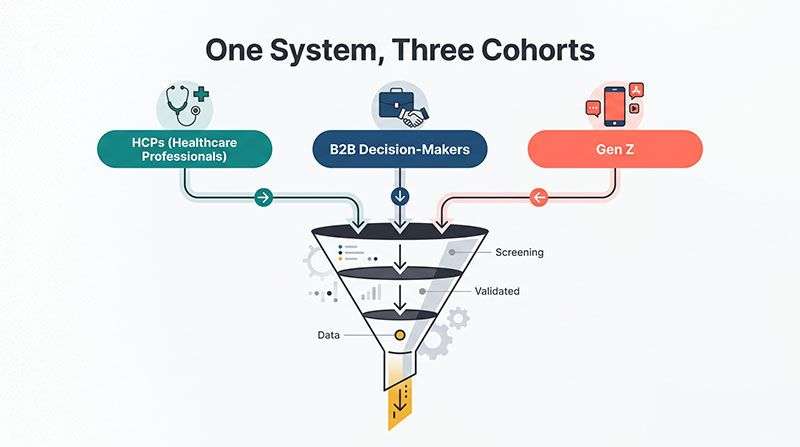 Cost drivers differ across HCP, B2B and Gen Z samples.[/caption]
What Specialty Audiences Really Are (And Why They Cost More)
Specialty audiences are respondent groups defined by criteria so narrow that only a small share of any population qualifies. Healthcare professionals, senior B2B decision-makers and Gen Z consumers are the three most common examples, and each is hard to reach for a different reason. Physicians are time-poor and tightly verified. Procurement and C-suite buyers are guarded and few in number. Younger consumers are abundant but fast-moving and easily lost to drop-off.
Why incidence drives the budget
The single biggest cost lever is incidence rate, the percentage of a sample that actually qualifies. When incidence is low, you pay to invite many people for every one completed interview. A general consumer study might see incidence above 60 percent. A study targeting a single medical specialty treating a rare condition can fall below 2 percent.
That gap is where budgets quietly inflate. Every screen-out still consumes panel goodwill, incentive exposure and project management time. The impact of low-incidence sampling is rarely the headline incentive cost, it is the volume of contacts needed to land each valid response.
Key Takeaway: Cost is driven less by who you pay and more by how many people you have to contact to find one qualified respondent.
Why HCP Recruitment Carries a Premium
HCP recruitment is the clearest example of how verification adds cost. A qualified physician is not just hard to find, they must be confirmed as genuinely practising, in the right specialty, seeing the right patient volume. Manual validation and credential checks are slow, and slow fieldwork is expensive fieldwork.
Verification, KOLs and the time barrier
Reaching healthcare professionals and key opinion leaders well means working through professional networks and verified opt-in communities rather than open panels. Time pressure on clinicians is the recurring barrier, so incentive design, scheduling flexibility and short, respectful instruments matter as much as the panel itself.
This is also where qualitative recruitment discipline pays off. A clean recruit, screened once and verified properly, removes the costly cycle of replacing respondents who fail validation after the interview. Done at scale, our healthcare fieldwork across multiple markets shows that the cost saving lives almost entirely in the screening stage, not the field stage.
Key Takeaway: With HCPs, money is saved or lost during verification, long before the interview happens.
Reaching Specialty Audiences in B2B and Gen Z Contexts
Reaching specialty audiences in B2B is a problem of scarcity, while in Gen Z it is a problem of attention. Both break single-channel recruitment, and both reward designs that meet the respondent where they already are. This is the second and final place this guide leans on the exact framing, because the contrast between the two cohorts is instructive.
B2B decision-makers: few, guarded, high value
Senior B2B decision-makers sit behind gatekeepers and rarely respond to generic outreach. Incidence is low because the relevant population is genuinely small, so reactive sourcing is slow and costly. Pre-profiled business panels, paired with CATI research for harder-to-reach seniority levels, shorten the path to a completed interview and keep cost per complete in check.
Gen Z: abundant but easily lost
Gen Z is the opposite shape. There are plenty of them, but attention is fragmented and drop-off is brutal on long or clunky surveys. Mobile-first design, short instruments and trusted recruitment sources are what protect completion rates. The prize is large: Deloitte's 2026 Global Gen Z and Millennial Survey shows just how sharply this group is reshaping consumer and workplace expectations, which is exactly why guessing about them is so risky.
[caption id="attachment_13469" align="alignnone" width="800"]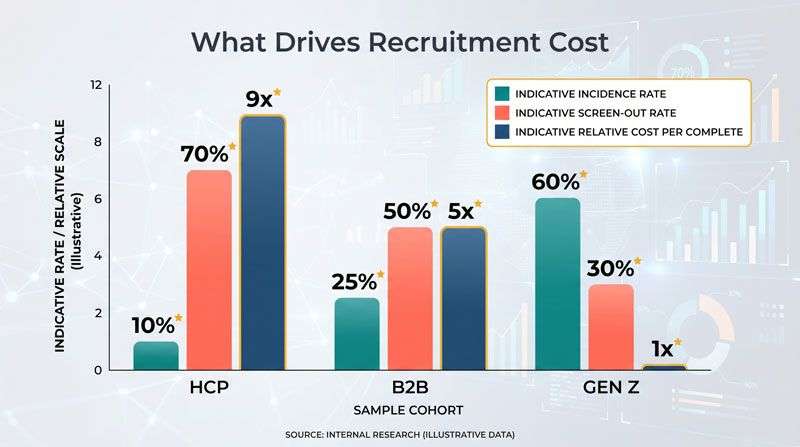 Cost drivers differ across HCP, B2B and Gen Z samples.[/caption]
Key Takeaway: B2B costs come from scarcity, Gen Z costs come from drop-off, and each needs a different recruitment design.
How Validated Panels and Feasibility Control Cost
The most reliable way to stop budgets inflating is to remove uncertainty before fieldwork begins. That means two things: sourcing from validated panels and running a proper feasibility study. Together they convert guesswork into a known cost per complete.
Feasibility first, field second
A feasibility study confirms real incidence, realistic timelines and achievable quotas before a single live interview. It is the cheapest hour you will spend on a project, because it prevents the most expensive mistake, committing to a sample that the market cannot actually supply at the assumed price. ESOMAR-aligned feasibility is built into how we scope niche work.
When recruitment runs through global fieldwork infrastructure with pre-profiled respondents, screen-out rates fall, replacement cycles shrink and the cost curve flattens. That predictability is the real product, not just the lower headline number.
Key Takeaway: Feasibility plus validated panels turns an unpredictable spend into a budgeted, defensible cost per complete.
5 Proven Ways to Reach Specialty Audiences Without Inflating Costs
The tactics below work across HCP, B2B and Gen Z projects. They are written as a system, not a menu, because they reinforce one another.
Five cost-control tactics that compound
- Start with feasibility. Confirm incidence, quota and timeline before fieldwork, so the budget reflects the market rather than an optimistic assumption. This one step prevents most overruns.
- Recruit from validated, pre-profiled panels instead of open sourcing. When respondents are already verified and profiled, screen-out rates drop and you stop paying for invitations that never qualify.
- Match the mode to the cohort. Use mobile-first online for Gen Z, CATI and CAPI for guarded B2B and HCP samples, and in-person work only where it genuinely adds value. Mode mismatches are a silent cost.
- Design incentives and instruments around respondent reality. Short surveys, fair incentives and respectful scheduling lift completion rates and reduce the replacement interviews that quietly double a budget.
- Use AI-assisted screening and fraud detection. Flagging duplicate, bot or misqualified respondents before they enter the field protects data quality and removes the cost of cleaning it out later.
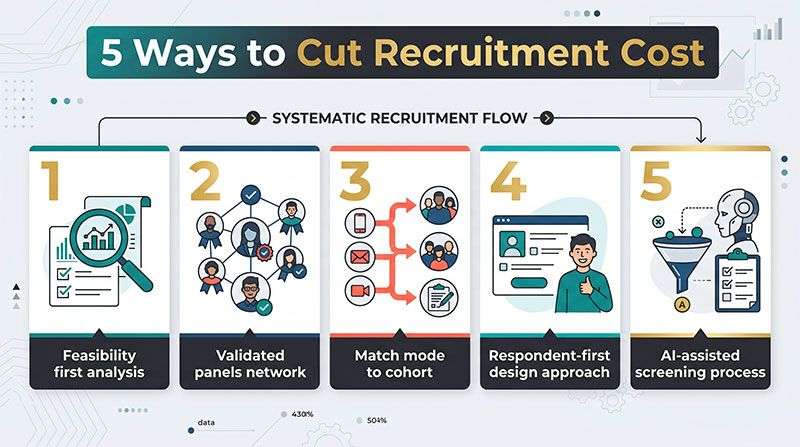 Five tactics to reach specialty audiences affordably.[/caption]
The Future of Niche Recruitment
The direction of travel is clear: less reactive sourcing, more pre-built and verified supply. As fraud detection and programmatic sampling mature, the gap between teams that plan recruitment and teams that scramble for it will widen.
Emerging trends in hard-to-reach sampling
Expect AI-assisted screening to become standard, mobile-first recruitment to dominate younger cohorts, and verified opt-in communities to replace open panels for healthcare and B2B work. Multi-market consistency will become a competitive edge, because brands increasingly want the same niche cohort measured the same way across regions. To see how this applies to your next study, contact Research and Metric.
Key Takeaway: The winners will treat recruitment as planned infrastructure, not a last-minute scramble.
Conclusion: Reaching Specialty Audiences Affordably
Specialty audiences will always cost more than general samples, but they do not have to break budgets. The premium comes from low incidence and strict verification, and both are controllable with the right preparation. Feasibility, validated panels, mode matching, respondent-first design and AI-assisted screening turn an unpredictable spend into a known, defensible cost per complete.
At Research and Metric, our teams worldwide recruit these hard-to-reach groups from pre-profiled communities, verify them properly and field them through ESOMAR-aligned methodology. That is how niche insight gets delivered at scale without runaway costs.
Ready to reach your hardest cohorts without inflating your budget? Contact Research and Metric today to discover how our AI-powered fieldwork solutions transform your data into actionable intelligence.
FAQ: Specialty Audiences
What are specialty audiences and why do they matter?
Specialty audiences are hard-to-reach respondent groups defined by narrow criteria, such as healthcare professionals, senior B2B decision-makers and Gen Z consumers. They matter because the highest-value commercial decisions depend on insight from exactly these people. Their low incidence and strict screening make them expensive to recruit, so getting the sampling approach right protects both data quality and budget.
How do specialty audiences impact research costs?
The impact comes from low incidence and high screen-out rates. When only a small share of any sample qualifies, you pay for many invitations to land one completed interview. Strict verification, premium incentives and longer field windows all add up. Costs rise sharply when these groups are sourced reactively rather than recruited from validated, pre-profiled panels.
What are the key trends in specialty audiences for 2026?
Key trends include mobile-first recruitment for younger cohorts, verified opt-in panels for healthcare and B2B, and AI-assisted screening that flags fraud before it reaches the field. Multi-mode designs that blend online, CATI and in-person work are replacing single-channel approaches. Teams are also investing earlier in feasibility so budgets reflect real incidence from day one.
What ROI can businesses expect from reaching specialty audiences well?
Businesses that recruit these groups efficiently see faster fielding, fewer replacement interviews and cleaner data, which shortens the path to decision-ready insight. The return shows up as lower cost per completed interview, reduced project overruns and higher confidence in findings. For high-stakes launches, that reliability is often worth more than the recruitment savings themselves.
How can Research and Metric help with specialty audiences?
Research and Metric supports clients with validated panels, manual verification and multi-mode fieldwork worldwide. Niche cohorts are sourced from pre-profiled communities rather than open recruitment, which controls cost and protects quality. Feasibility, screening and incentive design are handled by specialists. Learn more about our services.


