

Introduction
Online panels are at a crossroads. According to ESOMAR's Global Market Research Report, industry-wide survey completion rates have dropped by nearly 30% over the past decade yet the demand for fast, high-quality respondent data has never been higher. The tension between these two realities is reshaping how research firms design, recruit, and manage their panels.
The challenge runs deeper than completion rates. Online panels are increasingly competing for attention in a world of infinite digital distractions. Respondents who once answered surveys out of curiosity or civic obligation now expect relevance, fairness, and in many cases genuine value in return. Without meeting these expectations, even the most carefully recruited panel will underperform, producing skewed, low-quality data that undermines every research investment downstream.
In this guide, we explore how the future of online panels is being built on stronger respondent relationships, smarter technology, and a reimagined understanding of engagement. From AI-driven personalization to gamification and mobile-first design, we cover the strategies leading research organizations including our market research team at Research and Metric are already deploying to stay ahead.
[caption id="attachment_12257" align="alignleft" width="1024"] The Online Panels Ecosystem – The Future of Online Panels and Respondent Engagement 2026[/caption]
Online Panels Today: Why Respondent Engagement Is the Central Challenge
Online panels have powered market research for more than two decades, providing a scalable, cost-effective mechanism for reaching defined audiences at speed. But the model that worked in 2010 is straining under conditions that panel managers of that era could not have anticipated.
The Engagement Crisis Facing Modern Panel Research
Survey fatigue is now endemic. A study published by the Insights Association found that panelists who receive more than four survey invitations per month show a measurable decline in response quality not just response rates. Responses become shorter, less considered, and statistically less reliable. For researchers and clients who depend on high-quality data, this is not a marginal problem. It is a structural threat to the validity of findings.
Compounding this is the issue of panel fraud and low-quality respondents. As incentive-driven panel models have scaled, they have attracted participants whose primary motivation is reward collection rather than genuine contribution. Without rigorous quality controls embedded into online panels from the recruitment stage onward, data contamination becomes an ever-present risk.
Research and Metric's consumer research services address these challenges directly through layered quality assurance frameworks that include digital fingerprinting, attention checks, and response consistency scoring applied in real time.
Key Takeaway: The central challenge for online panels in 2026 is not scale it is sustaining genuine, high-quality respondent engagement across the full panel lifecycle.
How AI and Automation Are Transforming Online Panels in 2026
Artificial intelligence is not simply an add-on to existing panel infrastructure it is progressively becoming the engine that drives every element of respondent engagement, from first invitation to longitudinal tracking.
AI-Driven Personalization and Survey Matching
The most immediately impactful AI application in online panels is intelligent survey matching. Rather than broadcasting survey invitations across an entire panel, AI-powered systems analyze individual respondent profiles including past participation patterns, stated interests, demographic attributes, and behavioral signals to match each panelist with the surveys most likely to be relevant and engaging to them.
The results are significant. Platforms that have implemented AI-driven matching report completion rate improvements of 15–25% compared to broadcast invitation models, according to research cited by GreenBook's industry analysis. More importantly, matched respondents provide higher-quality data because they are genuinely qualified and interested in the subject matter.
Beyond matching, AI enables dynamic survey design adjusting question flow, language complexity, and even visual presentation in real time based on respondent behavior. A panelist who hesitates on a particular question type may be routed to a reformulated version. One who completes sections quickly may receive deeper follow-up probes. This kind of adaptive surveying was theoretically possible before AI; practically, it required human intervention and was rarely deployed at scale.
Research and Metric integrates AI-driven matching and adaptive design into its data collection platforms across all panel projects.
[caption id="attachment_12258" align="alignleft" width="1024"]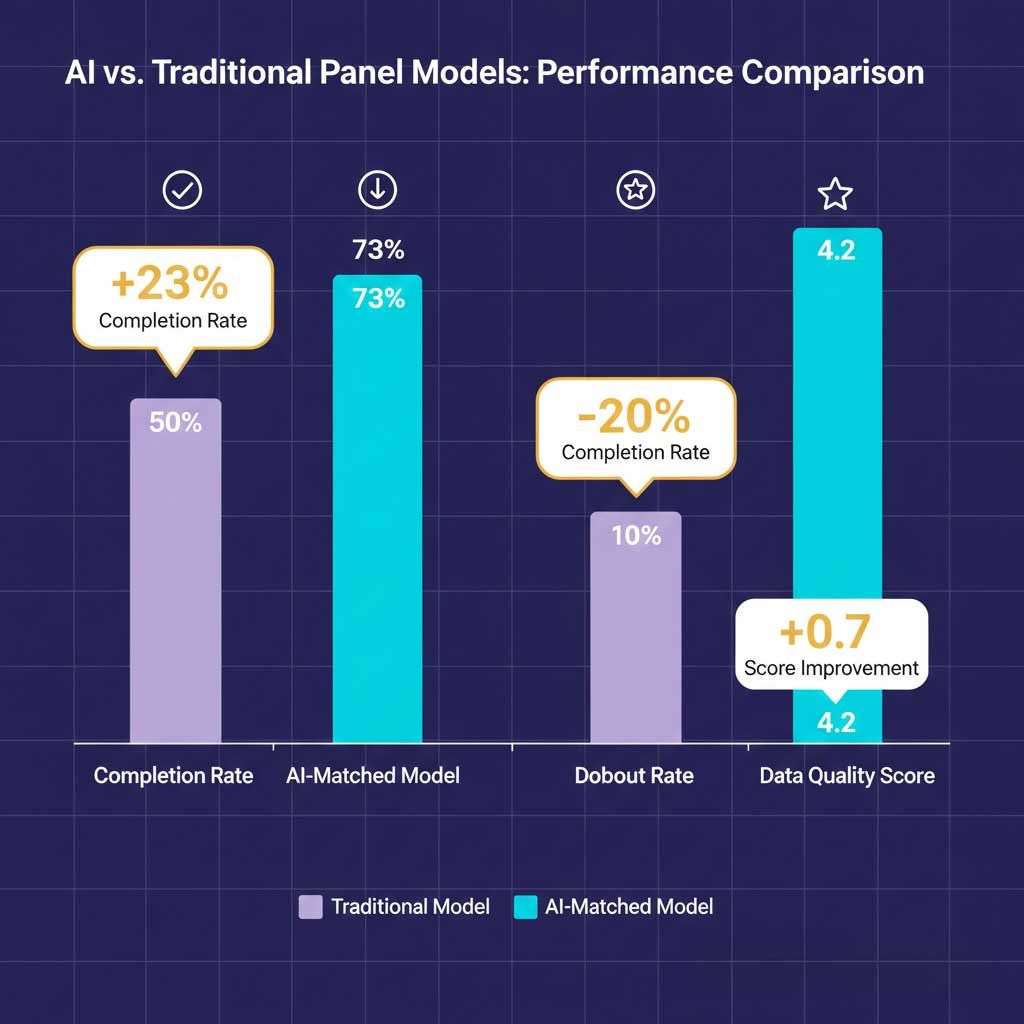 AI-driven personalization in online panels delivers measurable improvements in completion rates and data quality compared to traditional broadcast invitation models.[/caption]
Key Takeaway: AI personalization is the single highest-impact lever available to panel managers seeking to improve both respondent engagement and data quality simultaneously.
Gamification, Incentive Design, and the Psychology of Panel Participation
Understanding why people participate in online panels and why they stop is as important as any technological solution. Respondent engagement is fundamentally a behavioral and psychological challenge, and the most effective strategies are grounded in what we know about human motivation.
Designing Incentives That Drive Lasting Respondent Engagement
Traditional incentive models points redeemable for gift cards, cash sweepstakes entries remain effective but are increasingly insufficient on their own. The most engaged panels today layer intrinsic motivators alongside extrinsic rewards. Intrinsic motivators include a sense of impact (knowing that one's opinions influence real decisions), intellectual stimulation (surveys that feel meaningful rather than tedious), and community belonging (being part of a recognized group of contributors).
Gamification addresses both dimensions simultaneously. Well-designed gamification in online panels is not about trivializing the research process it is about applying game mechanics (progress indicators, achievement badges, streak rewards, leaderboards) to create a sense of momentum and recognition that sustains participation over time. Notably, gamification works particularly well in younger demographic segments and in longitudinal panel studies where maintaining engagement over weeks or months is essential.
Regional implementation matters too. Online panels operating across EU, UK, and APAC markets face distinct cultural attitudes toward incentives and participation. What constitutes a motivating reward in Germany may differ significantly from what drives engagement in South Korea or Australia. Global qualitative research methodologies must account for these nuances in incentive design.
[caption id="attachment_12261" align="alignleft" width="1024"]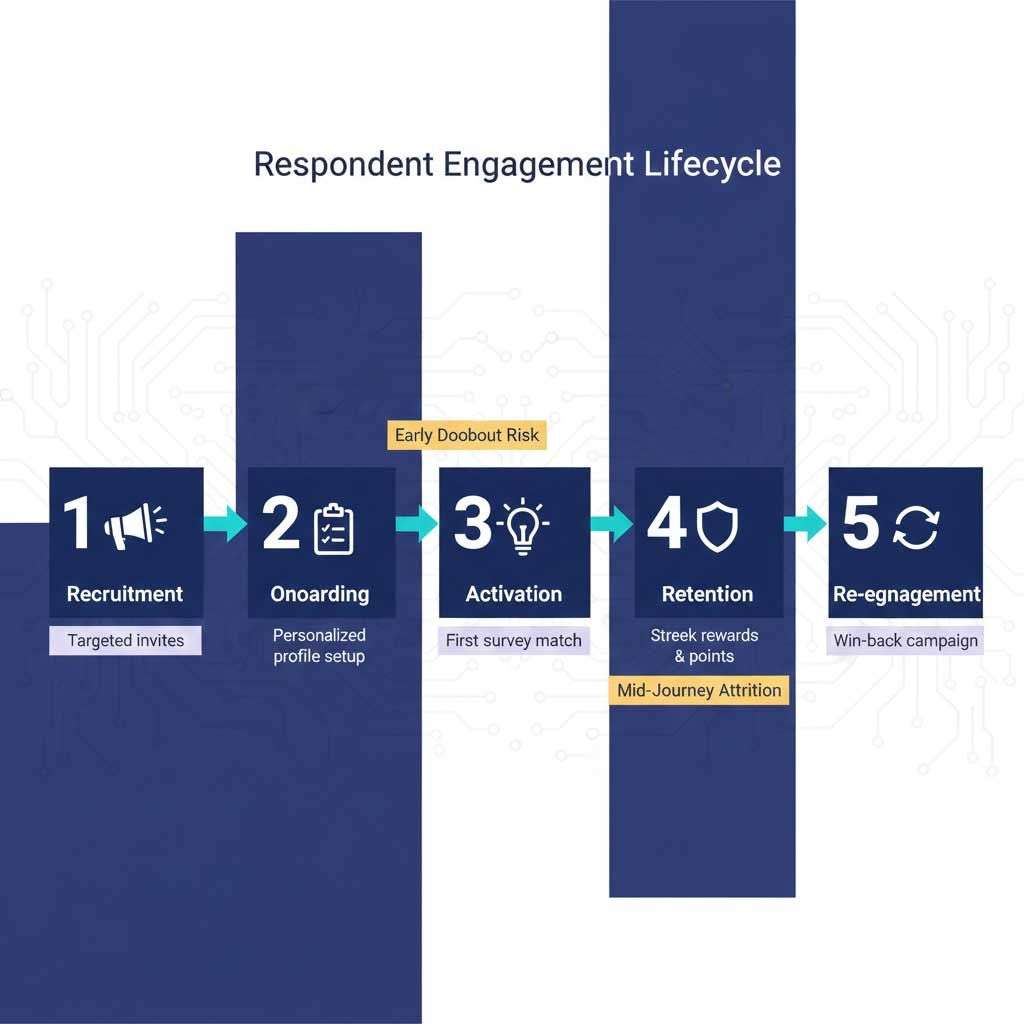 5 Strategies for Online Panel Respondent Engagement 2026 – Research and Metric[/caption]
Key Takeaway: Sustainable respondent engagement in online panels requires blending extrinsic incentive design with intrinsic motivators and calibrating both to the cultural context of each target market.
Mobile-First Design and the New Respondent Experience
More than 70% of survey responses in consumer-facing online panels are now submitted via mobile devices, according to data from Statista's digital research reports. Yet a substantial proportion of surveys deployed on legacy panel platforms remain designed for desktop screens creating friction that directly suppresses completion rates and data quality.
Building Online Panels for Mobile-Native Respondents
Mobile-first survey design is not merely a matter of responsive layout. It encompasses question format selection (favoring swipe interactions, image-based scales, and tap-friendly response options over complex grid questions), session length management (mobile respondents show significantly higher dropout rates on surveys exceeding 12 minutes), and notification design (push notifications substantially outperform email invitations for mobile-native panelists).
The shift to mobile also intersects with the rise of passive data collection. Modern online panels increasingly combine active survey participation with consented passive data streams location signals, app usage patterns, purchase behavior captured through integrated loyalty platforms. This enriches the research value of each panelist without adding survey burden, addressing the fatigue problem from a different angle entirely.
For global panel operations, mobile-first design is non-negotiable in APAC markets where smartphone internet penetration exceeds desktop penetration in many countries. Research and Metric's panel recruitment and deployment processes are built on mobile-first principles across all market regions.
Key Takeaway: Panel managers who have not fully migrated to mobile-first design are structurally disadvantaging their online panels in both completion rate and data quality performance.
Five Proven Strategies for Improving Respondent Engagement in Online Panels
The following strategies represent a synthesis of best practices observed across high-performing online panels globally in 2026. Each addresses a distinct dimension of the engagement challenge.
Strategies That Strengthen Online Panel Performance
First, implement intelligent panel segmentation from the outset. Rather than managing all panelists under a single engagement model, segment your panel by participation history, topic affinity, device preference, and demographic cohort. Each segment can then receive a customized communication cadence, incentive structure, and survey matching logic. Segmentation consistently outperforms one-size-fits-all panel management in both retention rates and data quality metrics.
Second, redesign your onboarding experience. The first 30 days of a panelist's membership are disproportionately predictive of long-term retention. High-performing online panels invest significantly in onboarding: welcome surveys that establish topic preferences, progressive profiling that builds respondent profiles gradually without overwhelming new members, and early participation prompts that create habitual engagement before dropout risk peaks.
Third, build a transparent value exchange. Respondents who understand how their data is used, what influence their participation has, and how their compensation compares to the value they provide are more engaged and more loyal. Regular feedback loops sharing study outcomes with panelists, publishing research summaries, acknowledging contribution milestones dramatically strengthen the perceived fairness of the panel relationship.
Fourth, deploy real-time quality monitoring. AI-powered quality scoring applied during live survey sessions enables immediate intervention: flagging speeder responses, detecting straight-lining patterns, and routing suspected low-quality respondents to validation questions before their responses contaminate the dataset. This protects data quality without retroactive exclusions that increase cost and timeline.
Fifth, establish a structured re-engagement program for lapsed panelists. Industry data suggests that 20–30% of lapsed panelists can be reactivated through well-timed, personalized re-engagement campaigns that acknowledge their absence, offer a compelling return incentive, and reduce the friction of re-entering the panel experience.
Research and Metric incorporates all five strategies into its panel recruitment and management frameworks for clients across industries.
[caption id="attachment_12267" align="alignleft" width="820"]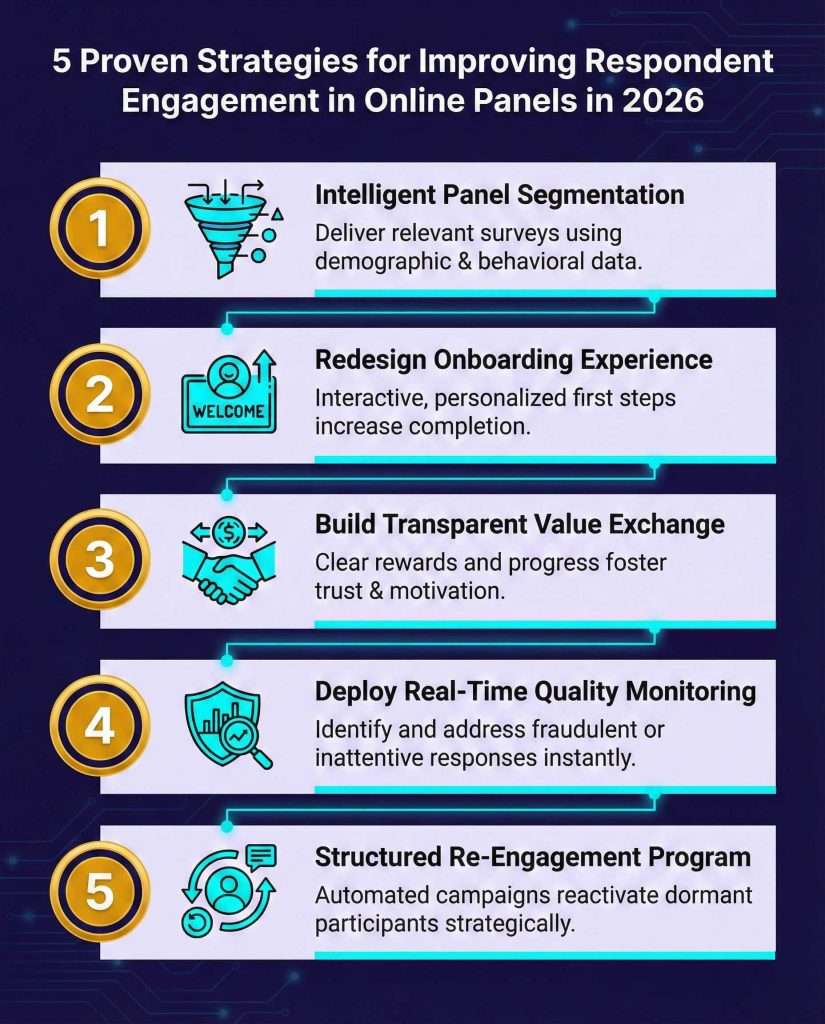 The respondent engagement lifecycle in online panels spans five stages from initial recruitment through reactivation each requiring distinct strategies to sustain participation quality.[/caption]
The Future of Online Panels: What Leading Research Organizations Are Preparing For
The next five years will bring changes to online panels that are as significant as the shift from telephone to online research that defined the early 2000s. Several emerging developments deserve close attention from panel managers and research directors in 2026.
Emerging Trends Reshaping Online Panels Beyond 2026
Synthetic data augmentation is one of the most discussed and most contested frontiers. AI-generated synthetic respondents, trained on real panel data, can expand sample sizes and fill demographic gaps that organic recruitment cannot address quickly enough. Used responsibly and transparently, synthetic augmentation has legitimate applications in feasibility modeling and questionnaire testing. Its role in primary data collection remains an active ethical and methodological debate that the research industry must navigate carefully.
Community-based panels persistent online communities rather than transactional sample pools are gaining share as clients seek deeper longitudinal relationships with their target audiences. These models trade the speed of traditional online panels for richer, more textured qualitative depth, and are particularly well-suited to brand tracker studies, customer experience research, and innovation co-creation projects.
Finally, privacy regulation GDPR in Europe, evolving frameworks in APAC and North America will continue to reshape how online panels are recruited, consented, and managed. Panels built on first-party, fully consented data with transparent purpose specification will be the only sustainable model in a tightening regulatory environment. Explore Research and Metric's global research capabilities to understand how we are building for this future.
[caption id="attachment_12265" align="alignleft" width="1000"]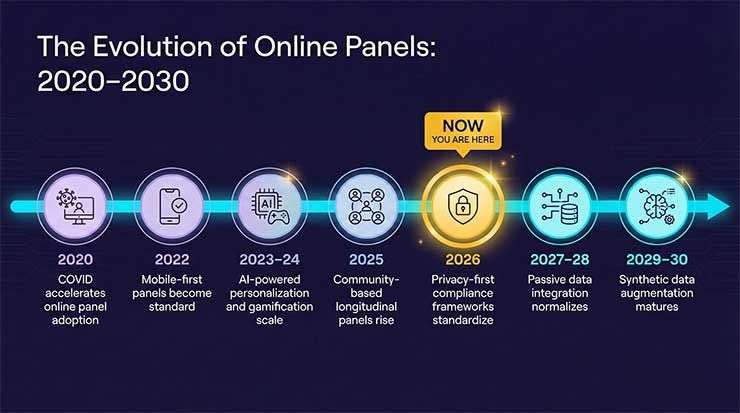 The future of online panels is being shaped by AI personalization, community-based models, and privacy-first data practices with 2026 marking a key compliance inflection point.[/caption]
Key Takeaway: The future of online panels belongs to organizations that invest now in first-party data relationships, AI-driven personalization, and community-based engagement models.
Conclusion: Online Panels Are Only as Strong as the Engagement Behind Them
Online panels remain the backbone of quantitative market research but the passive, transactional panel model that dominated the industry for two decades is no longer sufficient. As respondent expectations rise, attention windows shrink, and data quality requirements intensify, the organizations that thrive in 2026 and beyond will be those that treat panel management as a continuous, relationship-based discipline rather than a logistical function.
The strategies covered in this guide AI-driven personalization, gamification, mobile-first design, intelligent segmentation, and proactive re-engagement are not future aspirations. They are practices that leading research organizations are deploying today, with measurable results in both respondent engagement and downstream data quality.
Research and Metric has built its panel capabilities around these principles, combining global reach with rigorous quality frameworks to deliver the reliable, representative data that critical business decisions require.
Ready to transform the quality and reliability of your panel research? Contact Research and Metric today to discover how our AI-powered research solutions can transform your data into actionable intelligence.
FAQ: Online Panels
What are online panels and why do they matter for market research in 2026?
Online panels are pre-recruited groups of individuals who have consented to participate in research studies on an ongoing basis. In 2026, they matter more than ever because they provide researchers with rapid, cost-effective access to defined target audiences, enabling quantitative and qualitative studies that would be prohibitively slow or expensive using ad hoc recruitment. The quality of online panels directly determines the quality of the insights produced.
How do online panels affect data quality in market research?
Online panels affect data quality through the characteristics of the respondents they contain and the engagement levels they sustain. Well-managed online panels with rigorous recruitment standards, active quality monitoring, and strong respondent engagement consistently produce more reliable, representative data than lower-quality alternatives. Panel composition, response rate, and attentiveness all contribute to the statistical validity of research findings.
What are the key trends in online panels and respondent engagement for 2026?
The dominant trends shaping online panels in 2026 include AI-driven survey matching and personalization, mobile-first survey design, gamification as a retention tool, community-based longitudinal panels, and the integration of passive data collection alongside active survey participation. Privacy-compliant first-party panel recruitment is also a growing priority as global data regulation continues to tighten.
What ROI can businesses expect from investing in high-quality online panels?
Businesses that invest in high-quality online panels with strong respondent engagement see measurable returns through faster time-to-insight, lower data cleaning costs, reduced incidence of study restarts due to quality failure, and more confident decision-making backed by statistically reliable data. The cost of poor panel quality — in the form of flawed strategic decisions — typically far exceeds the investment required to build and maintain robust panels.
How can Research and Metric help improve our online panels and respondent engagement?
Research and Metric provides end-to-end online panel services including recruitment, quality management, AI-powered survey deployment, and longitudinal panel maintenance across 40+ global markets. Our teams combine deep methodological expertise with advanced technology to deliver panels that meet the highest standards of data quality and respondent engagement. Learn more about our services.


