

Introduction
Nearly 60% of enterprise research buyers now name documented quality and ethics compliance as a top-three vendor selection criterion, yet most fieldwork briefs still treat two very different frameworks as if they were one.
ISO 20252 vs ESOMAR is the single most misunderstood comparison in global research procurement. The difference is one of purpose: ISO 20252 is a certifiable quality-management standard that audits how research processes are run, while the ICC/ESOMAR Code is an ethical framework governing conduct toward participants and clients. One certifies your process; the other governs your principles.
That distinction matters more than ever. With the ICC/ESOMAR Code revised in June 2025 to address AI, synthetic data, and stronger duty-of-care obligations, and with ISO 20252 itself under revision by the ISO/TC 225 committee, the goalposts for global fieldwork standards have moved. Research buyers commissioning multi-market studies need to know exactly which framework covers what, and where the two overlap.
This guide breaks the ISO 20252 vs ESOMAR question into a practical, audit-ready checklist. At Research and Metric, our teams run ESOMAR-aligned fieldwork worldwide, so we built this from the documentation we actually maintain. By the end, you'll know how to evaluate a vendor, what to demand in a contract, and how to keep your own projects compliant.
[caption id="attachment_13160" align="aligncenter" width="1515"] How ISO 20252 vs ESOMAR combine process and principles into trusted fieldwork.[/caption]
Understanding ISO 20252 vs ESOMAR: Two Frameworks, Two Jobs
The ISO 20252 vs ESOMAR confusion starts because both appear on the same vendor credentials slide. But they answer different questions. ISO 20252:2019, Market, opinion and social research, including insights and data analytics, is published by the International Organization for Standardization and sets out how research is planned, carried out, supervised, and reported. It is auditable and certifiable by an accredited body.
What ISO 20252 Certification Actually Covers
ISO 20252:2019 was a substantial revision that absorbed the old ISO 26362 access-panel standard, meaning a single certificate now covers online and offline panels alike. Its structure centres on a core clause applicable to every service provider, supported by normative annexes for individual methodologies. Critically, ISO/TC 225, the technical committee maintaining the standard, designed it around documented, repeatable process control rather than ethics in the abstract. When a buyer asks for ISO 20252 certification, they are asking: can you prove your process is consistent and traceable?
This is the backbone of credible global fieldwork, and it's why enterprise procurement teams increasingly treat it as a baseline.
Key Takeaway: ISO 20252 vs ESOMAR begins with one truth, ISO certifies the process, not the principles.
The ESOMAR Side of ISO 20252 vs ESOMAR
While ISO governs process, the ESOMAR guidelines govern conduct. The ICC/ESOMAR International Code on Market, Opinion and Social Research and Data Analytics is the recognised global benchmark for ethical research, co-authored by the International Chamber of Commerce (ICC) and ESOMAR and endorsed by over 60 associations across more than 50 countries.
Why the 2025 Code Changed the Game
The 2025 revision, the fifth edition, approved in June 2025, is significant. It introduces explicit guidelines on AI and emerging technologies, mandates human oversight of automated research, enforces data minimisation, and strengthens the duty of care toward children, young people, and vulnerable individuals. It also places new responsibility on the client commissioning research to ensure their contractors comply. For anyone running online data collection at scale, that AI-governance clause is the headline change.
The Indian market felt this directly: in late 2025 the Market Research Society of India (MRSI) formally adopted the 2025 Code, aligning local self-regulation with the global standard.
[caption id="attachment_13161" align="aligncenter" width="1515"] Key differences in ISO 20252 vs ESOMAR: certification, enforcement, and the 2025 revision.[/caption]
Key Takeaway: In ISO 20252 vs ESOMAR, the Code is where ethics, AI governance, and participant protection live.
ISO 20252 vs ESOMAR: Where They Overlap and Diverge
The smartest way to read ISO 20252 vs ESOMAR is as complementary layers, not competitors. Both demand transparency, both require documented data handling, and both intersect heavily with data-protection law such as GDPR. Where they diverge is enforcement and scope.
Mapping the Two Across a Project Lifecycle
ISO 20252 enforcement runs through accredited third-party certification audits, valid for roughly three years. ESOMAR enforcement runs through disciplinary panels and is mandatory for members. Across a project lifecycle, from sampling through qualitative recruitment to reporting, ISO tells you the process must be documented and repeatable, while ESOMAR tells you the participant must be respected and the client honestly served. In multi-market work across the EU, UK, and APAC, our teams find the two frameworks reinforce each other: ISO documentation makes ESOMAR compliance demonstrable, and ESOMAR ethics give the ISO process its moral spine.
[caption id="attachment_13171" align="aligncenter" width="1515"]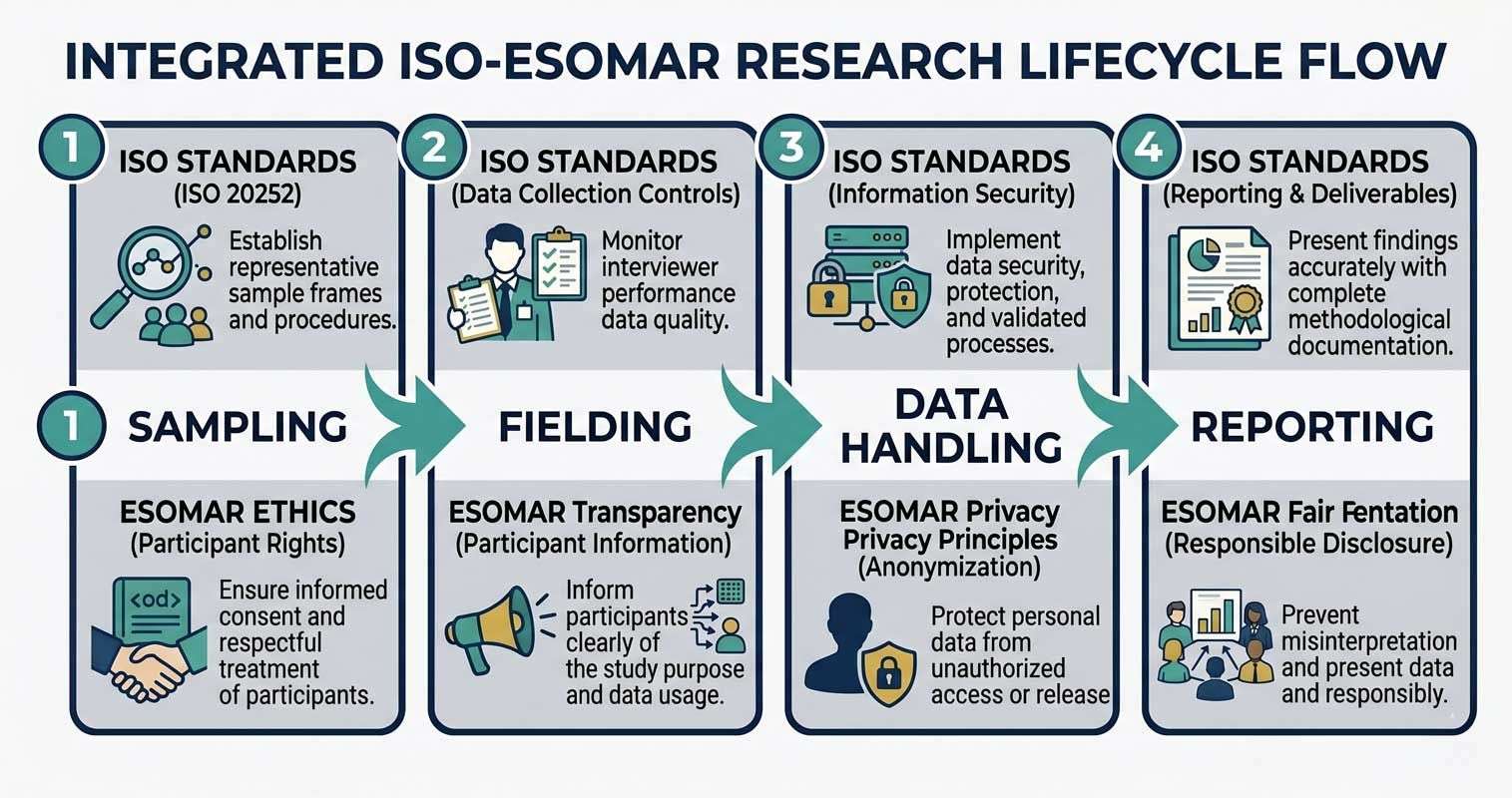 Mapping ISO 20252 vs ESOMAR layers across the global fieldwork project lifecycle.[/caption]
Key Takeaway: ISO 20252 vs ESOMAR is not either/or, mature fieldwork providers operate both as a single quality fabric.
The Practical Compliance Checklist for Global Fieldwork Standards
Turning ISO 20252 vs ESOMAR theory into practice means knowing what to verify before a project starts. Use this as a vendor and project audit list.
Documentation and Data Quality Checks
For ISO 20252, confirm a current certificate from an accredited body, scope coverage for your methodology, documented sampling and quality-control procedures, and traceable reporting. For ESOMAR, confirm member status or written Code adherence, a 2025-compliant privacy notice, data-minimisation practices, and an AI-use disclosure. When sourcing hard-to-reach respondents through specialty audiences, the duty-of-care provisions for vulnerable groups become especially relevant. For telephone work, the same logic applies to your CATI research scripting and consent flows.
Key Takeaway: A complete ISO 20252 vs ESOMAR checklist verifies certification and ethics before fieldwork begins.
[caption id="attachment_13169" align="aligncenter" width="1515"]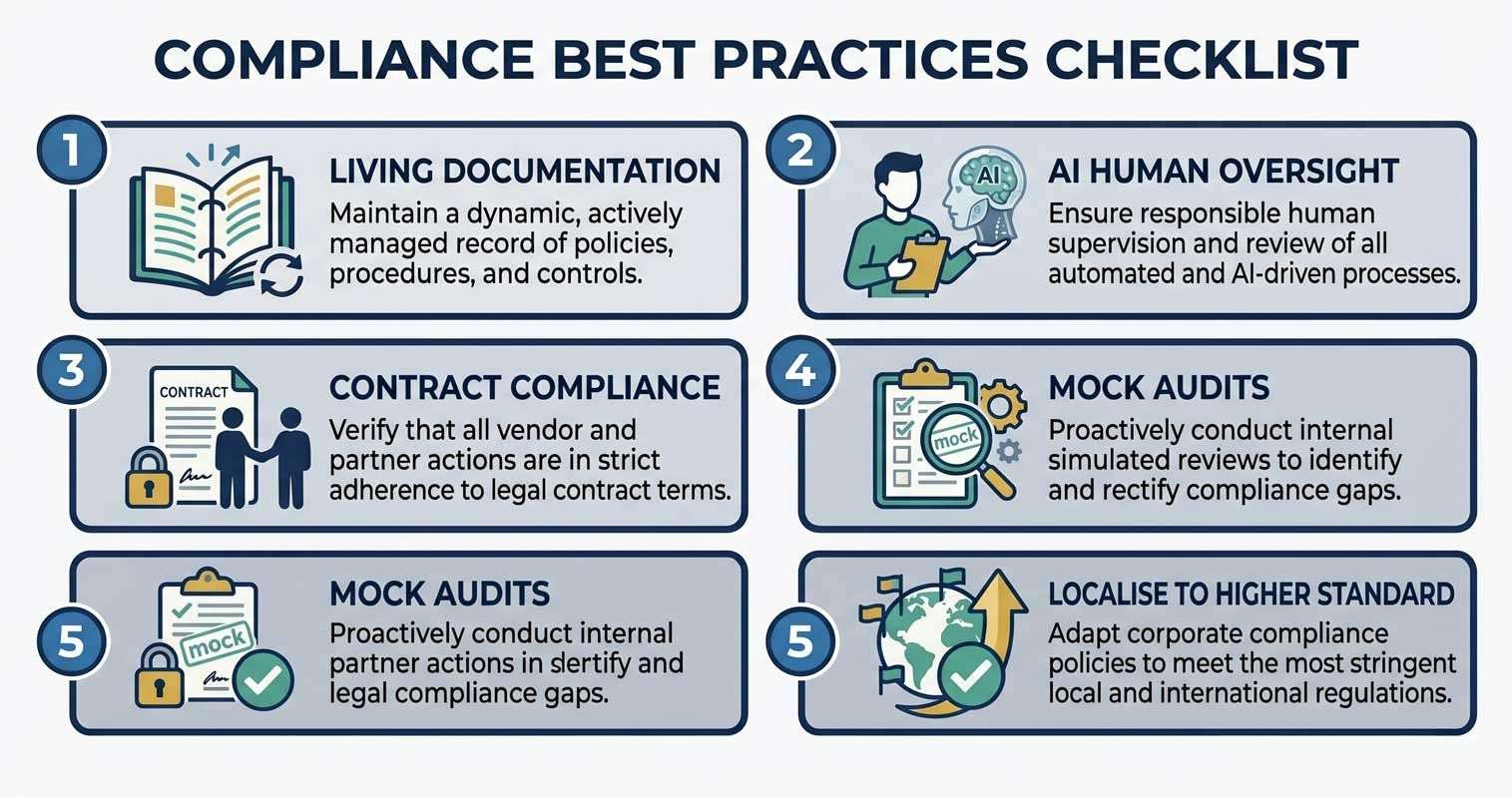 Five best practices for sustained ISO 20252 vs ESOMAR compliance in global fieldwork.[/caption]
Best Practices for ISO 20252 vs ESOMAR Compliance
Strong ISO 20252 vs ESOMAR compliance is a system, not a certificate on a wall. These five practices keep global fieldwork audit-ready.
Five Strategies for Sustained Compliance
First, treat documentation as a living asset. ISO audits reward traceability, so maintain version-controlled SOPs for sampling, fielding, and reporting that an auditor can follow end to end.
Second, build the 2025 ESOMAR Code into your AI workflows now. Any automated coding, synthetic-data use, or AI-assisted analysis needs documented human oversight, the Code makes this non-negotiable.
Third, push compliance upstream into contracts. Because the 2025 Code holds commissioners responsible, require written Code adherence from every subcontractor and panel partner.
Fourth, run internal mock audits annually. Don't wait for the certification body; pressure-test your own process against both frameworks each year.
Fifth, localise without lowering the bar. Markets like India now mirror the global Code via MRSI, but where local law is stricter, the higher standard always wins, a principle the ESOMAR Code states explicitly.
These are the disciplines our extended team services embed for clients who need compliance baked into delivery, not bolted on after.
The Future of Global Fieldwork Standards
The trajectory of ISO 20252 vs ESOMAR points firmly toward AI accountability and tighter data ethics. With ISO 20252 itself in revision and the ESOMAR Code now explicitly governing emerging technologies, the next phase of global fieldwork standards will reward providers who can prove both process integrity and algorithmic transparency.
Emerging Trends in Research Compliance
Expect synthetic data governance, auditable AI pipelines, and participant duty-of-care to dominate vendor evaluations through the rest of the decade. Forward-looking research buyers are already asking vendors not just "are you certified?" but "how is your AI governed?" Staying ahead means partnering with teams who treat compliance as continuous. Explore how we approach it.
Key Takeaway: The future of ISO 20252 vs ESOMAR compliance is defined by AI governance and provable trust.
Conclusion: Making ISO 20252 vs ESOMAR Work for You
ISO 20252 vs ESOMAR is best understood not as a contest but as two halves of a single trust system, one certifying process, one governing ethics. Together they tell research buyers that fieldwork is both consistent and conscientious, which is exactly what enterprise and public-sector procurement now demands.
The practical takeaway is to verify both before you commission, build the 2025 Code into your AI practices, and push compliance through your entire supply chain. At Research and Metric, our teams worldwide maintain ESOMAR-aligned methodologies and documented quality processes precisely so our clients never have to choose between speed and standards.
Ready to commission global fieldwork that's audit-ready from day one? Contact Research and Metric today to discover how our AI-powered, ESOMAR-aligned solutions transform your data into actionable intelligence.
FAQ: ISO 20252 vs ESOMAR
What is the difference between ISO 20252 vs ESOMAR?
The difference in ISO 20252 vs ESOMAR is one of type: ISO 20252 is a certifiable quality-management standard auditing how research processes are run, while the ICC/ESOMAR Code is an ethical framework governing conduct toward participants and clients. ISO 20252 proves your process; ESOMAR proves your principles. Most credible fieldwork providers maintain both for global trust.
Is ISO 20252 vs ESOMAR mandatory for global fieldwork?
Neither standard in ISO 20252 vs ESOMAR is legally mandatory, but both are commercially essential for global fieldwork. ISO 20252 certification is often a procurement requirement for enterprise and public-sector buyers, while ESOMAR Code adherence is mandatory for ESOMAR members and widely demanded in contracts. Together they signal audit-ready quality and ethical compliance.
How does the 2025 ESOMAR Code affect ISO 20252 vs ESOMAR compliance?
Within ISO 20252 vs ESOMAR, the 2025 ICC/ESOMAR Code revision adds emphasis on AI governance, human oversight, data minimisation, and stronger duty-of-care for vulnerable groups. While ISO 20252 governs documented process control, the 2025 Code raises the ethical bar for emerging technologies, so compliant fieldwork teams must now align both their quality systems and their AI practices.
What ROI can businesses expect from ISO 20252 vs ESOMAR compliance?
Businesses that leverage ISO 20252 vs ESOMAR compliance typically see faster procurement approvals, reduced vendor-audit friction, fewer data-quality disputes, and access to enterprise and government contracts that mandate certified, ethical fieldwork. The reputational value of demonstrable compliance also shortens sales cycles and strengthens client retention in competitive global markets.
How can Research and Metric help with ISO 20252 vs ESOMAR compliance?
Research and Metric supports clients with ISO 20252 vs ESOMAR compliance through ESOMAR-aligned methodologies, documented quality processes worldwide, and AI-governed data collection that respects the 2025 Code. Our specialist fieldwork teams deliver audit-ready documentation so research buyers can commission global projects with confidence. Learn more about our services.


