

Introduction
Three weeks ago, on 2 August 2026, the EU AI Act's transparency rules became fully enforceable across all 27 member states. Twenty US states began the year with comprehensive privacy laws in force, and four more signed their own by mid-summer. Multi-country fieldwork now operates inside the most demanding regulatory environment the research industry has ever faced, and the teams running these studies are discovering that the rules interact in ways no single-market checklist anticipated.
Does the AI regulation even touch research? The EU AI Act applies to market research whenever an AI system interacts with respondents in the EU, including AI moderated interviews, chatbots, emotion analytics, and synthetic stimuli. Most research applications fall into the transparency tier: respondents must be told they are dealing with AI, and AI generated material must be clearly disclosed.
The stakes are concrete. Prohibited AI practices carry fines of up to 35 million euros or 7 percent of global turnover, while transparency and high-risk breaches sit in the 15 million euro or 3 percent tier. Across the Atlantic, reported fines and penalties against US companies reached an estimated 1.4 billion dollars in 2025, and Texas secured a settlement above one billion dollars against a major technology company. The complete European framework is published on the European Commission's AI policy pages. Certivo Secure Privacy
This guide maps what actually changed in August 2026, where the European and American regimes overlap and collide, and the five-step playbook compliant teams follow. At Research and Metric, we run global fieldwork worldwide, so these rules shape how we design every cross-border study, and that operating experience informs everything below.
[caption id="attachment_13683" align="aligncenter" width="800"]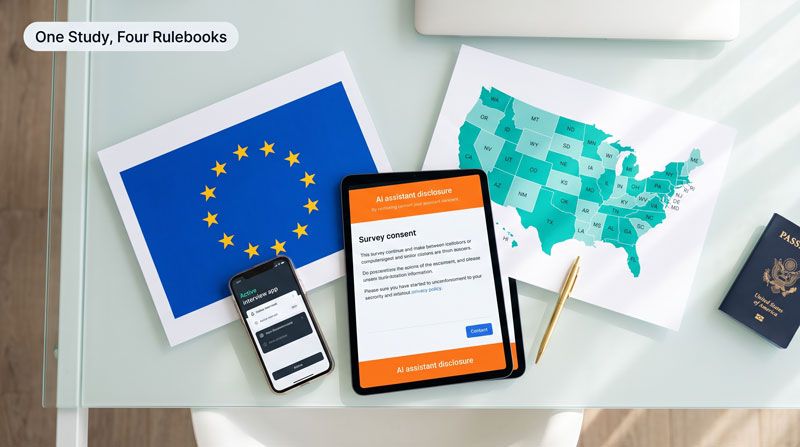 Multi-country fieldwork now inherits the EU AI Act, GDPR, and 20+ US state privacy laws at once[/caption]
Why Multi-Country Fieldwork Just Entered a New Compliance Era
A single brand tracker touching London, Berlin, Los Angeles, and Houston now answers to at least four rulebooks: GDPR, the AI Act, the California Consumer Privacy Act, and the Texas Data Privacy and Security Act. Each defines personal data, consent, and respondent rights slightly differently, and each claims extraterritorial scope. Multi-country fieldwork has always demanded local knowledge; what changed in 2026 is that the layers now stack on top of one another instead of sitting side by side.
One Study, Four Rulebooks
Europe starts from opt-in: processing personal data needs a lawful basis, and research typically relies on informed respondent consent under GDPR. The American model runs the other way. Most state laws permit collection by default and give residents the right to opt out, then carve out sensitive personal data, which requires opt-in consent in the majority of states. The AI layer adds a third dimension, regulating not what data is collected but how automated systems behave toward the people supplying it.
None of this stops at the water's edge. A fieldwork provider in Bengaluru or Singapore processing data about EU or US residents sits inside the scope of the relevant laws regardless of where its servers or interviewers are located. For agencies buying online data collection, the practical question is no longer whether a partner can field in a market but whether it can evidence compliance in that market. Procurement teams increasingly request consent records, assessment documentation, and subprocessor lists before a project is awarded.
Key Takeaway: One global study now inherits every applicable regime at once, so cross-border programs must be designed to the strictest standard from day one.
EU AI Act Compliance in 2026: What Changed and What Did Not
Headlines in June declared the AI Act delayed. That is half true, and the false half is the half that matters for research. After trilogue negotiations, the European Parliament endorsed the Digital Omnibus on AI on 16 June 2026 and the Council gave final approval on 29 June, and the Omnibus entered into force on 27 July 2026. It defers high-risk obligations for standalone Annex III systems to 2 December 2027 and for AI embedded in regulated products under Annex I to 2 August 2028. Certivo + 2
What the Omnibus did not touch is Article 50. The transparency obligations remain effective from 2 August 2026: people must be informed when they are interacting with an AI system, when content is AI generated, and when they are subject to emotion recognition or biometric categorization systems. Machine-readable marking of generative output under Article 50(2) follows on 2 December 2026 for systems already on the market, the same date new prohibited practices take effect. Compliancehub Winston Taylor
Transparency Duties for AI Interviewing and Synthetic Content
For multi-country fieldwork teams, the translation is direct. An AI moderated qualitative session or a probing chatbot embedded in a survey must identify itself to EU respondents. AI generated concept stimuli, synthetic ad mock-ups, and voice agents used in CATI research need clear disclosure. Facial coding and other emotion analytics trigger both an AI Act disclosure duty and, because biometric data is a special category under GDPR, explicit opt-in consent. General-purpose AI obligations have applied since August 2025, so teams building on large models also inherit documentation duties from their providers, and the AI literacy requirement in force since February 2025 covers every project member operating these tools.
Key Takeaway: The delay covers high-risk systems; the disclosure duties that touch everyday research tools are live right now.
[caption id="attachment_13685" align="aligncenter" width="800"] Transparency duties went live in August 2026 while high-risk rules moved to December 2027[/caption]
How 20+ US State Privacy Laws Reshape Multi-Country Fieldwork
Twenty states entered 2026 with comprehensive privacy laws in effect, after new laws in Indiana, Kentucky, and Rhode Island took effect on 1 January. By summer, Alabama, Louisiana, Oklahoma, and Vermont had passed frameworks of their own, taking the enacted total to 24, while the long-anticipated federal privacy bill expired without a vote. There is no national standard to harmonize any of it. MultiState + 2
The skeleton is broadly shared: privacy notices, rights of access, correction, deletion, and opt-out, mandatory contracts with processors, and data protection assessments for higher risk processing. The divergences are where multi-country fieldwork programs get hurt. Most states treat health information, precise geolocation, biometric identifiers, and data revealing race, religion, or sexual orientation as sensitive personal data requiring opt-in consent. Maryland bans the sale of sensitive personal information outright, Texas applies with no revenue threshold at all, and twelve states now require honoring Global Privacy Control as a universal opt-out mechanism. Washington's My Health My Data Act adds a private right of action around consumer health data, which matters enormously for healthcare recruitment. Consenteo
Sensitive Data, Opt-Ins, and Universal Opt-Outs
Enforcement is no longer theoretical. The California Privacy Protection Agency set a settlement record of 1.35 million dollars, then broke it in February 2026 with a 2.75 million dollar settlement over opt-out failures, and California, Colorado, and Connecticut are running a coordinated enforcement sweep. For recruiters building specialty audiences such as physicians, patients, or high net worth consumers, sensitive data handling is now the sharpest edge in American research, and the laws follow the resident: a panel inviting Colorado residents into a diabetes study is in scope wherever that panel is managed from. Secure Privacy Consenteo
Key Takeaway: Treat the strictest state as the national baseline: opt-in for sensitive data, honored opt-out signals, and documented assessments everywhere.
[caption id="attachment_13687" align="alignnone" width="800"] Sensitive personal data now requires opt-in consent across most active state laws[/caption]
Where GDPR, the AI Act, and State Privacy Laws Collide
The three regimes agree on more than the patchwork suggests. Transparency, purpose limitation, security, vendor contracts, and impact assessments appear in all of them under different names, and a GDPR data protection impact assessment can share most of its content with a state data protection assessment when the templates are designed together.
The collisions are structural. Europe's opt-in default meets America's opt-out default, deletion timelines differ by market, and respondent incentives can qualify as financial transactions that trigger additional rules in some states. Cross-border transfers add another layer: EU respondent data moving to processing hubs in India or the United States needs a recognized mechanism such as standard contractual clauses or the EU-US Data Privacy Framework, and pseudonymized data only escapes some obligations if it genuinely cannot be re-linked.
Consent Architecture That Travels
The teams that cope build a single consent and disclosure architecture to the strictest applicable standard, then localize the language rather than the logic. That means layered notices, explicit opt-in for anything sensitive, AI interaction disclosure built into the flow, and one centralized pipeline for access, deletion, and opt-out requests across every market a multi-country fieldwork program touches. In qualitative recruitment, where screeners routinely handle health or financial details, this architecture decides whether a project is feasible at all. The same discipline behind layered quality control in fraud prevention applies here: build the control once, at the front of the study, not after the data arrives.
Key Takeaway: Design consent once, to the strictest standard, and localize wording rather than rebuilding logic market by market.
5 Proven Strategies for Compliant Cross-Border Data Collection
From Mapping to Monitoring: A Sequence That Works
- First, inventory every AI touchpoint and data flow in the research process, from panel invitation to reporting, and classify each against the AI Act's tiers and each state's definitions. Most teams discover AI in more places than expected, including translation, verbatim coding, and quality checks.
- Second, build one consent and disclosure framework to the strictest standard: opt-in for sensitive personal data, plain language AI disclosure at the moment of interaction, and recognition of universal opt-out mechanisms like Global Privacy Control.
- Third, centralize respondent rights operations so access, deletion, and opt-out requests are executed across every panel, market, and subcontractor within statutory timelines, with a full audit trail.
- Fourth, tighten the vendor chain. Data processing agreements, transfer safeguards, and flow-down clauses to every subcontractor turn a paper promise into an enforceable control, and they are the first documents clients now request.
- Fifth, run and document assessments before fieldwork launches, and train every project team member, because AI literacy is a legal obligation in the EU rather than a nice to have.
This sequence mirrors the transparency and duty of care principles in the ICC/ESOMAR Code, and ESOMAR's codes and guidelines give buyers concrete questions to ask any partner. In our own multi-country fieldwork, the assessment stage routinely surfaces design changes that improve data quality as much as compliance.
[caption id="attachment_13689" align="aligncenter" width="800"]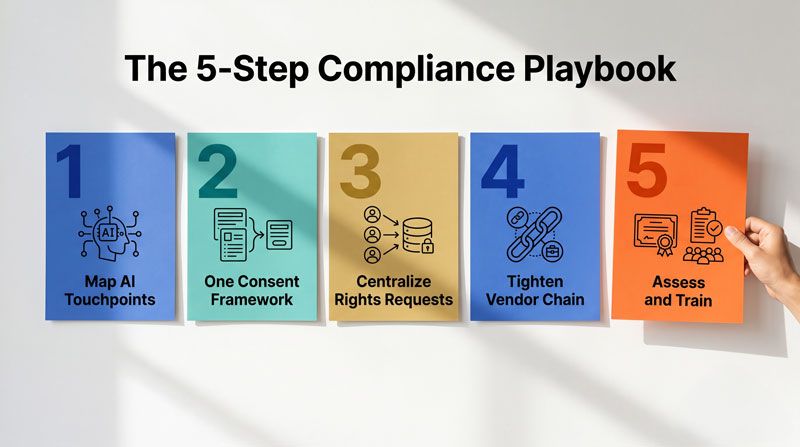 The five-step sequence multi-country fieldwork teams use to launch compliant studies[/caption]
The Future of Global Research Compliance
The calendar keeps moving. On 2 December 2026, Article 50(2) marking requirements reach legacy systems and the new prohibited practices apply; high-risk obligations follow for Annex III systems on 2 December 2027 and for embedded systems on 2 August 2028. In the US, two more state laws are already signed and set to take effect in 2027, and the state count will keep climbing while Congress remains stalled. Winston Taylor Enzuzo
Emerging Trends in Privacy-First Research
Expect three shifts. Privacy enhancing technologies and governed synthetic data will move from experiments to standard tooling. Buyers will push compliance evidence into RFPs, turning documented assessments into a commercial asset rather than overhead. And harmonized standards under the AI Act will gradually replace today's interpretive grey zones with checklists. International market research will not get simpler, but it will get more predictable for the teams building this muscle now, and we track each milestone on our blog.
Key Takeaway: December 2026 is the next hard deadline, when content marking rules and new prohibitions arrive before year end.
[caption id="attachment_13690" align="aligncenter" width="800"]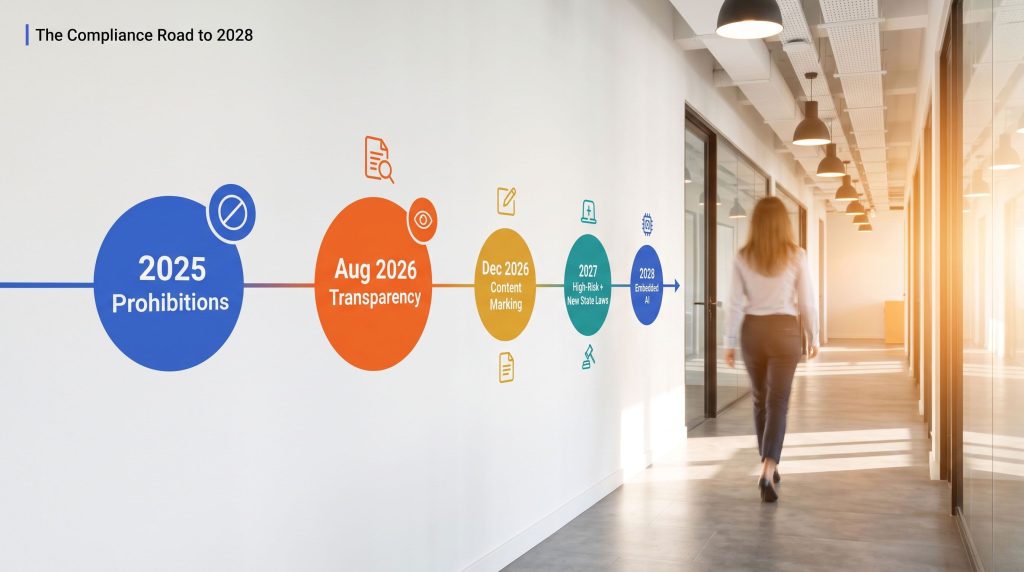 Content marking rules and new state laws are the next milestones after August 2026[/caption]
Conclusion: Compliance Is Now a Competitive Edge
Multi-country fieldwork in 2026 rewards the prepared. The EU AI Act's transparency duties are live, twenty state privacy laws are being actively enforced, and the gap between compliant and non-compliant partners is now visible in audits, RFPs, and settlement headlines. The playbook is clear: map AI touchpoints, design consent to the strictest standard, centralize rights handling, control the vendor chain, and document everything.
At Research and Metric, our teams worldwide build these controls into every study as standard, combining ESOMAR aligned methodology with the local regulatory knowledge each market demands. That is what lets global programs launch quickly without accumulating hidden legal risk.
Ready to run global studies that regulators and clients both trust? Contact Research and Metric today to discover how our AI-powered fieldwork solutions transform your data into actionable intelligence.
Frequently Asked Questions
What is multi-country fieldwork and why is compliance harder in 2026?
Multi-country fieldwork means running one study across several markets at once, each with its own privacy and AI rules. Compliance got harder in 2026 because the EU AI Act's transparency duties went live on 2 August, twenty US states now enforce comprehensive privacy laws, and four more signed new ones this year. A single survey can now sit under three or four rulebooks simultaneously.
How does the EU AI Act affect multi-country fieldwork?
The biggest impact is transparency. From 2 August 2026, respondents in the EU must be told when they interact with an AI system, such as an AI moderated interview or a probing chatbot, and AI generated stimuli must be disclosed. Emotion analytics like facial coding trigger extra disclosure and consent duties. High-risk obligations were deferred to December 2027, but this transparency layer applies right now.
Do US state privacy laws apply to multi-country fieldwork run from outside the US?
Yes. State privacy laws follow the resident, not the researcher. A fieldwork company in India or Singapore that collects or processes data about California, Texas, or Colorado residents falls within scope once thresholds are met, and Texas applies to nearly any non-small business. Cross-border teams therefore need sensitive data opt-ins, honored opt-out signals, and processor contracts regardless of where they operate.
What ROI can businesses expect from compliant multi-country fieldwork?
Businesses that leverage compliant global studies protect far more than fine exposure. They avoid penalties reaching 35 million euros or 7 percent of turnover in the EU, stay out of enforcement sweeps, and win work from clients who now audit fieldwork partners before awarding projects. Clean consent also improves data quality, because respondents who trust the process answer more honestly and stay in panels longer.
How can Research and Metric help with multi-country fieldwork?
Research and Metric supports clients with ESOMAR aligned fieldwork worldwide, combining local compliance knowledge with centralized consent, disclosure, and respondent rights processes. Our teams design studies to the strictest applicable standard, document assessments, and manage vendor chains end to end, so agencies and brands can launch cross-border projects without building this expertise in house. Learn more about our services.


