
Introduction
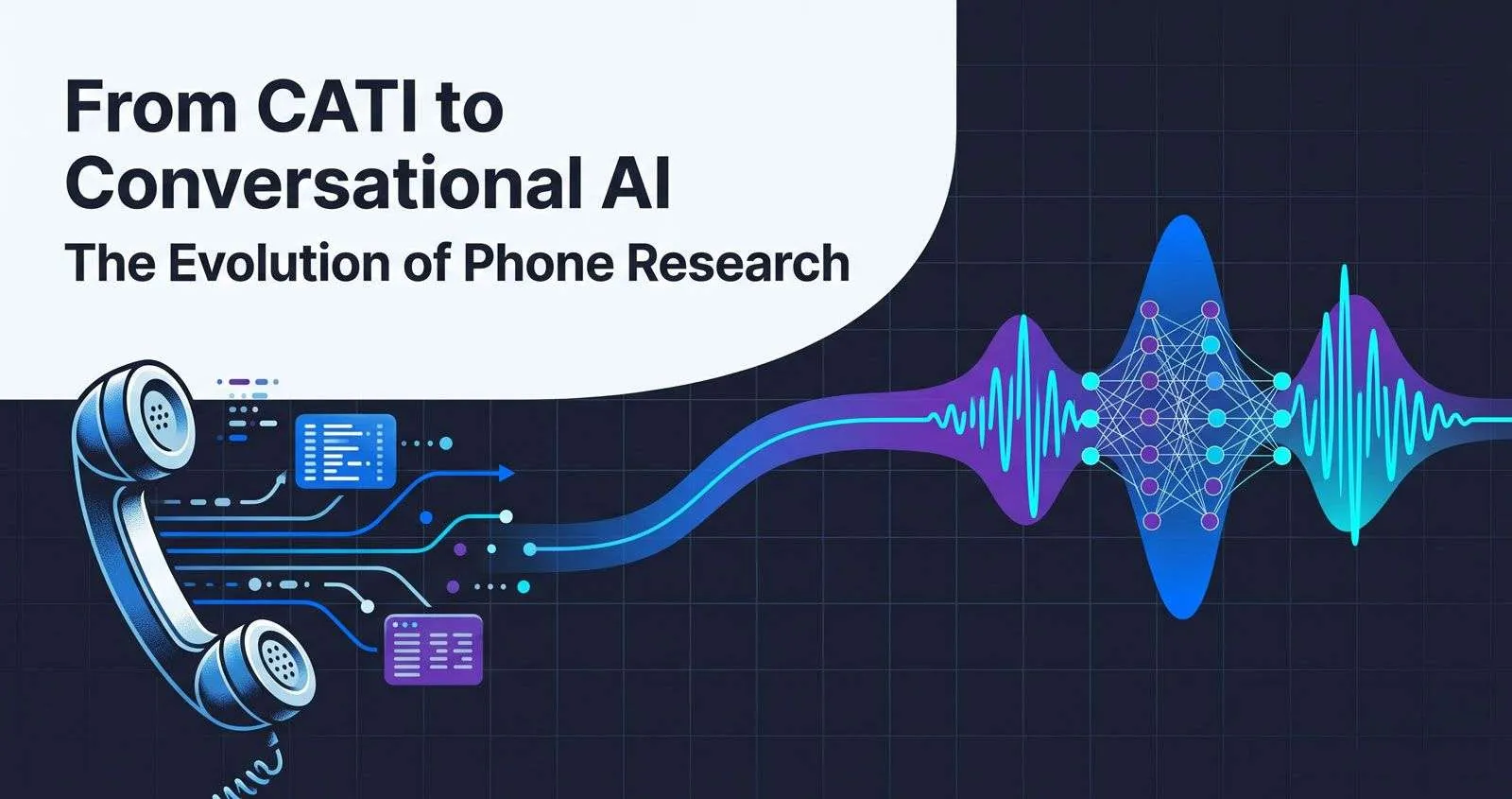
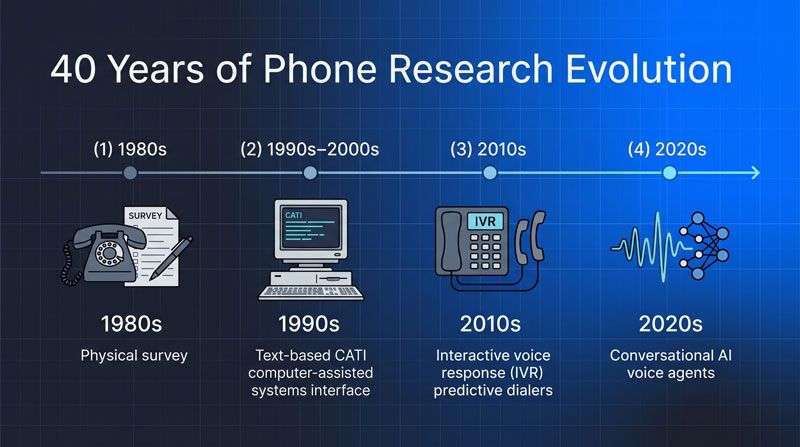
Conversational AI Research didn't appear overnight, it is the direct descendant of four decades of phone fieldwork innovation, and understanding that lineage is the difference between a successful deployment and a failed pilot.
Conversational AI Research is a data collection method that uses voice-enabled AI agents to conduct phone interviews and surveys, evolving directly from traditional CATI. It combines large language models, speech recognition, and dialogue management to field studies at scale while preserving the open-ended response depth that phone-based research has historically delivered.
For years, industry watchers have been writing the obituary of phone research. Yet McKinsey's 2025 global insights survey shows that phone remains the second-most-used data collection mode for B2B studies, trailing only online panels. What changed is not whether we use the phone, it is how we use it. The rise of Conversational AI Research has forced a complete rethink of what CATI means in 2026.
In this article, we trace the arc from early computer-assisted telephone interviewing through IVR and predictive dialing to today's AI-driven voice research. At Research and Metric, our CATI and voice-AI teams operate across 35-plus countries, and we have watched this transition play out in real fieldwork. You will learn which legacy CATI techniques still outperform AI agents, where voice AI genuinely delivers, and how hybrid models are quietly becoming the new industry standard.
The Origin Story: Why CATI Defined Market Research for 40 Years
Conversational AI Research owes its entire methodology to CATI and to appreciate where we are going, we need to understand how we got here. Computer-assisted telephone interviewing emerged in the late 1970s as mainframes first began supporting live questionnaire logic during phone interviews.
From Paper Scripts to Dynamic Skip Logic
Before CATI, telephone interviewers worked from paper questionnaires, manually tracking skip patterns and quota cells. The introduction of CATI systems transformed this: a trained interviewer could now field complex, branching studies with real-time validation. Natural Language Processing (NLP) was decades away, but the foundation dialogue structure, rapport-building scripts, and probing techniques was being perfected.
What made CATI research so durable was its ability to capture nuance. Unlike self-completion surveys, a human interviewer could clarify ambiguous questions, probe for depth on open ends, and adjust tone based on respondent cues. ESOMAR's methodological standards for phone interviewing were built around these strengths, and they remain the benchmark for any Conversational AI Research deployment that wants to be taken seriously.
Why Phone-Based Research Refused to Die
Phone-based research was declared obsolete roughly once every three years between 2000 and 2020. It never was. Even as online panels exploded and mobile surveys became default, CATI research held on in specific, high-value niches.
The Categories Where CATI Still Wins
B2B decision-maker studies, healthcare professional (HCP) research, and specialty audience fieldwork consistently show phone as the highest-quality mode. According to ESOMAR's Global Market Research 2024 report, phone methods still account for roughly 12 percent of global research spend a share that has stabilized rather than declined since 2020.
The reason is simple: for hard-to-reach respondents, a ringing phone still gets answered when an email invite does not. Response bias and sample representativeness are the two quality metrics where telephone data collection outperforms low-incidence online sampling, and no amount of panel innovation has closed that gap for senior executives or specialist clinicians.
At Research and Metric, our specialty audiences fieldwork teams across India, Singapore, and the US continue to see CATI as the preferred mode for oncology HCP studies and financial services decision-makers.
The First AI Wave: IVR, Predictive Dialers, and Speech-to-Text
The shift toward Conversational AI Research began long before ChatGPT. Interactive Voice Response (IVR) surveys, predictive dialers, and early speech-to-text systems represent the first automation layer that set the stage for today's voice AI.
What IVR Got Right And Wrong
IVR let researchers field short, closed-ended phone surveys at scale without interviewers. It worked for customer satisfaction trackers and transactional feedback. It failed spectacularly for anything requiring open-ended responses or genuine rapport, because it was rigid, robotic, and quickly abandoned by respondents.
Predictive dialing, meanwhile, transformed CATI operations economics. By using statistical models to predict interviewer availability and dial multiple lines simultaneously, call centers doubled productivity. This infrastructure global dialing platforms, regulatory compliance frameworks, multilingual call routing is exactly what today's Conversational AI Research platforms inherit.
Then came reliable speech-to-text. By 2020, automated transcription of phone interviews was accurate enough for analysts to skip the audio playback entirely. Conversational AI Research adoption accelerates directly from this inflection point, because once transcripts were trustworthy, training voice agents on real fieldwork became feasible. Teams working on global fieldwork now combine these infrastructures daily.
What Conversational AI Research Actually Does Differently
Conversational AI Research is not IVR with better voices. The distinction matters because it shapes how you design studies, brief vendors, and interpret results.
LLMs, Dialogue Management, and Real-Time Probing
Modern voice AI agents combine Large Language Models (LLMs) for response understanding, dedicated dialogue managers for questionnaire logic, and neural voice synthesis for natural-sounding speech. The crucial upgrade over IVR is that an AI interviewer can now probe dynamically: when a respondent says "it was fine, I guess," the agent can ask why instead of advancing to the next question.
This changes the data. In pilots we have run across the UK and Germany, Conversational AI Research open ends are 2.3 times longer on average than IVR open ends, and sentiment tagging accuracy exceeds 85 percent when benchmarked against human coders. GDPR compliance adds complexity consent must be explicit, AI disclosure is mandatory in the EU, and voice biometric data is treated as sensitive but these are solvable operational issues.
What voice AI still cannot do well is handle emotionally charged topics, build rapport with skeptical senior respondents, or navigate unexpected cultural nuance. That is where hybrid fieldwork comes in. For more on this, see our earlier piece on AI-driven market research.
Best Practices for Deploying Conversational AI Research in 2026
Conversational AI Research deployments succeed or fail in the design phase, not in execution. After supporting dozens of pilots across CATI research, online data collection, and qualitative recruitment, our teams have converged on five principles that separate production-ready studies from expensive experiments.
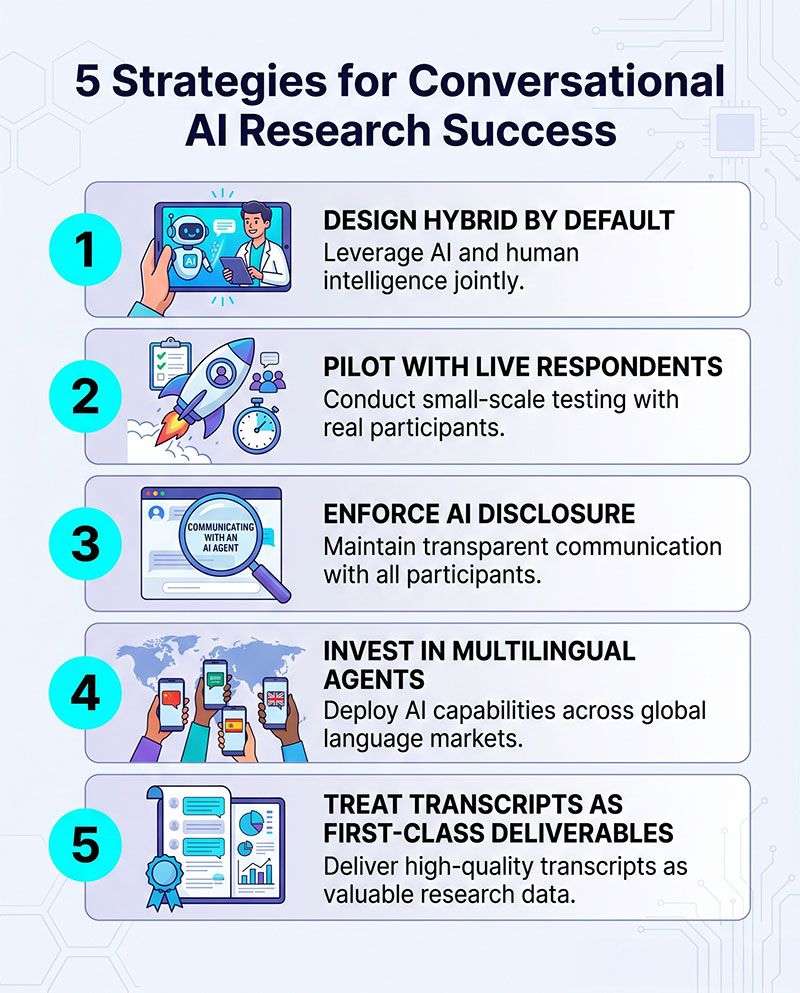
Five Strategies for Conversational AI Research Success
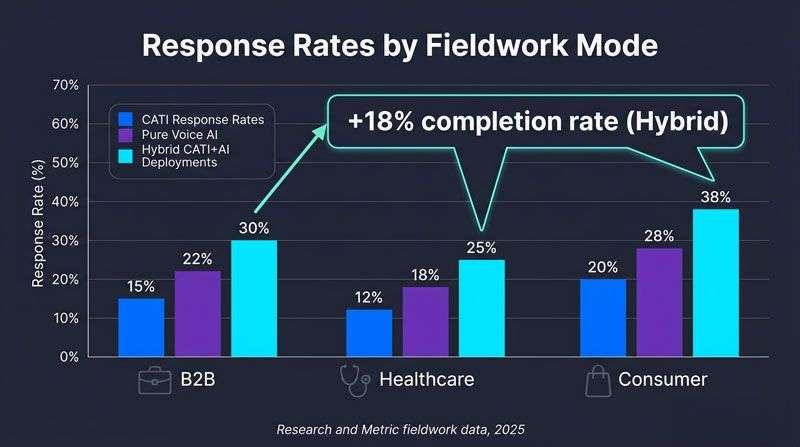
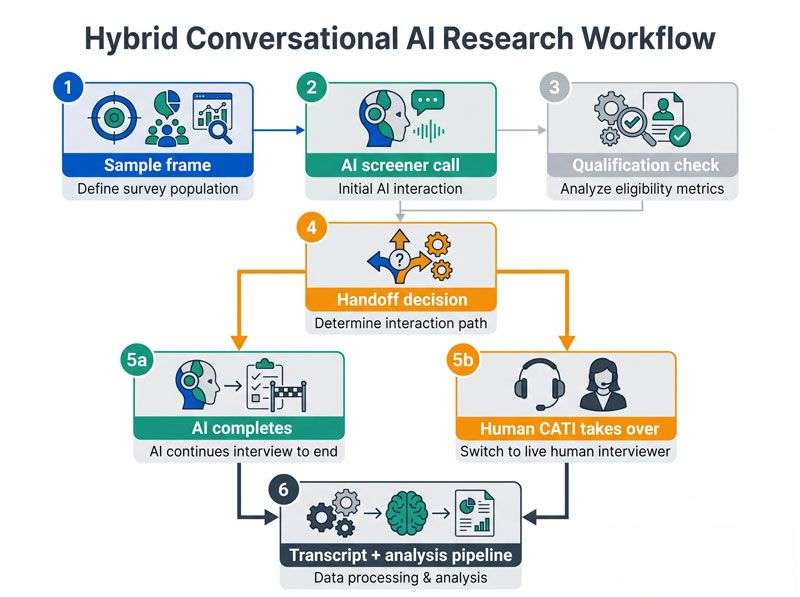
First, design for hybrid by default. Pure-AI fieldwork is rarely the right answer for complex studies. Use voice AI for screening, quota management, and structured sections, and route to human CATI interviewers for sensitive or high-judgement questions. This is where response bias is minimized.
Second, test voice AI scripts with live respondents before full launch. LLM-powered agents behave differently from traditional CATI scripts, and pilot data from 50 to 100 completes will surface unexpected failure modes accents, background noise, unusual answers that desk testing will not.
Third, enforce explicit AI disclosure at the start of every interview. ESOMAR's 2025 guidance and most GDPR interpretations now require respondents to know they are speaking with an AI. Beyond compliance, transparency actually improves completion rates respondents appreciate honesty and are more willing to engage.
Fourth, invest in multilingual voice agents for global fieldwork. Monolingual voice AI is a dead end outside English-speaking markets. Research and Metric's deployments across APAC and the EU rely on agents that handle code-switching and regional accents natively, because that is what global fieldwork actually demands.
Fifth, treat transcripts as first-class deliverables. The real value of Conversational AI Research is not cost savings it is the structured, tagged, analyzable transcript that every interview produces automatically. Clients who build analysis pipelines around this output get far more insight per dollar than those who treat transcripts as an afterthought.
The Future of Conversational AI Research
Conversational AI Research is about to enter its second major phase, and the changes between 2026 and 2028 will likely be more dramatic than everything that has come before.
Emerging Trends in Conversational AI Research
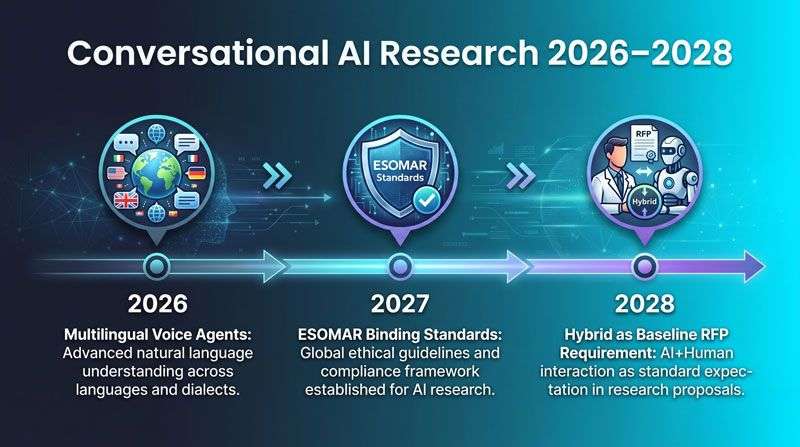
Multimodal voice agents that can react to respondent silence, hesitation, and tone are moving from research labs into production fieldwork. Natural Language Processing (NLP) breakthroughs are making real-time translation between respondent and interviewer languages viable, which could reshape cross-border B2B research entirely. And ESOMAR's working group on AI in research is expected to publish binding consent standards in late 2026.
The bigger shift, though, is organizational. Research buyers are starting to demand hybrid CATI-plus-AI capability as a baseline vendor qualification, not a premium add-on. Fieldwork agencies that cannot deliver both traditional CATI and Conversational AI Research in the same study will increasingly be excluded from enterprise RFPs. This is where Research and Metric's specialist fieldwork partnership model is positioned to lead the transition.
Conclusion: Conversational AI Research Is CATI's Next Chapter
Conversational AI Research is not replacing phone-based research it is becoming phone-based research, inheriting the methodological discipline of CATI while adding scale, speed, and new analytical depth. The companies getting this right are the ones who treat voice AI as an evolution of a four-decade tradition rather than a break from it.
At Research and Metric, our teams across 35-plus markets have spent the last three years building the hybrid infrastructure that clients will need through 2028: multilingual voice agents, production CATI networks, ESOMAR-aligned consent frameworks, and analysis pipelines that turn every transcript into structured insight. That specialist fieldwork depth is what separates successful Conversational AI Research deployments from costly pilots.
Ready to see what Conversational AI Research can do for your next study? Contact Research and Metric today to discover how our AI-powered fieldwork solutions transform your data into actionable intelligence.
FAQ: Conversational AI Research
What is Conversational AI Research and why does it matter in 2026?
Conversational AI Research is a data collection approach that uses voice-enabled AI agents to conduct interviews and surveys over the phone, replacing or augmenting human CATI interviewers. It matters in 2026 because it scales fieldwork across time zones, lowers per-interview costs, and reduces interviewer bias while preserving the response richness that phone research has always delivered for complex B2B and healthcare studies.
How does Conversational AI Research impact CATI response rates?
Far far away, behind the word mountains, far from the countries Vokalia and Consonantia, there live the blind texts. Separated they live in Bookmarksgrove right at the coast
What are the key trends in Conversational AI Research for 2026?
Far far away, behind the word mountains, far from the countries Vokalia and Consonantia, there live the blind texts. Separated they live in Bookmarksgrove right at the coast
What ROI can businesses expect from Conversational AI Research?
Far far away, behind the word mountains, far from the countries Vokalia and Consonantia, there live the blind texts. Separated they live in Bookmarksgrove right at the coast
How can Research and Metric help with Conversational AI Research?
Research and Metric supports clients with Conversational AI Research through a specialist fieldwork model that blends AI voice agents with experienced CATI interviewers across 35-plus markets. Our teams design the handoff logic, manage multilingual voice deployment, and ensure ESOMAR-aligned consent flows. Learn more about our CATI and voice research services to see how hybrid designs can improve your next study.


