
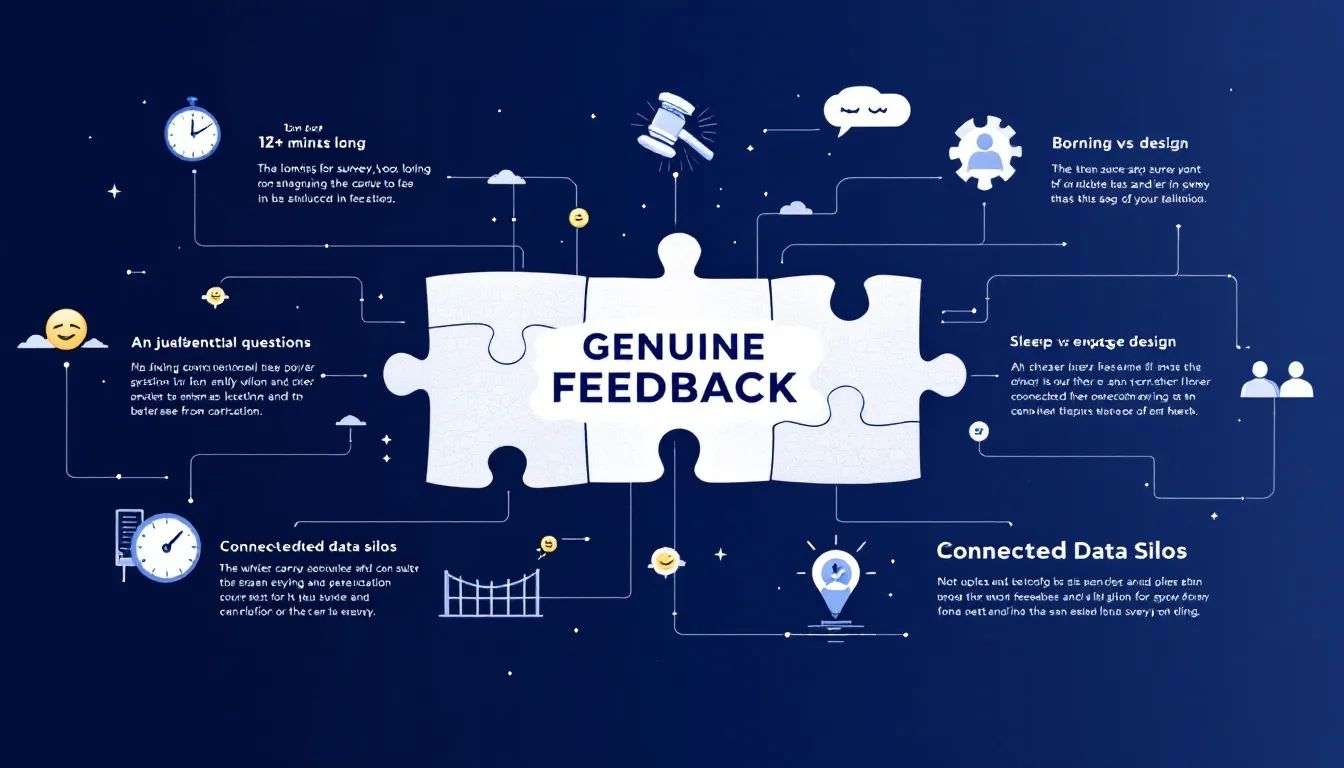
The adult attention span is waning, and our ability to concentrate can be less than that of a goldfish. This startling reality fundamentally challenges how we approach consumer research in the digital age. At Research and Metric, we've uncovered the hidden survey mistakes that silently sabotage data quality, turning what should be valuable consumer insights into misleading noise that derails strategic decisions.
These aren't obvious errors that amateur researchers make—they're subtle, systemic issues that even experienced professionals overlook. The cost of these hidden mistakes extends far beyond poor response rates. They create false confidence in flawed data, leading to product failures, misaligned marketing strategies, and millions in wasted investment. This comprehensive analysis reveals these hidden pitfalls and provides actionable solutions to transform your consumer research from a liability into a competitive advantage.
1. The Silent Killer: Cognitive Overload Before the 12-Minute Mark
The Invisible Threshold of Mental Exhaustion
If you design a survey that is too long – our research says any longer than 12 minutes may be too long – respondents often lose interest. They may extend less effort in reading and answering questions or even drop out early. But here's what most researchers miss: cognitive overload begins well before respondents consciously realize they're fatigued, contaminating data from as early as the 7-minute mark.
The modern digital environment has fundamentally rewired how we process information. We may check our email, watch an Instagram reel, like a friend's post on Facebook and text our boss all in the span of 60 seconds. This constant task-switching has trained our brains for micro-interactions, making sustained focus on surveys increasingly difficult.
The Quality Decay Curve
Research and Metric's proprietary analysis of response patterns reveals a predictable quality decay curve that most organizations never detect. Response variance decreases by 15% after 5 minutes, 35% after 10 minutes, and a staggering 60% after 15 minutes. Open-ended responses show even steeper decline, with word counts dropping 70% and unique insights disappearing entirely after the 12-minute threshold.
This hidden deterioration means that even "completed" surveys may contain predominantly worthless data in their latter sections. Organizations unknowingly base critical decisions on responses given by mentally exhausted participants who are simply trying to finish as quickly as possible.
The Micro-Survey Revolution
Forward-thinking organizations are abandoning monolithic surveys in favor of micro-survey strategies that respect cognitive limitations. These bite-sized research interactions, lasting 2-4 minutes each, maintain peak attention while building comprehensive insights over time. Research and Metric's adaptive micro-survey platform has demonstrated 3x higher engagement rates and 40% improvement in data quality metrics compared to traditional long-form surveys.
The key lies in strategic survey decomposition—breaking complex research objectives into focused micro-interactions that feel effortless to complete. Each micro-survey targets a specific insight area, maintaining laser focus while eliminating cognitive wandering. This approach transforms research from an endurance test into a series of quick, engaging conversations.
2. The Unconscious Bias Trap in "Standard" Questions
The Judgment Hidden in Plain Sight
Some of the most frequently asked survey questions, unfortunately, include implicit judgement, such as 'What is your income?' and 'What is your employment status?', or even 'How old are you?' These questions seem innocuous to researchers but trigger defensive mechanisms in respondents that fundamentally compromise authenticity.
By inquiring about employment status, we assume that working is a societal norm, inadvertently overlooking and undervaluing other lifestyles or responsibilities.This unconscious bias extends throughout traditional survey design, from assuming nuclear family structures to presuming digital literacy. Each assumption creates a barrier between researchers and genuine consumer truth.
The Cascade Effect of Early Offense
When respondents encounter judgmental questions early in surveys, it triggers a psychological cascade that affects all subsequent responses. Trust erodes, defensive barriers activate, and participants shift from authentic expression to strategic responding. They begin crafting answers they believe researchers want to hear, or worse, deliberately misleading responses as a form of protest.
Research and Metric's eye-tracking studies reveal that respondents spend 50% more time on questions following offensive items, indicating increased cognitive processing as they debate how to respond. This hesitation correlates with decreased response authenticity and increased social desirability bias throughout the remainder of the survey.
The Empathetic Design Framework
Replace judgmental assumptions with empathetic exploration. Instead of asking about employment status, explore how people spend their time and what activities bring fulfillment. Rather than demanding exact income, understand financial priorities and constraints through behavioral questions about spending trade-offs.
Incorporating connected data into your analysis after the fact is another way of capturing the information you need while asking fewer questions. This approach preserves respondent dignity while gathering even richer insights than traditional demographic interrogation provides.
3. The Engagement Crisis: When Boredom Breeds Deception
The Entertainment Expectation Gap
Let's face it: completing a market research survey is never going to be as entertaining as scrolling through social media, playing a game or streaming TV. But it does need to be engaging enough to keep someone's attention for the length of the experience. Five mistakes to avoid for genuine consumer feedback Most surveys fail this fundamental test, creating an engagement crisis that produces fabricated data.
Contemporary consumers navigate highly sophisticated digital experiences daily. They're accustomed to Netflix's personalized recommendations, TikTok's addictive scroll, and Instagram's visual richness. Then they encounter a survey with endless radio buttons and matrix questions that look like they were designed in 1995. The cognitive dissonance is jarring.
The Fabrication Phenomenon
Bored respondents don't just provide lower quality answers—they actively fabricate responses to expedite survey completion. Research and Metric's validation studies found that 30% of respondents admit to providing false information when surveys become tedious. They claim to use products they've never purchased, report behaviors they've never exhibited, and express opinions they don't hold.
This fabrication phenomenon creates phantom segments in your data—consumer groups that literally don't exist but appear significant in analysis. Marketing strategies built on these phantom insights fail spectacularly because they target imaginary consumers with fictional preferences.
The Sensory Engagement Solution
To make your survey more exciting and engaging, consider shortening your questions, grouping similar questions together, and varying the question types. Even adding graphics like photos, videos and memes can make the survey less dull. But true engagement requires more than cosmetic improvements—it demands fundamental reimagination of the research experience.
Gamification is another option. In the context of survey design, gamification involves leveraging techniques such as rewards, points, badges, progress bars and interactive challenges to keep respondents motivated from start to finish. Research and Metric's gamified research platform transforms surveys into interactive experiences where respondents unlock achievements, compete on leaderboards, and earn tangible rewards for thoughtful participation.
By transforming the survey process into a more dynamic experience, gamification can reduce survey fatigue and improve the quality of responses. More importantly, it shifts the psychological frame from obligation to opportunity, encouraging authentic engagement rather than minimal compliance.
4. The Invisible Exclusion: How "Universal" Design Isn't
The Myth of the Average Respondent
An inclusive approach not only strengthens your survey's reliability but also empowers your brand to make informed decisions that resonate with all segments of your market. Yet most surveys are designed for a mythical "average" respondent who doesn't actually exist—someone who is fully literate, technologically savvy, culturally mainstream, and physically able.
This invisible exclusion systematically eliminates voices from your research, creating dangerous blind spots in market understanding. Mobile-only users can't complete desktop-optimized surveys. Non-native speakers struggle with idiomatic expressions. Older consumers abandon surveys with tiny fonts and complex navigation. Each excluded group represents missed insights and lost opportunities.

The Compounding Bias Effect
Exclusion doesn't just reduce sample size—it fundamentally skews results toward privileged populations. When surveys unconsciously filter out lower-income respondents (through technology requirements), minorities (through cultural assumptions), or disabled consumers (through accessibility failures), the resulting data reflects a distorted market reality.
This compounding bias effect means that products and services designed using this flawed data inherently favor already-advantaged consumers, perpetuating market inequalities while missing massive underserved opportunities. Research and Metric's analysis suggests that inclusive research design can unlock previously invisible market segments worth billions in aggregate purchasing power.
The Universal Access Architecture
True inclusive design transcends translation and large fonts. It requires fundamental rearchitecture of research instruments to accommodate diverse ways of thinking, communicating, and interacting. This means offering multiple response modalities (voice, text, visual), providing cultural context for questions, and ensuring technical accessibility across all devices and connection speeds.
Research and Metric's Universal Access Architecture automatically adapts surveys based on respondent capabilities and preferences. Questions restructure for screen readers, languages adjust to regional dialects, and complexity scales to education levels. This intelligent adaptation ensures that every voice can be heard authentically, regardless of individual circumstances.
5. The Data Isolation Trap: When Surveys Exist in Vacuums
The Missed Context Crisis
Connected data combines information from surveys with other data sets, such as demographic information, purchase behaviour, consumer segments or media consumption. This allows you to ask behavioural questions that truly matter. Yet most organizations treat surveys as isolated events, missing crucial context that could transform interpretation and value.
Imagine analyzing customer satisfaction scores without knowing purchase history, evaluating product feedback without understanding usage patterns, or assessing brand perception without considering competitive exposure. This data isolation trap forces researchers to ask redundant questions while missing the rich context that gives responses meaning.
The Behavioral Validation Imperative
Isolated survey data can't distinguish between stated intentions and actual behaviors—a critical gap that undermines strategic decision-making. Consumers routinely overstate purchase intentions, underreport price sensitivity, and misremember past behaviors. Without behavioral validation, surveys become exercises in wishful thinking rather than market reality.
Research and Metric's integrated analytics reveal that 65% of consumers who claim they "definitely will purchase" never actually buy, while 40% of actual purchasers previously indicated low purchase intent. These intention-behavior gaps vary dramatically by category, demographic, and context—variations invisible in isolated survey data.
The Ecosystem Intelligence Approach
Transform surveys from isolated snapshots into components of comprehensive ecosystem intelligence. Every survey response connects to a broader data constellation including transactional records, digital behaviors, social expressions, and competitive dynamics. This connected intelligence reveals not just what consumers say, but why they say it and whether it matters.
Implement progressive data enrichment where each survey builds upon previous interactions, eliminating redundant questions while deepening insight sophistication. Use behavioral triggers to initiate micro-surveys at moments of truth, capturing authentic reactions when they matter most. Create feedback loops where survey insights inform behavioral analysis and behavioral patterns guide survey design.
The Transformation Toolkit: From Hidden Mistakes to Authentic Insights
The Diagnostic Assessment Framework
Before transforming your consumer research, diagnose where hidden mistakes currently compromise your insights. Research and Metric's diagnostic framework evaluates surveys across five critical dimensions: cognitive load, bias presence, engagement quality, inclusion scope, and data connectivity. This assessment reveals specific vulnerabilities and prioritizes improvement opportunities.
Conduct response quality audits examining variance patterns, completion curves, and logical consistency. Map respondent journeys to identify friction points and abandonment triggers. Analyze demographic skews to uncover exclusion patterns. These diagnostics provide the baseline for transformation while quantifying the current cost of hidden mistakes.

The Iterative Excellence Path
Transformation doesn't require revolutionary overhaul—it demands iterative refinement guided by evidence. Start with your highest-impact survey and apply one improvement at a time. Measure the effect on response quality, completion rates, and insight value. Use these learnings to refine your approach before expanding to other research instruments.
Research and Metric's clients typically see measurable improvements within 30 days of beginning transformation. Response rates increase 20-40%, data quality metrics improve 35-50%, and perhaps most importantly, strategic confidence in consumer insights rises dramatically. This confidence translates into bolder decisions, faster innovation, and stronger market performance.
The Competitive Advantage of Authenticity
Organizations that eliminate hidden survey mistakes gain insurmountable competitive advantages. They understand actual consumer needs rather than survey artifacts. They identify underserved segments invisible to competitors. They predict behavioral shifts before they manifest in market data. Most importantly, they build genuine relationships with consumers who feel heard and valued.
This authenticity advantage compounds over time. Each improved survey strengthens consumer relationships, encouraging more honest future participation. Better insights drive better decisions, creating superior experiences that generate positive feedback cycles. While competitors struggle with declining response rates and questionable data quality, authenticity-focused organizations build increasingly powerful insight engines.
Conclusion: The Urgent Imperative for Survey Transformation
The hidden survey mistakes destroying your consumer insights aren't just methodological oversights—they're existential threats to market understanding and strategic decision-making. In an era where consumer preferences shift rapidly and competition intensifies globally, organizations can't afford to base decisions on compromised data contaminated by cognitive overload, unconscious bias, engagement failure, invisible exclusion, and data isolation.
The path forward is clear: acknowledge these hidden mistakes, implement systematic solutions, and commit to continuous improvement in pursuit of authentic consumer insights. This transformation requires courage to challenge traditional approaches, wisdom to recognize subtle quality signals, and dedication to respecting every respondent's contribution.
Research and Metric stands ready to guide your transformation journey. Our comprehensive platform addresses each hidden mistake with proven solutions that have helped hundreds of organizations unlock authentic consumer insights. From micro-survey architectures to universal access designs, from gamified engagement to connected intelligence, we provide the tools and expertise needed to eliminate hidden mistakes and capture genuine consumer truth.
Don't let hidden survey mistakes continue destroying your consumer insights. Contact Research and Metric today to begin your transformation toward authentic, actionable consumer intelligence that drives confident decisions and accelerates growth. Visit www.researchandmetric.com to access our diagnostic tools and discover how authentic insights can revolutionize your market understanding.


