

Nearly half the planet now shops with a calculator in hand. The value seeker has moved from the economic margins to the mainstream, and the shift is rewriting the rules of consumer goods across every continent and income bracket.
A value seeker is a consumer who regularly makes cost-conscious choices, deal-driven purchases, and convenience sacrifices to stretch household budgets. Once a recession reflex, value-seeking behavior has become a permanent, structural expectation, now spanning nearly half of consumers globally and reshaping how brands compete on price and worth.
This is not a temporary dip in confidence. According to Deloitte's ConsumerSignals survey, almost half of consumers surveyed globally, 47%, including 35% of high-income households, are now considered value seekers, and executives view this as a long-term structural issue rather than a passing trend. The driving force is persistent financial anxiety: one in four consumers remain concerned about their finances long term and have continued to pull back spending across entertainment, dining, apparel and beauty. Deloitte Insights EY
In this analysis, we unpack why the value seeker has gone global, how financial anxiety is reshaping consumer goods categories, and what it means for brands and researchers. As a specialist fieldwork partner operating worldwide, Research and Metric sees these behavioral shifts surface first in the data, often before they hit the income statement. Explore how our consumer insights fieldwork captures these signals at the source.
[caption id="attachment_13185" align="aligncenter" width="1433"]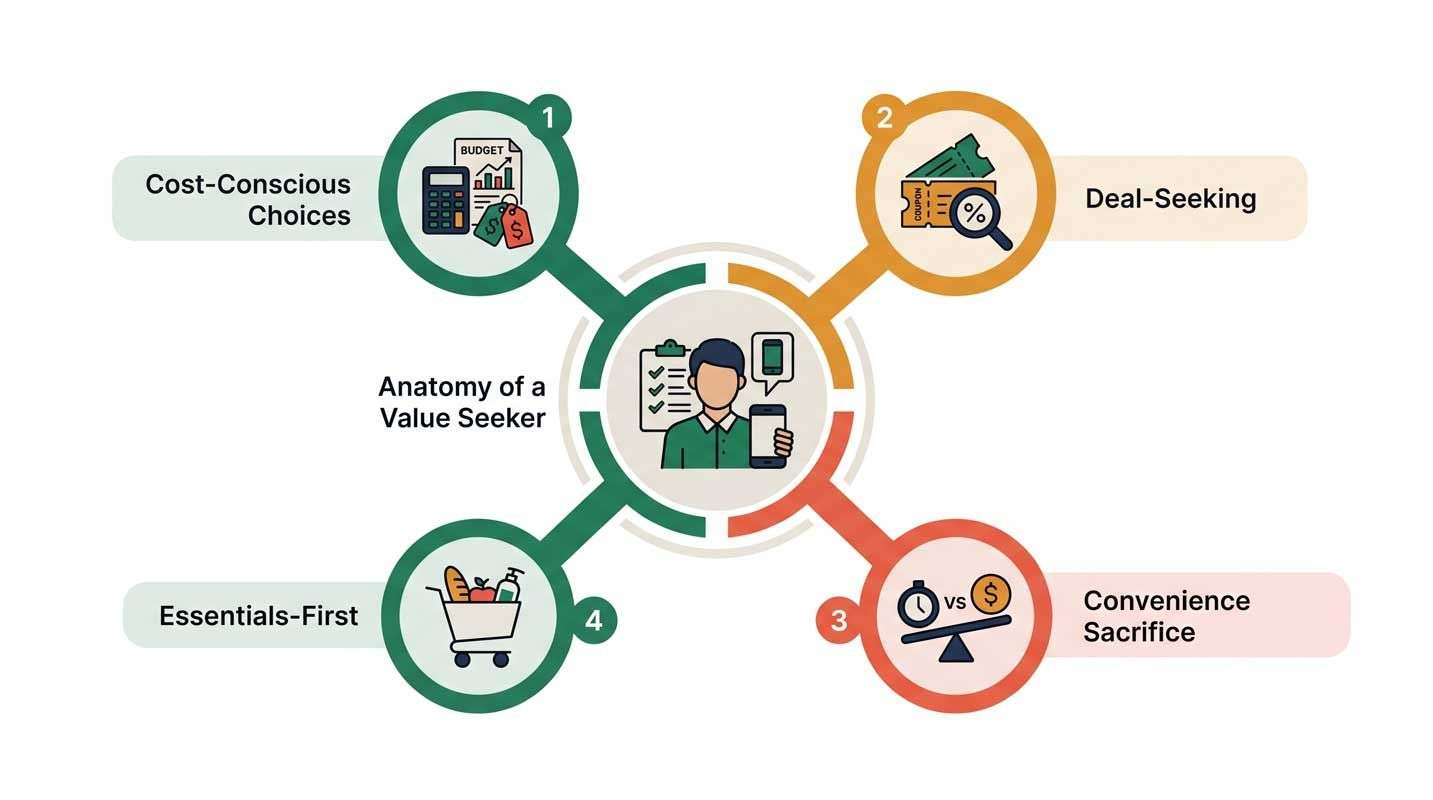 The value seeker defined: cost-conscious choices, deal-seeking, convenience sacrifice, and an essentials-first mindset.[/caption]
Why the Value Seeker Went Global
The value seeker is no longer confined to lower-income households or downturn economies. What began as inflation-driven coping has hardened into a worldwide behavioral norm, cutting across geographies that rarely move in unison.
The Synchronized Global Shift
Markets that historically diverged are now converging on the same instinct. Research spanning the U.S., Canada, Europe, Asia, and Australia demonstrates consistent patterns of economic bifurcation and behavioral shifts that transcend geographic boundaries. The most striking development is who has joined the movement. Consumers aged 65+ remain the most cautious, while high-income consumers, who last year indicated they would spend more, now expect a spending decline, reflecting the reach of ongoing economic pressures. Rbccm AlixPartners
This is the defining feature of today's market: financial anxiety is no longer a low-income phenomenon. When affluent households trade down and retailers like Dollar General report an influx of shoppers earning over $100,000, value-seeking behavior has clearly escaped its traditional segment. For research teams, this demands precise segmentation, our specialty audience recruitment helps brands locate these emergent value seekers wherever they hide.
Key Takeaway: The value seeker is now a cross-income, cross-border archetype, not a recession-bound minority.
How Financial Anxiety Reshapes Consumer Spending
Financial anxiety doesn't reduce spending uniformly; it redistributes it. Value seekers protect essentials and surgically cut everything else, creating a spending landscape that looks calm in aggregate but is violently reshuffling beneath the surface.
The Essentials-First Reallocation
The pattern is consistent worldwide. Shoppers plan to spend more on groceries, healthcare, and utilities, while cutting back on out-of-home dining, entertainment, and apparel, the lesson being that consumers are still buying, but prioritizing essentials and value over indulgence. Even grocery growth is deceptive: consumers anticipate net spending growth in groceries, though much of this is value-driven rather than volume-driven due to food inflation. NielsenIQ AlixPartners
Crucially, value-seeking is becoming methodical rather than panicked. Consumers are becoming more methodical in their grocery shopping, making detailed lists, planning meals ahead, and avoiding impulse purchases. This deliberateness makes the value seeker harder to win with promotion alone. Capturing intent at this granularity requires continuous tracking, which is where our CATI research capabilities deliver longitudinal precision. AlixPartners
[caption id="attachment_13186" align="aligncenter" width="1433"]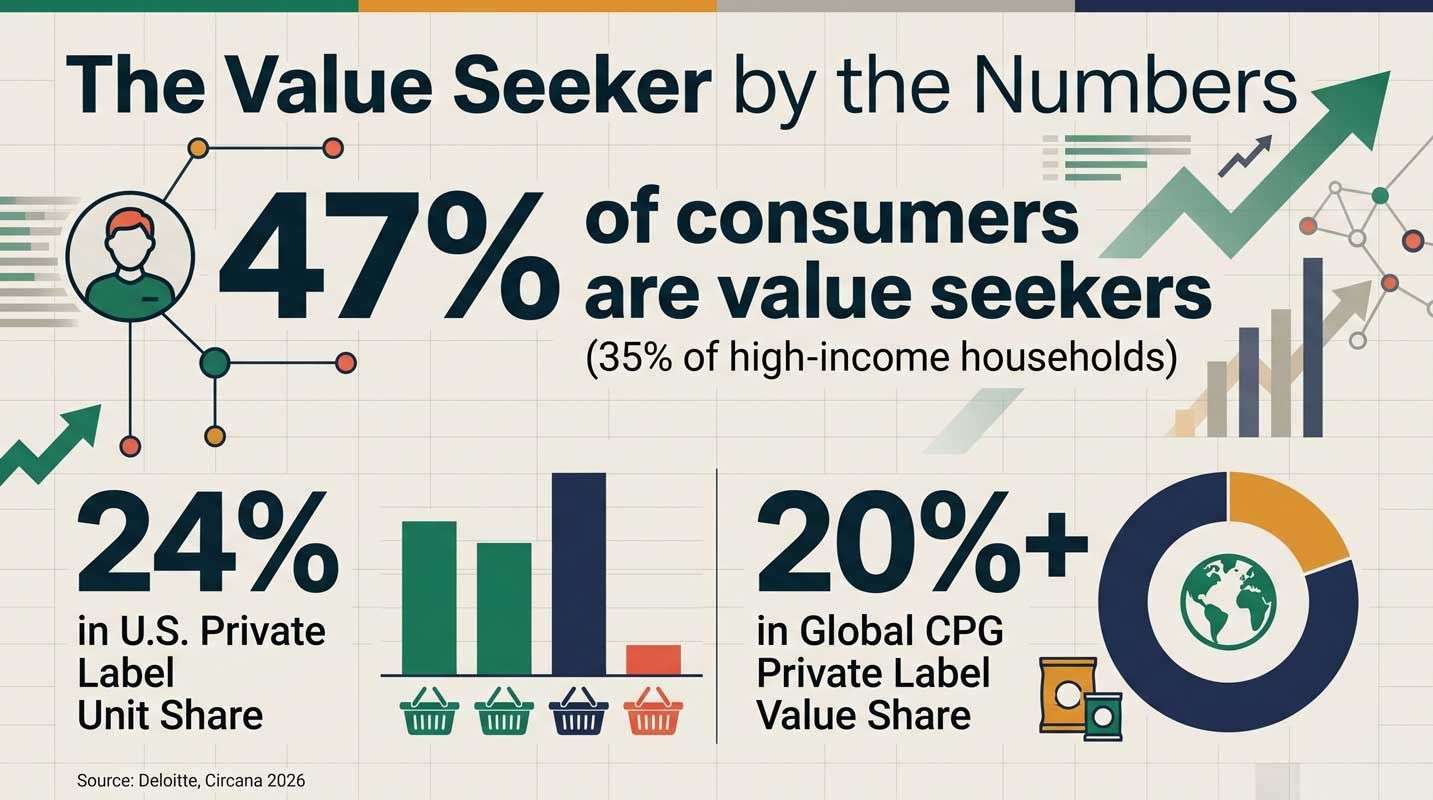 Value seeker statistics: 47% of consumers globally and private label reaching 24% U.S. unit share.[/caption]
Key Takeaway: Financial anxiety reallocates rather than eliminates spending, essentials win, discretionary loses.
The Value Seeker and the Private Label Surge
Nowhere is the value seeker's impact more visible than in private label, where the deal-driven shopper has transformed store brands from fallback to first choice across global consumer goods aisles.
From Fallback to First Choice
The numbers signal a structural reset. U.S. private-label sales reached $330 billion, accounting for 24% of unit share and 23% of dollar share in the market, while private labels now account for more than 20% of global CPG value sales, with a 1.4 percentage point increase in 2024 alone. Simon-Kucher's global study captures the deeper shift: private label is no longer a fallback, it is the first choice for many shoppers, with nearly half of consumers predominantly buying private labels and private labels dominating everyday essentials while brands are pushed into emotional and indulgent categories. Supermarket News + 2
The regional picture varies sharply. No category in Asia currently holds a private label market share of 20% or more, presenting a significant opportunity, a contrast that matters enormously for multinational brands. Understanding these market-by-market dynamics is core to our global fieldwork across EU, UK, APAC, and emerging markets. Innova Market Insights
[caption id="attachment_13187" align="aligncenter" width="1433"]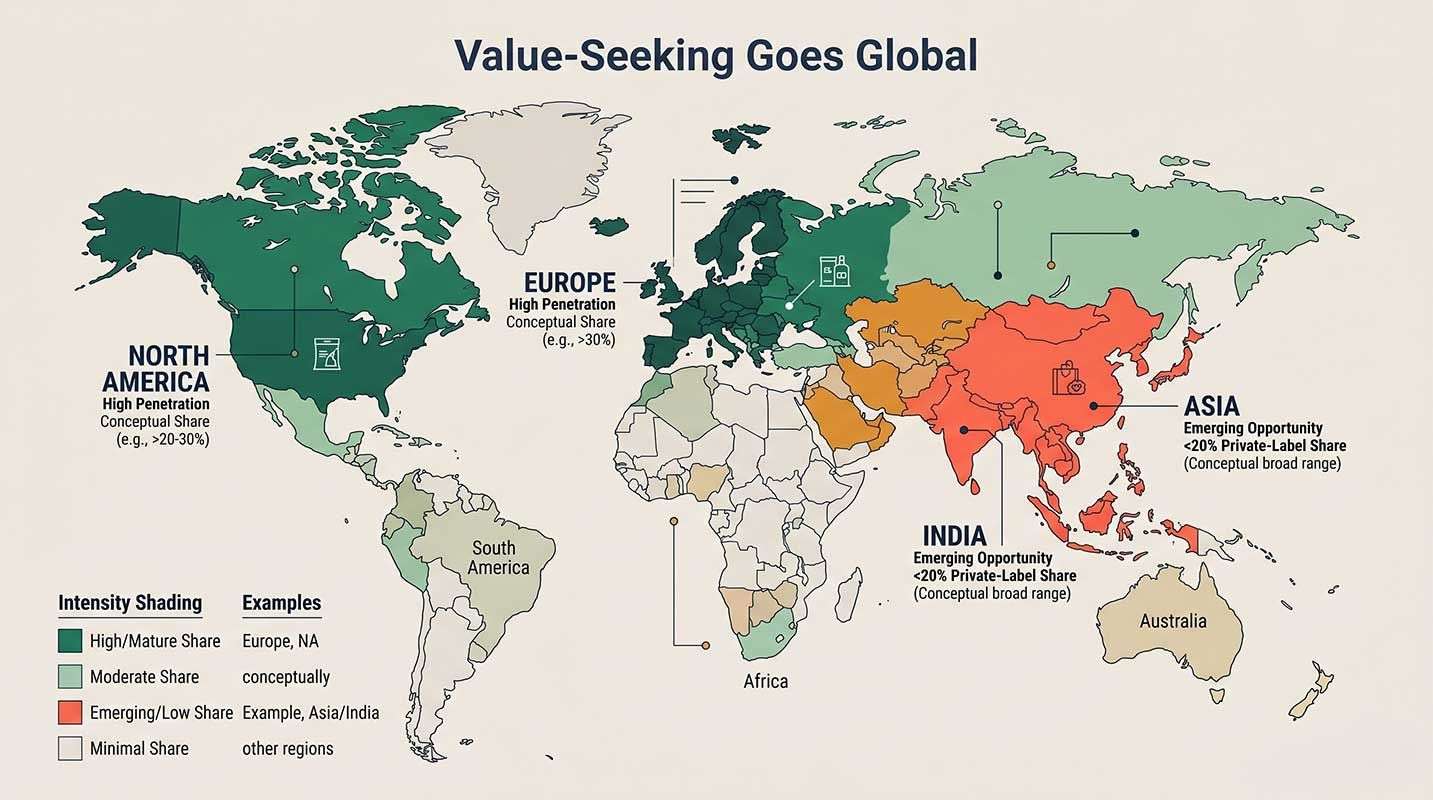 Value-seeking behavior intensity varies by region, with Asia and India representing the next private label frontier.[/caption]
Key Takeaway: Value seekers have made private label a structural pillar of consumer goods, not a budget afterthought.
Consumer Bifurcation: The Hidden Risk for Brands
Beneath the universal value seeker trend lies a widening split that makes one-size-fits-all strategy dangerous. Consumer bifurcation, the growing gulf between economic groups, means brands face two opposite customers at once.
Two Economies, One Brand
The divide is structural and deepening. Consumer bifurcation deepens globally with high-income households benefiting from investment gains while lower-income groups face rising essential costs. Deloitte frames the commercial consequence bluntly: growth will favor more-value-for-the-price brands that consistently feel "worth it" across price tiers, but only one-third of brands currently achieve that. Rbccm Deloitte
This bifurcation explains a confusing market signal, the simultaneous rise of frugality and "intentional indulgence." Seven in ten consumers opt for treats and small indulgences to cope with financial stress. The value seeker isn't simply spending less; they are spending with intent, splurging selectively while economizing ruthlessly elsewhere. Decoding which categories earn the splurge requires deep qualitative insight, the foundation of our qualitative recruitment practice. Capgemini
Key Takeaway: Bifurcation forces brands to serve frugality and indulgence simultaneously, generic positioning loses both.
Best Practices for Reaching the Value Seeker
Winning the value seeker requires moving from assumption to evidence. The brands gaining share are those that have rebuilt strategy around demonstrable worth, and five practices separate them from the rest.
Five Strategies for Value Seeker Markets
First, prove worth at every tier. With only a third of brands feeling "worth it," value seekers reward those that justify their price with tangible quality or function, price alone is no longer the deciding factor when financial anxiety meets skepticism.
Second, defend essentials and premiumize indulgence. Because private label now owns everyday categories, national brands should concentrate brand-building investment where emotion and indulgence still command loyalty.
Third, embrace AI-guided shopping. One-quarter of consumers have already used Gen AI shopping tools, while a further 31% plan to use them in the future, and value seekers will use these tools to find the best deal, so visibility within them is now a battleground. Capgemini
Fourth, track intent continuously, not annually. Value-seeking behavior shifts month to month; within nondiscretionary categories, pressure points kept shifting from April to May, with grocery spending intent jumping to its highest level since August 2025. Static research misses these turns. Deloitte Insights
Fifth, segment by behavior, not just demographics. Because high earners now behave like value seekers, traditional income-based targeting fails. Behavioral segmentation, built on rigorous fieldwork, is the only reliable map. This is precisely the ESOMAR-aligned methodology our data collection teams deploy globally.
[caption id="attachment_13188" align="alignnone" width="1433"]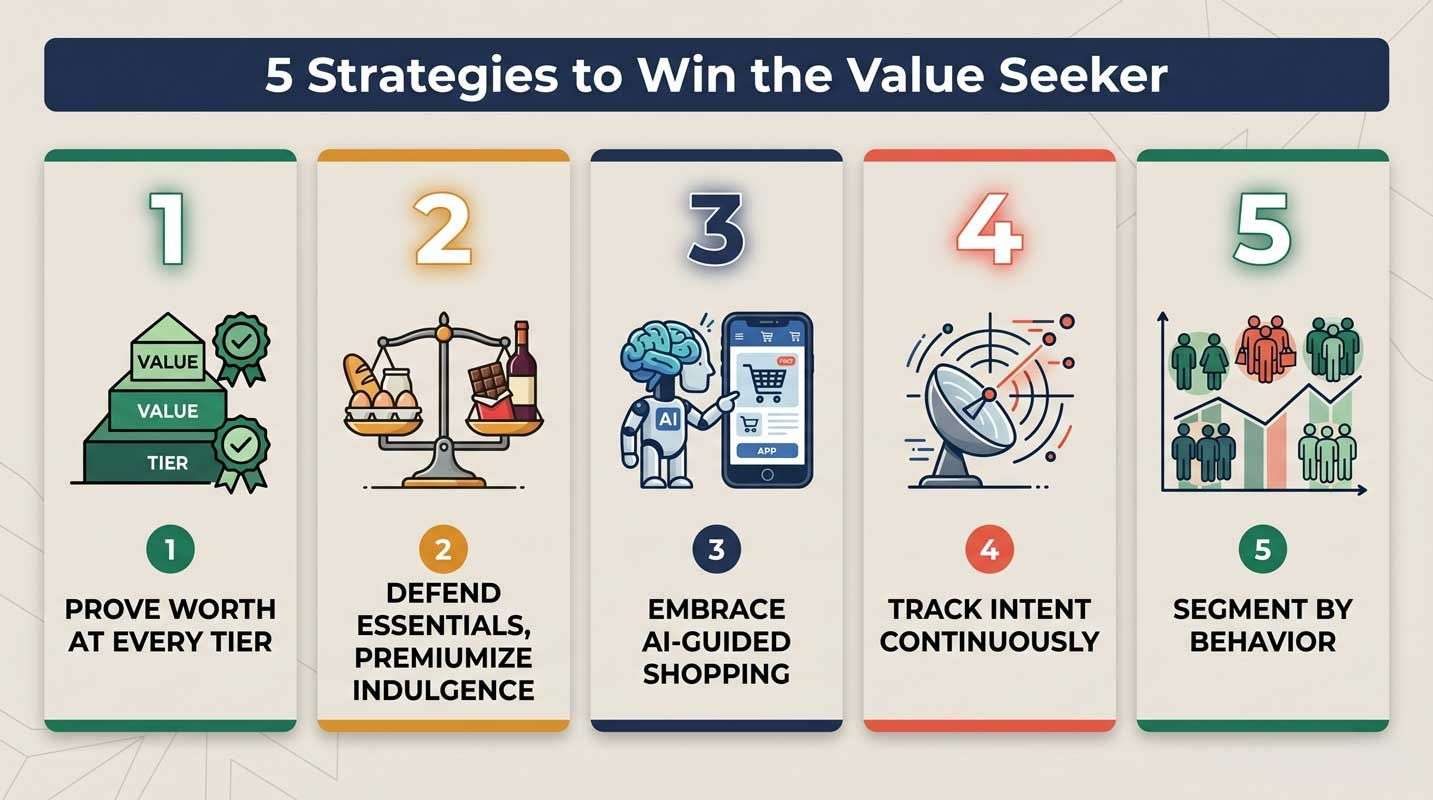 Five strategies for reaching the value seeker: prove worth, defend essentials, embrace AI shopping, track intent, segment by behavior.[/caption]
The Future of Value-Seeking Behavior
The value seeker is not a phase to wait out; it is the new baseline that consumer goods strategy must be built upon for the coming decade.
Emerging Trends in Value-Seeking
The trajectory points toward consolidation of retailer power and smarter, AI-mediated value hunting. 79% of executives expect power to shift further toward retailers over the next two to three years, driven by private label growth, retailer scale, and advantages in consumer data. Meanwhile, emerging markets, particularly Southeast Asia and India, represent the next frontier for both value-driven brands and the research that decodes them. Forward-thinking brands are investing in the intelligence to stay ahead; start by exploring our latest insights. Deloitte
Key Takeaway: The value seeker is a permanent structural force, brands that treat it as temporary will lose the next decade.
Conclusion: Why the Value Seeker Demands a New Playbook
The value seeker has become the defining consumer of our era, and financial anxiety has converted what was once cyclical caution into a permanent reshaping of consumer goods markets worldwide. From private-label dominance to deepening bifurcation and AI-guided shopping, the brands that thrive will be those built on evidence rather than assumption.
At Research and Metric, our teams worldwide track these behavioral shifts at the source, combining specialist fieldwork with AI-driven analytics to turn consumer uncertainty into commercial clarity. As value-seeking hardens into the global norm, the question is no longer whether your customers are value seekers, but whether you understand them well enough to earn their basket.
Ready to decode the value seeker in your market? Contact Research and Metric today to discover how our AI-powered fieldwork solutions transform your data into actionable intelligence.
FAQ: The Value Seeker
What is a value seeker and why do value seekers matter?
Value seekers are consumers who regularly make cost-conscious choices, deal-driven purchases, and convenience sacrifices to manage household budgets. Value seekers matter because they now represent nearly half of consumers globally, including a third of high-income households, turning value scrutiny into a mainstream expectation that is permanently reshaping consumer goods strategy across every income tier and market worldwide.
How do value seekers impact consumer goods brands?
The impact of value seekers on consumer goods is structural, not cyclical. Value seekers push national brands into emotional and indulgent categories while private labels dominate everyday essentials. Brands must now justify every price point, prove they are "worth it" across tiers, and compete on demonstrable value rather than habit-based loyalty, forcing fundamental portfolio and pricing reinvention for the value seeker era.
What are the key trends in value seeker behavior for 2026?
Key trends in value seeker behavior include deepening consumer bifurcation between income groups, private-label adoption exceeding 20% of global CPG value sales, premium brand trade-downs, growth of club and dollar channels, and rising AI shopping tool use. Value seekers are spending smartly on essentials like groceries while cutting discretionary categories such as dining, apparel, and entertainment.
What ROI can businesses expect from understanding value seekers?
Businesses that leverage value seeker insights typically see stronger pricing power, reduced trade-down losses, and sharper portfolio decisions. Understanding value seekers lets brands identify which categories justify premiums, where private label threatens share, and how to design "worth it" offers. Robust fieldwork on value seeker segments converts market uncertainty into precise, defensible commercial strategy and measurable basket retention.
How can Research and Metric help with value seeker research?
Research and Metric supports clients with value seeker research through specialist global fieldwork worldwide, combining online data collection, CATI, and qualitative recruitment with AI-driven analytics. We help brands segment value seekers, track shifting spending intent, and quantify trade-down risk. Learn more about our services to turn value seeker behavior into actionable intelligence.


