
Key takeaways
- Most failed expansions trace back to inadequate pre-entry research rather than poor execution, and seventy percent of international expansions miss projected ROI within three years.
- Brands must understand local consumers beyond demographics, examining cultural values, emotional drivers and purchasing behaviour, because home-market success does not translate automatically.
- Competitive analysis should map the whole ecosystem of local incumbents, earlier international players and disruptors, to reveal genuine gaps and vulnerabilities.
- Regulatory compliance and operational feasibility, including supply chains and distribution, must be validated before entry, since unanticipated barriers can add months or years to timelines.
- Financial models need primary research on pricing, adoption and market size, and the final test is whether market timing and the organisation's own readiness align.
On this page 9 sections
- Why New Market Entry Fails: The Research Gap
- Question 1: Who Are You Really Selling To?
- Question 2: What Competitive Gaps Actually Exist?
- Question 3: Can You Actually Execute Here?
- Question 4: What Will This Actually Cost and Generate?
- Question 5: Is Now the Right Moment?
- Building Your New Market Entry Strategy
- Frequently Asked Questions About New Market Entry
- FAQ Section
Successful new market entry separates thriving global brands from those forced into costly retreats. Yet seventy percent of international expansions fail to meet projected ROI within three years. What makes the difference? The questions brands ask, or fail to ask, before committing resources to unfamiliar territory.
Entering a new market is one of the most significant strategic decisions any organisation can make. Whether targeting emerging economies in APAC, established markets across the EU, or high-growth regions in the Middle East, the stakes are enormous. According to Harvard Business Review, failed international expansions cost companies an average of $60 million in direct losses, not counting opportunity costs and brand damage.
At Research and Metric, we've guided brands through these decisions across global markets. Therefore, this guide distils the five essential questions that separate successful expansion strategies from expensive missteps.
[caption id="attachment_11948" align="alignleft" width="800"] Evaluating global expansion pathways[/caption]
Why New Market Entry Fails: The Research Gap
Before examining the five critical questions, it helps to understand why expansion fails so often. McKinsey research reveals that 65% of failed expansions trace back to inadequate pre-entry research rather than execution problems.
The pattern repeats across industries. For example, brands assume home-market success translates automatically, underestimate local competition, or miscalculate regulatory timelines. As a result, successful international expansion requires systematically addressing five fundamental questions before any launch commitment.
Question 1: Who Are You Really Selling To?
Understanding Local Consumer Behavior
The first question every brand must answer before entering a new market goes far beyond basic demographics. Understanding your actual target audience requires examining cultural values, purchasing behaviours, and unmet needs that create genuine opportunity. Strong consumer insights make this possible.
Consumer behaviour varies dramatically across regions. For example, product positioning that resonates strongly with UK consumers may fall flat in Southeast Asian markets. The reason is not language barriers, but fundamentally different relationships with brands, authority, and purchasing decisions. In addition, research indicates that localised consumer understanding accounts for nearly 40% of variance in new market entry success rates.
Effective market research methodologies approach this challenge through multiple angles. Quantitative surveys, for example, establish baseline preferences and price sensitivity across segments. Qualitative research, however, uncovers emotional drivers and cultural contexts that numbers alone cannot reveal.
Industry-Specific Consumer Variations
For example, consider healthcare, where patient-provider relationships differ substantially between markets. Or retail, where the balance between online and offline purchasing varies not just by country but by product category. Technology adoption curves, trust in foreign brands, and even colour associations all require investigation. Therefore, brands should complete this work before finalising positioning for any expansion initiative.
Key Takeaway: Consumer understanding for a successful market expansion strategy requires examining cultural, emotional, and behavioural factors beyond surface demographics.
Question 2: What Competitive Gaps Actually Exist?
Mapping the Complete Competitive Landscape
Before entering a new market, brands must develop clear-eyed views of competitive landscapes. Instead, these views should reflect not how the landscape appears from headquarters, but how local consumers experience it daily.
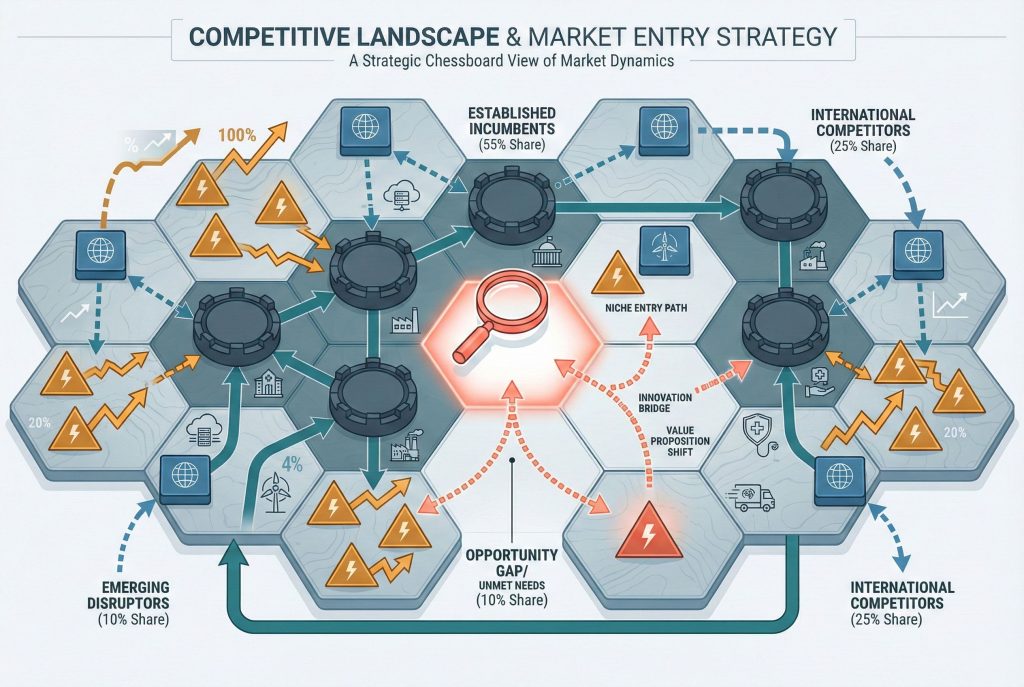
Competitive analysis for international expansion extends beyond identifying direct competitors. It requires mapping entire ecosystems: local incumbents with established distribution networks, international players who arrived earlier, and emerging disruptors reshaping categories. According to Boston Consulting Group, understanding competitive dynamics before new market entry prevents costly discovery of obstacles that research could have anticipated.
Finding Genuine Market Opportunities
Financial services illustrate this complexity well. For example, a fintech solution successful in the UK faces entirely different competitive dynamics in Germany, where traditional banking relationships remain stronger. In India, however, mobile-first competitors have captured significant market share.
Research and Metric approaches competitive intelligence through primary research with market participants. In addition, it combines this with AI-driven analysis of market signals: pricing patterns, promotional strategies, distribution coverage, and consumer sentiment toward existing players.
Key Takeaway: Comprehensive competitive analysis reveals not just market occupants, but strategic gaps and vulnerabilities that create genuine opportunities.
Question 3: Can You Actually Execute Here?
Regulatory Environment Assessment
Market attractiveness means nothing if regulatory barriers, operational complexities, or infrastructure limitations prevent effective execution. This essential question forces brands to examine whether they can actually deliver on their promises.
Regulatory environments vary enormously. For example, data privacy regulations differ between the EU's GDPR framework, evolving UK standards, and the patchwork of requirements across APAC nations. The World Trade Organization reports that product certifications, labelling requirements, import restrictions, and sector-specific regulations can add months or years to entry timelines when not anticipated early.
Operational Feasibility Factors
Beyond regulations, operational feasibility demands attention. Supply chain infrastructure, logistics capabilities, payment processing options, and talent availability all influence whether expansion can succeed at scale. Markets may offer attractive consumer demand. However, if distribution networks cannot reliably reach those consumers, opportunities remain theoretical.
Research and Metric's market feasibility studies examine practical dimensions alongside consumer and competitive factors. Our global network across EU, UK, and APAC markets provides on-the-ground perspective. Desktop research, by contrast, cannot capture this.
Key Takeaway: Regulatory compliance and operational feasibility must be validated before entering a market, as practical barriers undermine even the most attractive opportunities.
Question 4: What Will This Actually Cost and Generate?
True Investment Requirements
Financial modelling for a market launch requires honest assessment of both investment requirements and realistic revenue projections. These projections should rest on market data rather than optimistic assumptions.
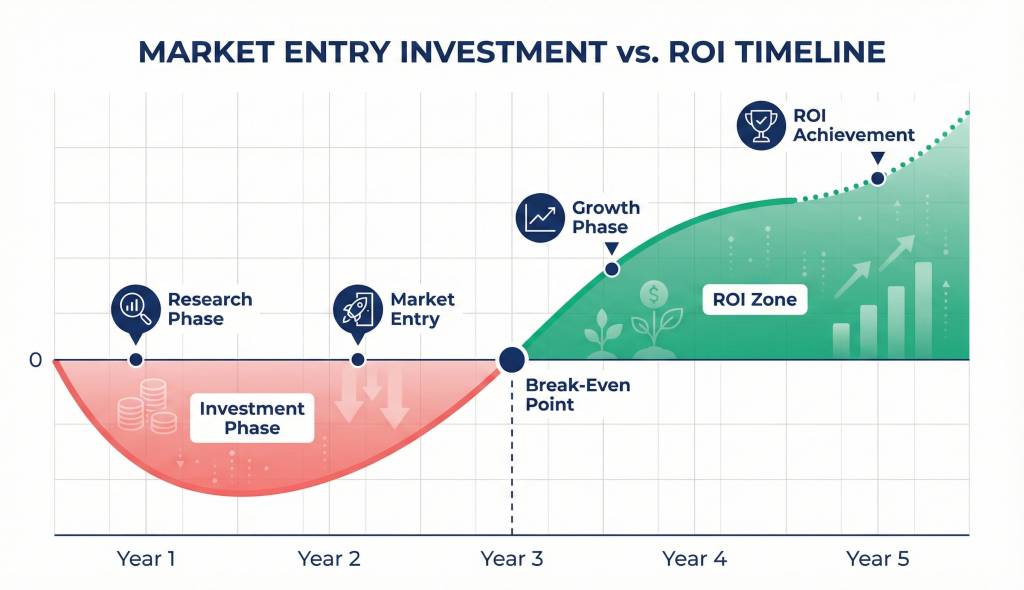
Expansion costs extend far beyond initial launch expenses. Building brand awareness in markets without established presence requires sustained investment. Similarly, distribution partnerships demand margin concessions. Local team development, regulatory compliance, and market-specific product adaptations all add to true costs that many brands underestimate.
Bain & Company research shows that brands underestimating these requirements often find themselves underfunded mid-launch. As a result, they must inject additional capital or accept suboptimal market positions.
Realistic Revenue Projections
Revenue projections must account for realistic market penetration timelines. Consumer adoption curves vary by market and category. For example, what takes eighteen months in one market may require three years in another. Pricing assumptions must also reflect local competitive dynamics and consumer price sensitivity.
Research and Metric's approach combines quantitative survey data with AI-powered predictive analytics. As a result, this generates financial projections that clients can defend to boards and investors planning an expansion.
Key Takeaway: Accurate financial modelling requires primary research into pricing, adoption rates, and market size, not assumptions extrapolated from other markets.
Question 5: Is Now the Right Moment?
Market Timing Considerations
The final essential question examines timing from two perspectives. First, are markets ready for your new market entry? Second, is your organisation ready for the demands of expansion?
Market timing involves understanding where categories sit in development cycles. Entering too early means educating consumers at your expense while competitors wait. Conversely, entering too late means fighting for share in mature markets against established players with deeper local roots.
Gartner emphasises that identifying the right window requires ongoing market monitoring, not point-in-time analysis. The right window is where consumer readiness meets competitive opportunity.
Organizational Readiness Assessment
Organisational readiness proves equally important. Brand expansion demands executive attention, organisational capacity, and strategic focus. However, brands that attempt expansion while managing internal challenges, such as acquisition integrations, leadership transitions, or operational transformations, often find their efforts starved of required attention.
Research and Metric helps clients assess both market and organisational readiness through structured frameworks refined across hundreds of market entry engagements. Contact our team to ensure optimal timing for your growth strategy.
Key Takeaway: Successful expansion requires alignment between market opportunity timing and organisational readiness to execute effectively.
Building Your New Market Entry Strategy
Expanding into new markets offers tremendous growth potential, but only for brands approaching new market entry with rigour and discipline. The five questions outlined here form the foundation of a successful expansion strategy: understanding consumers, mapping competition, validating operational feasibility, modelling financials accurately, and assessing timing.
The cost of getting these questions wrong is measured not just in failed investments, but in opportunity costs. Markets you could have entered successfully go untouched while resources are tied up in unsuccessful expansions. Brand reputation also suffers after public retreats.
Ready to explore your next market with confidence? Contact Research and Metric today to discover how our AI-powered research solutions transform global market entry decisions from calculated risks into strategic advantages.
For more insights on international market research strategies, explore our research insights blog or learn about our full range of market research services.
Frequently Asked Questions About New Market Entry
What is new market entry and why do most attempts fail?
It is the strategic process of launching products or services in geographic markets where brands have no existing presence. Approximately 70% of attempts fail to meet ROI targets, primarily due to inadequate consumer research, underestimated competitive pressures, and unrealistic financial projections.
How long does comprehensive market entry research take?
Thorough pre-entry research typically requires eight to twelve weeks. AI-powered analytics can accelerate certain components. However, primary research with consumers and market participants requires adequate time for quality data collection. Learn more about our research timelines.
What ROI should brands expect from market expansion research?
Pre-entry research typically represents 1-3% of total expansion investment, but it directly influences success probability for the remaining 97-99%. Brands investing in rigorous research consistently report higher satisfaction with outcomes than those proceeding on limited information.
Which industries benefit most from market entry research?
All industries benefit from structured research. However, consumer goods, healthcare, financial services, and technology sectors particularly gain due to regulatory complexity and consumer behaviour variation across markets. Explore our industry-specific solutions.
How does Research and Metric approach market entry differently?
Research and Metric combines traditional primary research methodologies with AI-powered analytics. As a result, this delivers faster, more comprehensive insights for planning global market entry. Our presence across global markets provides on-the-ground perspective that desktop research cannot match. Learn more about our unique approach.
FAQ Section
What is the most important factor in market entry success?
While all factors matter, consumer understanding typically has the greatest impact. Brands that accurately understand local consumer behaviour, preferences, and cultural contexts show significantly higher success rates. By contrast, brands relying on assumptions from other markets see lower success rates.
How long does comprehensive market entry research take?
Timeline varies by scope. However, comprehensive market feasibility studies typically require eight to twelve weeks. AI-powered analytics can accelerate certain components, but primary research with consumers and market participants requires adequate time for quality data collection.
What ROI should brands expect from market entry research?
Market entry research typically represents 1-3% of total market entry investment. It directly influences the success probability of the remaining 97-99%. Brands that invest in rigorous pre-entry research consistently report higher satisfaction with market entry outcomes than those that proceed on limited information.
Which industries benefit most from market entry research?
All industries benefit. However, consumer goods, healthcare, financial services, and technology sectors particularly gain from structured market entry research, due to their regulatory complexity and consumer behaviour variation across markets.
How does Research and Metric approach market entry research differently?
Research and Metric combines traditional primary research methodologies with AI-powered analytics. As a result, this delivers faster, more comprehensive consumer insights. Our presence across global markets provides on-the-ground perspective that pure desktop research cannot match.
Get new articles by email
Useful tips on surveys and research. One email when we post something new. Unsubscribe anytime.