Introduction
Something significant is happening in boardrooms, research labs, and marketing departments across the globe. Despite a decade-long obsession with big data, predictive algorithms, and AI-generated dashboards, brands are quietly and urgently turning back to the human voice.
Qualitative research trends in 2026 signal a decisive shift: the data-rich but context-poor era of pure quantitative measurement is giving way to something more textured, more truthful, and ultimately more useful for business decision-making.
Qualitative research trends in 2026 are defined by a return to human-centered methodologies including in-depth interviews, ethnographic observation, and digital focus groups as brands seek the contextual intelligence that quantitative data cannot provide. This shift, accelerated by AI-assisted analysis tools, is reshaping how research agencies deliver consumer intelligence to their clients.
According to ESOMAR's Global Market Research Report, the qualitative segment is experiencing renewed investment as organizations recognize that numbers alone rarely explain the why behind consumer behavior. For research agencies navigating this landscape, the strategic question is no longer whether to invest in qualitative methods but how to execute them with greater scale, speed, and analytical depth.
At Research and Metric, our qualitative recruitment services and global fieldwork capabilities worldwide position specialist research agencies to capture the human stories that drive actionable intelligence. With 18+ years of combined leadership experience in market research and ESOMAR-aligned methodologies, we have seen this shift building for years.
[caption id="attachment_13046" align="alignleft" width="800"]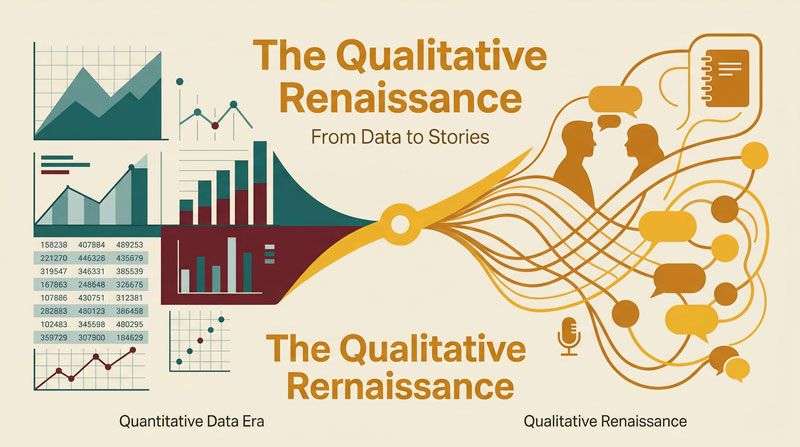 Consumer insights 2026 data shows qualitative research growing at 7.2% CAGR - outpacing several quantitative segments.[/caption]
The Rise, Fall, and Qualitative Research Trends Renaissance
The story of qualitative research trends mirrors the broader arc of business strategy: a pendulum that swings between extremes before finding its productive equilibrium.
In the 1990s and early 2000s, qualitative methods were considered the cornerstone of any serious consumer research program. Focus groups, ethnographic studies, narrative research, and in-depth interviews were the primary tools through which brands understood their customers' lives, motivations, and choices. Then the data revolution arrived and everything changed.
The Quantitative Decade and Its Hidden Cost
The rise of digital analytics, social listening platforms, and AI-powered consumer profiling created an irresistible promise: near-real-time, large-scale behavioral data at a fraction of the cost of traditional fieldwork. Brands shifted research budgets decisively toward quantitative methods. Online surveys scaled to tens of thousands of respondents. Web analytics replaced observation. Consumer sentiment was reduced to a net promoter score.
But something essential was lost in translation. Consumer behavior, it turns out, is stubbornly resistant to purely numerical explanation. A tracking survey can tell you that 68% of consumers prefer Brand A over Brand B. It cannot tell you why the childhood memory, the social aspiration, or the environmental conviction that underpins that preference.
By 2024, a growing body of evidence from McKinsey's consumer decision journey research to ESOMAR industry surveys pointed to a widening gap between what brands thought they knew about consumers and what consumers actually experienced, felt, and believed. The qualitative research renaissance was no longer a hypothesis. It was a measurable trend.
Key Takeaway: Qualitative research trends in 2026 represent a deliberate course correction the strategic recognition that numbers need context, and data requires meaning to become intelligence.
Human-Centered Research Methods Driving Consumer Insights 2026
The resurgence of qualitative research trends is emphatically not a nostalgic return to the focus group facility of 2005. The methodologies have evolved dramatically, powered by technology that enables deeper, faster, and more globally consistent qualitative data collection than was ever previously possible.
In-Depth Interviews, Digital Ethnography, and the New Qualitative Toolkit
In-depth interviews remain the gold standard for capturing authentic consumer perspective and behavioral insights. In 2026, the modality has fundamentally shifted: online IDIs conducted via video platforms now span time zones and geographies that were previously impractical for qualitative fieldwork programs. A research agency in London can conduct in-depth interviews simultaneously in Singapore, São Paulo, and Nairobi with real-time transcription and thematic analysis running in parallel.
Digital ethnography observing consumers within their natural digital environments has emerged as one of the fastest-growing qualitative research methods in the consumer insights 2026 landscape. Researchers observe actual shopping journeys, social media behavior, and product interactions in real time, generating rich behavioral data no survey instrument can replicate.
[caption id="attachment_13050" align="alignleft" width="800"]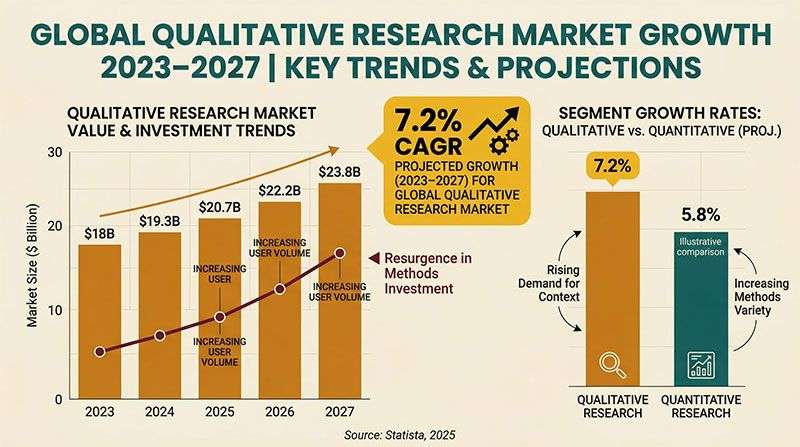 Consumer insights 2026 data shows qualitative research growing at 7.2% CAGR - outpacing several quantitative segments.[/caption]
According to Statista's 2025 Market Research Industry Outlook, the global qualitative research market is projected to grow at approximately 7.2% CAGR through 2027, outpacing several major quantitative research segments. Research agencies that maintain robust qualitative fieldwork capabilities including specialist online data collection and digital recruitment infrastructure are positioned to capture a disproportionate share of this growth.
Focus groups methodology has similarly evolved. Traditional in-person focus groups are being supplemented and in many cases replaced by asynchronous online communities, mobile ethnography platforms, and AI-moderated group discussions that produce richer qualitative data at greater scale.
Key Takeaway: Modern qualitative research trends combine the interpretive depth of traditional fieldwork with the scale and speed of digital research infrastructure delivering consumer insights 2026 at a cost and velocity that was impossible five years ago.
Global Qualitative Data Collection: The Multi-Market Fieldwork Imperative
One of the most persistent limitations of qualitative market research was always scale: meaningful qualitative work was slow, expensive, and geographically constrained. The qualitative research trends emerging in 2026 are breaking all three of these constraints simultaneously and reshaping how global brands commission consumer insight programs.
Multi-Market Qualitative Fieldwork in Practice
Brands with global footprints particularly in FMCG, pharmaceutical, automotive, and financial services now require qualitative consumer insights that span multiple markets concurrently rather than sequentially. A brand launching simultaneously in Southeast Asia, Western Europe, and Latin America cannot afford three sequential qualitative research waves separated by six-week fieldwork intervals. They require parallel ethnographic research and in-depth interviews running across all markets at once, with consistent recruitment standards, moderation guidance, and analytical frameworks.
[caption id="attachment_13051" align="alignleft" width="800"]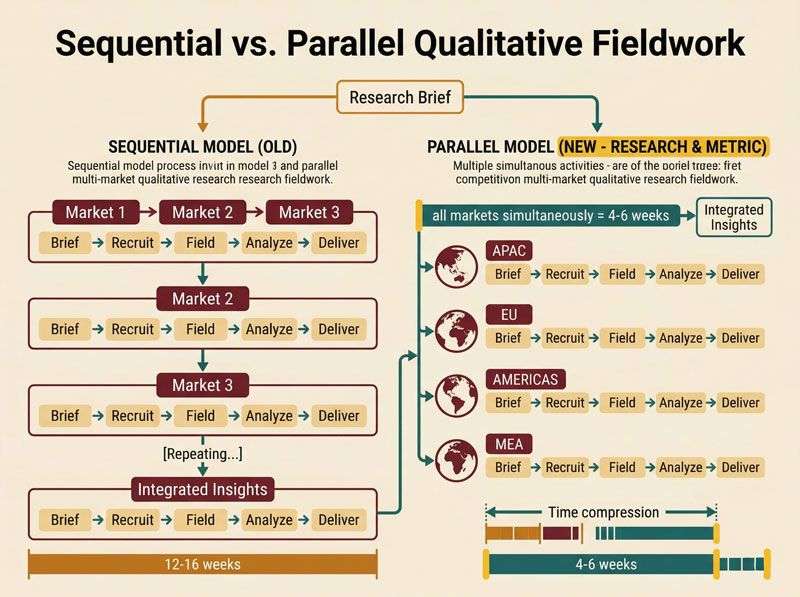 Qualitative data collection worldwide simultaneously - Research and Metric's global fieldwork model compresses research timelines from 16 weeks to 6.[/caption]
This is precisely where specialist fieldwork partners define their competitive value. Research and Metric's global fieldwork capabilities span global markets, enabling research agencies to execute simultaneous qualitative programs across geographically dispersed markets with standardized recruitment quality controls, local cultural intelligence, and real-time project management.
The practical result for qualitative data collection programs: research waves that once required 12–16 weeks of sequential fieldwork can be compressed into 4–6 week parallel windows, dramatically accelerating brand decision-making cycles. The qualitative methodology does not change; the operational architecture that supports it does.
Thematic analysis across markets is also being enhanced by AI-powered coding tools that identify patterns across hundreds of hours of qualitative data while retaining the human interpretation layer that gives qualitative research its genuine strategic value. This is narrative research operating at a scale that was unimaginable in the traditional fieldwork era.
Key Takeaway: Qualitative research trends in 2026 are globally scalable provided research agencies partner with fieldwork specialists who have genuine multi-market presence and proven recruitment infrastructure.
AI-Enhanced Qualitative Research: The New Competitive Advantage
Perhaps the most transformative shift in qualitative research trends for 2026 is the systematic integration of artificial intelligence into the qualitative research workflow not as a replacement for human judgment, but as a powerful amplifier of it.
AI Tools Redefining Qualitative Data Collection Economics
Traditional qualitative analysis was a significant bottleneck in the research process. A skilled researcher could meaningfully analyze approximately 8–12 in-depth interviews per working day. AI-assisted thematic analysis platforms can now process transcripts from 50–100 interviews in the same timeframe automatically flagging emerging themes, consumer sentiment patterns, and linguistic anomalies for human researcher review.
This development has fundamentally altered the economics of human-centered research. Projects that previously required large analyst teams and extended timelines are being delivered faster and at greater analytical depth. Research from Gartner's 2025 Research Technology Report indicates that AI-augmented qualitative research delivers up to 40% faster time-to-insight compared to traditional qualitative analysis workflows.
Importantly, AI is not homogenizing qualitative output or replacing the interpretive work that makes qualitative research valuable. The contextual, culturally nuanced, and phenomenologically complex aspects of qualitative methodology remain fundamentally human activities. AI processes the volume; human researchers construct the meaning. This distinction matters enormously for research agencies committed to delivering genuine strategic insight rather than automated sentiment summaries.
At Research and Metric, our AI-powered approach integrates automated quality monitoring, intelligent participant screening, and real-time data validation across our specialty audiences recruitment programs ensuring that the human stories captured in qualitative fieldwork are both authentic and analytically robust from the moment of collection.
Key Takeaway: AI integration is amplifying not replacing the human intelligence that makes qualitative research trends meaningful for brand strategy in 2026.
Best Practices for Qualitative Research Trends in 2026
For research agencies and brand teams seeking to leverage qualitative research trends effectively, the following strategic principles define best-in-class practice in the current landscape.
Five Strategies for Qualitative Research Excellence
[caption id="attachment_13053" align="alignnone" width="644"]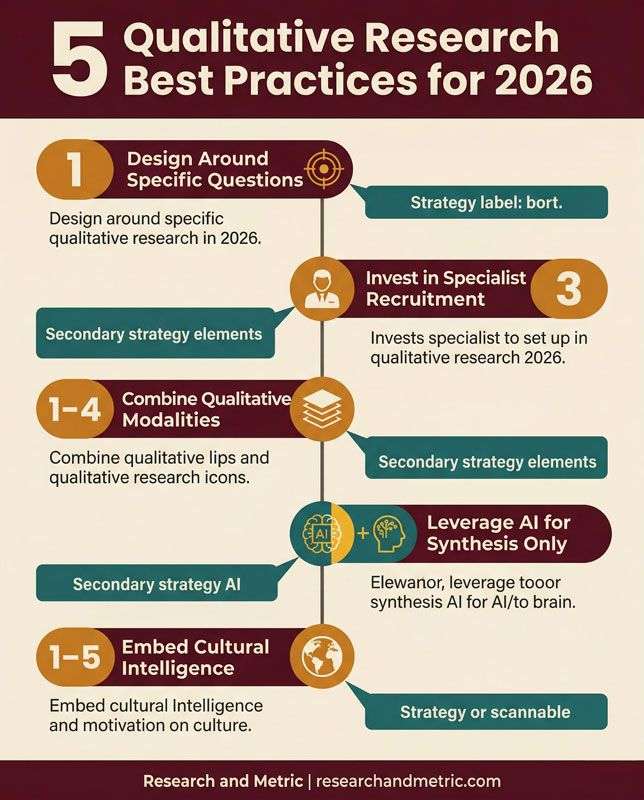 Five strategies for qualitative research excellence in 2026 — from specialist recruitment to AI-enhanced analysis.[/caption]
First, design qualitative research around specific strategic questions rather than broad topic areas. Qualitative research trends data consistently shows that the most actionable consumer insights 2026 programs are scoped narrowly interrogating specific decision moments, emotional triggers, or usage contexts rather than attempting to map general brand attitudes.
Second, invest in specialist recruitment for qualitative research participants. The quality of qualitative insights is entirely contingent on the quality of the people who provide them. Specialty research audiences healthcare professionals, high-net-worth individuals, B2B decision-makers, category enthusiasts require dedicated recruitment expertise that generalist panel providers cannot reliably deliver. Research and Metric's specialty audiences service is purpose-built for exactly this requirement, with verified recruitment across 35+ global markets.
Third, combine qualitative modalities for triangulated insights rather than relying on any single method. Effective qualitative research trends frameworks in 2026 layer online IDIs, digital ethnography, and projective techniques each revealing different dimensions of consumer experience that the others cannot capture alone.
Fourth, leverage AI for synthesis and pattern recognition, not for data collection. The human-centered research process requires authentic human connection at the fieldwork stage. AI's legitimate role in qualitative research is in transcript processing, thematic coding, and cross-market pattern analysis not in replacing the interview dynamic that generates genuine consumer narrative.
Fifth, embed deep cultural intelligence into every multi-market qualitative research design. Consumer insights 2026 programs spanning APAC, EU, Americas, and MEA markets require locally calibrated recruitment, facilitation, and interpretation not a single discussion guide translated into 15 languages. This is where the brand storytelling research emerges: in the culturally authentic stories that only locally grounded fieldwork can surface.
The Future of Qualitative Research Trends Through 2027 and Beyond
Emerging Qualitative Research Trends Shaping the Next Phase
[caption id="attachment_13055" align="alignleft" width="800"]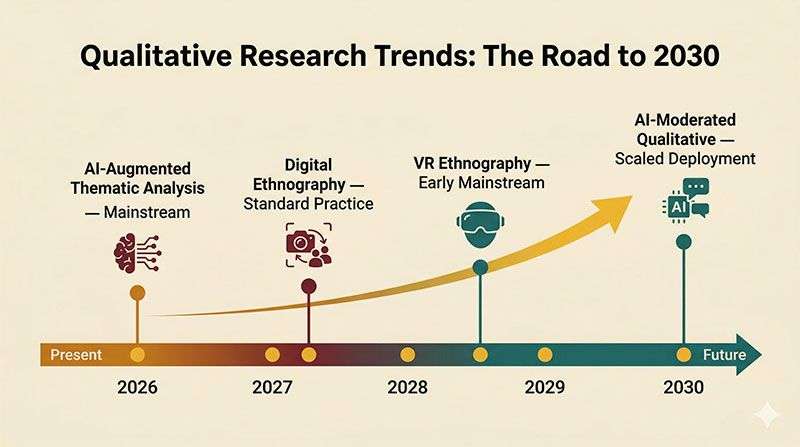 Qualitative research trends through 2030: from AI-augmented analysis to VR ethnography and AI-moderated fieldwork at scale.[/caption]
The qualitative research trends trajectory for 2026 and beyond points to several interconnected developments that will continue reshaping how research agencies deliver human-centered insight to brand clients.
Immersive qualitative methods including virtual reality ethnography and augmented reality product placement testing are transitioning from experimental to mainstream. Brands in retail, automotive, and real estate are already using VR environments to simulate consumer contexts that are otherwise impossible to replicate, enabling qualitative researchers to observe decision behaviors in high-fidelity purchase simulations.
Passive behavioral observation layered alongside active qualitative participation is creating powerful hybrid research designs. These hybrid frameworks combine what consumers do (behavioral and biometric data) with what they say (narrative research and interview data) resolving the persistent gap between stated preference and revealed behavior that has challenged market research methodology for decades.
AI-moderated asynchronous qualitative research is emerging as a scalable format for initial qualitative exploration, with conversational AI conducting screening-level qualitative interviews at volume before human researchers engage with highest-priority participants for deep qualitative work.
Brands and research agencies that invest strategically in qualitative research capabilities now building specialist recruitment networks, multi-market fieldwork infrastructure, and AI-enhanced thematic analysis workflows will define the competitive advantage in consumer intelligence through 2030. The window to build this capability is open, but it will not remain open indefinitely.
Research and Metric's CATI and fieldwork services provide the foundational infrastructure for agencies ready to scale qualitative programs across global markets. We invite you to explore our full capabilities to understand how we can support your qualitative research agenda.
Key Takeaway: Qualitative research trends in 2026 represent not a temporary correction but a structural realignment of how the industry invests in understanding the humans it serves.
Conclusion: Qualitative Research Trends Are Redefining Consumer Intelligence
Qualitative research trends in 2026 confirm what the most insightful brand strategists have long understood: numbers describe behavior, but human stories explain it.
The qualitative renaissance is not a retreat from data it is a recognition that data without interpretive context is incomplete intelligence. The brands building durable competitive advantages in consumer understanding are those combining the analytical power of quantitative research with the contextual depth of qualitative methodologies, executed at global scale with the precision that specialist fieldwork infrastructure enables.
At Research and Metric, our teams worldwide deliver specialist qualitative recruitment, human-centered research, and AI-enhanced fieldwork capabilities that help research agencies capture the human stories behind the numbers. With 18+ years of combined leadership experience and ESOMAR-aligned qualitative market research methodologies, we are purpose-built for the era of qualitative intelligence.
Ready to capture the human stories driving your consumers' decisions? Contact Research and Metric today to discover how our AI-powered qualitative fieldwork solutions transform your data into actionable intelligence.
FAQ: Qualitative Research Trends
What are qualitative research trends and why do they matter?
Qualitative research trends are the evolving methodologies, technologies, and strategic priorities shaping how brands collect and analyze non-numerical consumer insights. In 2026, these trends matter because quantitative data increasingly fails to explain consumer motivation, emotional context, and cultural nuance - the dimensions most critical for brand differentiation and effective strategic decision-making.
How do qualitative research trends impact brand strategy in 2026?
The impact of qualitative research trends on brand strategy in 2026 is significant: brands investing in human-centered research methodologies consistently uncover insights that quantitative surveys miss. From product positioning to communication strategy, qualitative market research provides the contextual intelligence that turns behavioral data into strategic clarity - making it indispensable for competitive brand planning.
What are the key qualitative research trends for 2026?
Key trends in qualitative research for 2026 include AI-assisted thematic analysis, digital ethnography, multi-market parallel qualitative fieldwork, hybrid quantitative-qualitative research designs, and immersive modalities including VR ethnography. These qualitative research trends are collectively enabling faster, deeper, and more globally consistent consumer insights than traditional qualitative methods ever allowed.
What ROI can brands expect from investing in qualitative research trends?
Businesses that leverage qualitative research trends effectively typically see measurable returns across multiple brand performance dimensions: faster and more confident product launch decisions, stronger creative brief quality, reduced innovation failure rates, and deeper consumer loyalty. Research programs integrating qualitative consumer insights 2026 methodologies consistently reduce strategic decision-making timelines by enabling richer alignment earlier in the research process.
How can Research and Metric help with qualitative research trends?
Research and Metric supports clients with qualitative research trends through specialist qualitative recruitment, multi-market fieldwork coordination, AI-enhanced screening and quality monitoring, and end-to-end project management worldwide. Our teams combine deep methodological expertise with a technology-first infrastructure - making us the specialist fieldwork partner of choice for research agencies executing qualitative programs at scale. Learn more about our services.