
Key takeaways
- In-Home Usage Tests show what people actually do with a product in their own homes, typically over one to four weeks.
- They work best for products whose performance depends on context and unfolds over time, which a 60-minute facility test cannot reveal.
- Logistics is the methodology itself, covering chain of custody, cross-border shipping and returns, because poor shipment control corrupts data before any response arrives.
- Compliance is specific to each jurisdiction and category, and multi-market studies need separate consent frameworks for every country.
- Recruitment quality drives insight quality, so rigorous screening and fraud checks matter, as does designing duration, diaries and follow-up to fit the product.
Introduction
In-Home Usage Tests are the closest thing market research has to a truth serum. Focus groups capture what consumers say, and concept tests measure what they think. IHUTs, however, reveal what people actually do with a product. They see it over days and weeks in their own kitchens, bathrooms, and living rooms.
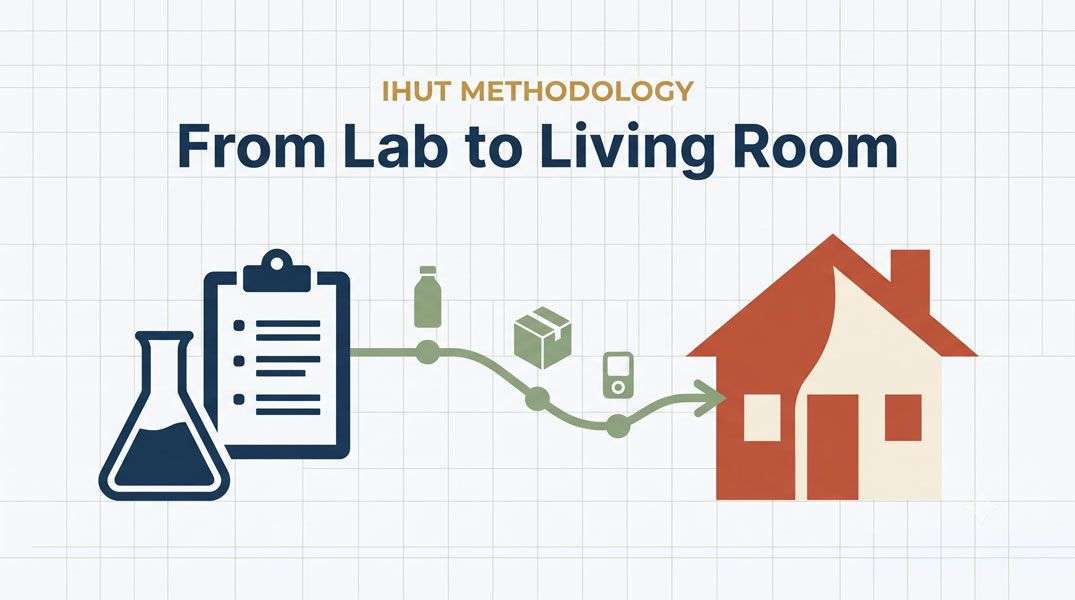
An In-Home Usage Test (IHUT) is a market research methodology where consumers receive products to use in their natural home environment over a defined period, typically one to four weeks. Participants document their experience through structured diaries, surveys, and follow-up interviews. As a result, researchers gain authentic behavioural data that controlled lab tests cannot capture.
The global product testing market has expanded sharply over the past three years. CPG, healthcare, and household appliance brands increasingly demand real-world validation before launch. According to Deloitte's consumer products outlook, brands that validate concepts through in-home testing reduce launch failure rates by up to 30 percent. This compares with brands that rely solely on lab-based methods.
In this guide, you'll learn the operational mechanics of IHUTs, from recruitment and shipment logistics to compliance frameworks and insight quality controls. At Research and Metric, our product placement specialists run IHUTs worldwide. The patterns we see consistently separate insight-grade studies from logistical disasters.
What Are In-Home Usage Tests? Methodology and Use Cases
IHUTs sit at the intersection of quantitative rigour and qualitative depth. Unlike a Central Location Test (CLT), where participants evaluate a product in a controlled facility, an IHUT lets consumers integrate the product into their actual routines. As a result, surprising data emerges.
When IHUT Methodology Outperforms Other Approaches
IHUTs are particularly valuable for products whose performance depends on context. Examples include a fabric softener tested over multiple wash cycles, a sleep supplement evaluated across weeknight routines, a small appliance used during real meal preparation, and a personal-care product applied morning and evening for two weeks. ESOMAR's methodology guidance recognises IHUT as the gold standard for performance claim validation. This is because it captures longitudinal behaviour that CLTs and online surveys miss.
Categories where IHUTs deliver disproportionate value include CPG household products, food and beverage prototypes, personal-care formulations, and baby and pet products. Consumer electronics also benefit, because setup friction and daily-use patterns matter. The methodology also supports sensitive segments, such as diabetic glucose monitors, incontinence products, and mental-wellness apps. In these cases, a recruitment screener and ethical protocol carry as much weight as the test itself.
Key Takeaway: IHUTs excel when consumer behaviour unfolds over time and in context. These are exactly the dimensions a 60-minute facility test cannot reveal.
IHUT Logistics: The Operational Backbone of Product Placement Studies
The single biggest predictor of an IHUT's success is logistics, and it's also where most studies quietly bleed quality. Product placement studies involve coordinating physical shipments, returns, hazardous materials handling, customs declarations, and participant compliance. At the same time, teams must protect confidential prototypes from leaking into the public.
Shipment, Tracking, and Chain-of-Custody
Every product going into a participant's home needs a chain-of-custody trail: who packed it, when it shipped, when it arrived, and whether tampering was detected. Sample shipment logistics for cross-border CPG IHUTs become especially complex. For example, a household cleaner shipped from a US manufacturer to participants in Singapore or the EU may require MSDS documentation, GST/VAT handling, and local customs codes. As a result, field teams without import-export experience often add weeks to study timelines.
Returns logistics matter equally. Many product placement studies require post-test product return for residual analysis, breakage assessment, or simply to prevent prototype leakage. Building return-shipping into the participant journey separates professional fieldwork from amateur execution. In practice, this means pre-paid labels, scheduled pickups, and clear packaging instructions.
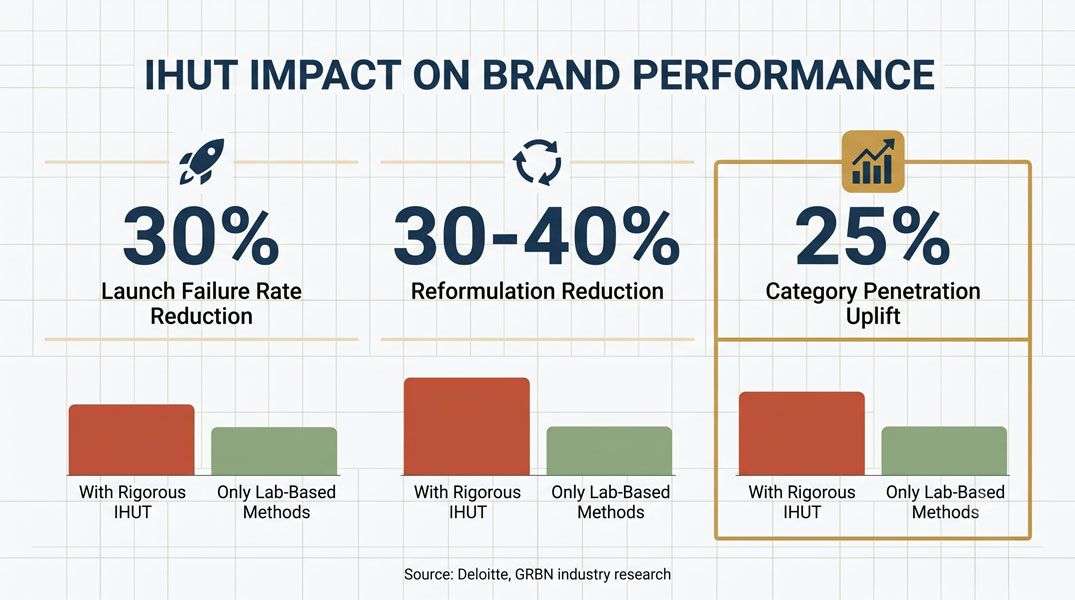
Key Takeaway: Logistics is not a "support function" in IHUT delivery. It is the methodology. As a result, poor shipment control corrupts data before a single response is collected.
Compliance, Ethics, and Regulatory Considerations in IHUTs
IHUTs now operate inside an increasingly complex compliance landscape. GDPR in the EU, India's DPDP Act, CCPA in California, and ESOMAR's ICC/ESOMAR Code shape how participant data is collected, stored, and processed. Product placement studies in regulated categories also trigger sector-specific rules. Examples include pharmaceuticals, medical devices, cosmetics with active ingredients, and infant nutrition.
Informed Consent, Data Privacy, and Special Audiences
Informed consent for IHUTs is not a checkbox. It's a layered document that must disclose product nature, potential risks, data usage, retention periods, and withdrawal rights. For sensitive product categories like medical devices or allergen-containing food prototypes, the consent process often involves a physician sign-off or screening protocol. This protocol is separate from the recruitment screener itself.
In multi-market studies, compliance requirements multiply. For example, a study running simultaneously in Germany, India, the UK, and the United States needs four parallel consent frameworks, four data-residency strategies, and four sets of incentive disclosure rules. Research and Metric's global fieldwork operations handle these regulatory matrices as standard practice. However, for brands new to international IHUTs, this is where studies most often stall or generate legal exposure.
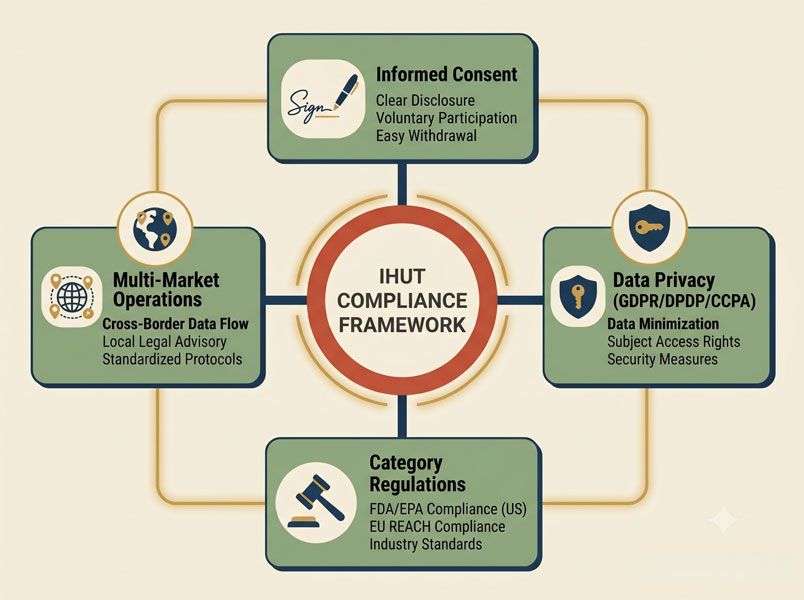
Key Takeaway: Compliance in IHUTs is jurisdiction-specific and category-specific. Generic protocols don't survive contact with regulators or ethics committees.
IHUT Recruitment: Sourcing the Right Participants for Quality Insight
The participants you recruit are the study. A flawlessly executed IHUT with the wrong sample produces confidently wrong conclusions, which is far more dangerous than no data at all. IHUT recruitment is fundamentally different from general survey recruitment. This is because participants must commit to multi-week engagement, follow detailed protocols, and demonstrate honesty under minimal supervision.
Screening Specialty Audiences and Preventing Professional Respondents
A recruitment screener for an IHUT typically runs longer than a survey screener. For example, it often has 15 to 25 questions covering category usage, brand affinity, household composition, allergy histories, and behavioural consistency checks. Specialty audiences include diabetics, parents of infants under 12 months, professional chefs, and allergy sufferers. For these groups, screeners must also validate condition or status without leading the respondent.
Professional respondent fraud is a growing threat to IHUT quality. Sophisticated panel hygiene combines digital fingerprinting, behavioural pattern analysis, response-time monitoring, and red-flag triggers across the participant journey. According to research from the GRBN (Global Research Business Network), studies without rigorous fraud screening can contain up to 20 percent compromised respondents. As a result, this contamination level distorts any insight derived from the data. Research and Metric's specialty audience panels layer biometric verification, multi-stage attention checks, and historical participation gates. Consequently, this protects IHUT integrity.
Key Takeaway: IHUT recruitment quality is the leading indicator of insight quality. Short-cuts at this stage cascade through every downstream finding.
Best Practices for Designing High-Quality In-Home Usage Tests
Strong IHUTs are designed for fidelity from day one, not patched together as logistical problems emerge. The brands extracting the most value from IHUTs treat them as engineered research instruments with multiple quality checkpoints.
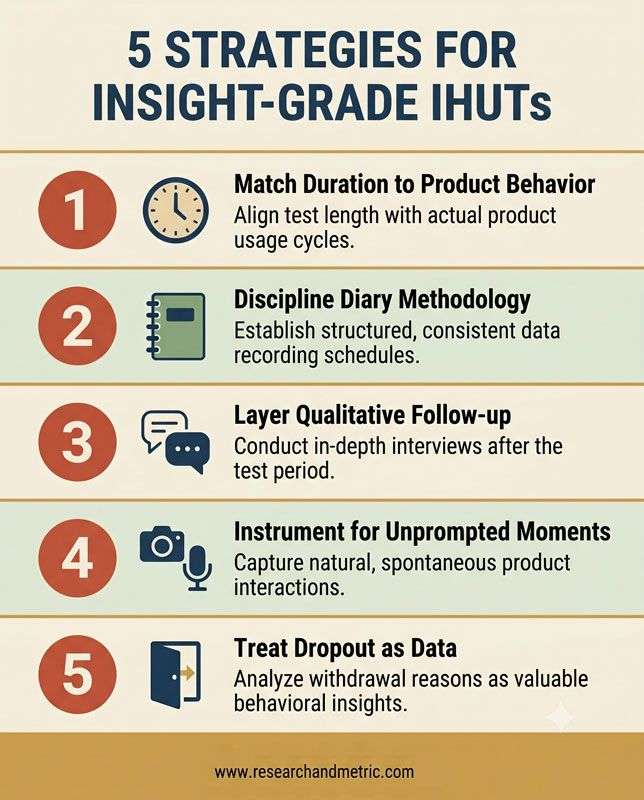
Five Strategies for Insight-Grade IHUT Execution
First, match study duration to product behaviour. A toothpaste claim around long-term whitening needs four weeks minimum. However, a single-use razor concept may need only seven days. Forcing every IHUT into a standard two-week template wastes budget on short-cycle products. It also corrupts findings on long-cycle ones.
Second, build diary methodology with discipline. Daily diaries capture sentiment drift and habit formation, but participants fatigue. The best IHUT designs use a mix of brief daily check-ins (under three minutes) and longer mid-study and end-study assessments (10 to 15 minutes). In addition, reminder cadences should be calibrated to category context.
Third, layer in qualitative follow-up. Quantitative IHUT data tells you what happened, while depth interviews or video diaries tell you why. Even a sub-sample of qualitative follow-ups (15 to 20 percent of the IHUT panel) materially enriches the insight output. It also often surfaces unanticipated use cases.
Fourth, instrument for unprompted moments. Open-ended diary fields, photo uploads, and voice-note prompts capture spontaneous reactions that structured rating scales miss. As a result, some of the most commercially valuable IHUT findings emerge from participants describing a product moment in their own unscripted words.
Fifth, treat dropout and non-compliance as data. Participants who quit a four-week IHUT in week one are telling you something. Designing exit interviews for dropouts, even brief ones, extracts insight that brands typically throw away. Research and Metric's end-to-end fieldwork management treats every participant touchpoint as a data point.
The Future of In-Home Usage Tests: Trends Reshaping Product Placement Research
IHUTs are evolving rapidly under pressure from three forces: AI-driven analysis, IoT-enabled product telemetry, and rising consumer expectations around participation experience.
Emerging Trends in IHUT Methodology
AI-powered diary coding is reducing IHUT analysis timelines from weeks to days. Mobile-first participant journeys with in-app photo, video, and voice capture are replacing paper diaries entirely. Connected products, such as smart toothbrushes, IoT kitchen appliances, and wearable health devices, increasingly transmit usage data directly to researchers. Therefore, this removes self-report bias. Sustainability claim validation is a fast-growing IHUT use case, as regulators in the EU, UK, and APAC tighten green-marketing rules. Cross-market parallel studies are also emerging as the new standard for global launches. In these, the same IHUT runs simultaneously across five to fifteen markets.
Brands that fold these capabilities into their research stack capture insights faster, cheaper, and more reliably. However, competitors still running paper-and-mail IHUTs fall behind. To explore how AI and connected methodology integrate with fieldwork operations, visit our insights and analysis blog.
Key Takeaway: The next generation of IHUTs will combine human authenticity with machine-grade data capture. The brands investing now will lead their categories.
Conclusion: Why In-Home Usage Tests Are Indispensable for Modern Product Strategy
In-Home Usage Tests are no longer optional infrastructure for any brand serious about product-market fit. The brands launching successfully in 2026 are the ones treating IHUT logistics, compliance, and recruitment as seriously as the product formulation itself.
The pattern we see across CPG, healthcare, and household categories is consistent. Studies that invest in rigorous IHUT methodology surface issues months before launch. As a result, brands avoid costly recalls, repositioning, and reformulations. At Research and Metric, our teams worldwide handle IHUT operations end-to-end. Recruitment, shipment, compliance, diary capture, and depth interviews all sit under one accountable workflow.
Ready to design an In-Home Usage Test that delivers genuine consumer insight? Contact Research and Metric today to discover how our AI-powered fieldwork solutions transform product placement studies into actionable launch intelligence.
Get new articles by email
Useful tips on surveys and research. One email when we post something new. Unsubscribe anytime.