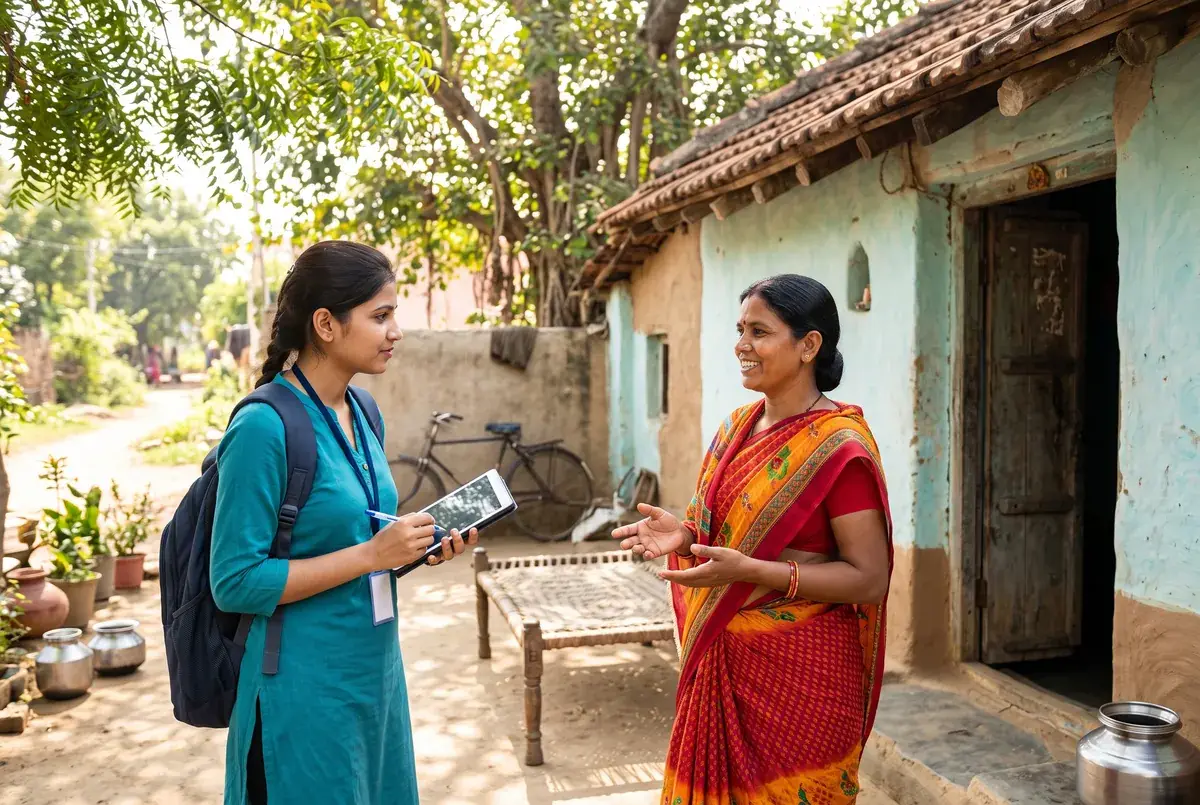
The challenge
A research institute needed reliable data for a rural household survey on how households cook and which fuels they use. Phone or online contact could not reach many of these households, and the interviews had to take place in local languages. As a result, the study called for face-to-face CAPI interviews in people's homes.
Why a rural household survey needs face-to-face fieldwork
In a rural household survey, sampling lists are often incomplete and phone coverage is uneven. Online surveys also leave out people who have no connection or who are less comfortable with devices. Face-to-face survey fieldwork solves this problem. An interviewer visits the home, explains each question and records the answer in the respondent's own language.
For this reason, research teams widely use computer-assisted personal interviewing for household survey data collection. The interviewer reads the questions from a tablet, the software controls the routing, and the tablet stores the answers digitally instead of staff keying them in later.
Our approach to CAPI interviews
We deployed local interviewers with tablets, GPS-stamped every interview and checked quality daily. The ICC/ESOMAR International Code sets out the standards that guide fieldwork of this kind.
- Translated and tested the questionnaire in local languages
- Trained interviewers in each district before field start
- GPS-stamped and timed every interview for quality checks
- Back-checked a share of interviews by revisit or phone
How a CAPI survey supports data quality
A well-configured CAPI survey builds quality control into the interview itself. For example, the tablet can do the following:
- Apply routing rules, so that interviewers cannot skip questions by mistake
- Flag answers that are impossible or inconsistent while the interviewer is still with the household
- Record the time and location of each interview
- Store answers offline and upload them when a connection is available
As a result, the team catches errors early and can review data while fieldwork is still running.
Designing a cooking fuel survey
A cooking fuel survey must be clear about what it measures. Households often use more than one fuel, so the questions should separate the main fuel from the secondary fuels. It also helps to ask separately about different uses, such as cooking meals and heating water.
Plain wording matters just as much. Testing each question in every language before field start reduces the risk that respondents understand it differently from one district to the next. Interviewers should also read questions exactly as written, so that teams can compare answers across communities.
Sampling and household selection
Good sampling matters as much as good questions. Rural areas rarely have complete address lists, so the team needs a clear rule for choosing which homes to visit. Without one, interviewers may drift towards the easiest households to reach, and the results then lean towards those homes.
The following steps help to keep selection fair:
- Define the area and the type of household that qualifies before fieldwork starts
- Give interviewers a written rule for choosing the starting point and the route
- Decide in advance who in the household answers, for example the person who usually cooks
- Set a fixed number of return visits before replacing a household
In addition, supervisors should check the route and selection of each interviewer against the plan. This keeps the sample consistent and makes the final data easier to defend.
Good practice for rural fieldwork
Rural fieldwork depends on people as much as on technology. The following points apply to most projects of this kind:
- Use interviewers who speak the local language and whom the community accepts
- Explain the purpose of the study and obtain consent before each interview
- Plan visits around the working day of the household, and return when the right person is unavailable
- Review data every day, so that the team corrects problems while it is still in the area
Together, these steps help a rural household survey deliver data that clients can trust and use.
The results
- 1,200 household interviews completed
- Quality checks on every interview before data delivery
- Data delivered in the client's format at field close
Illustrative scenario based on typical engagements. Client details are anonymised.